

Vote count underway after polling ends for NA-148 by-election in Pakistan’s Multan

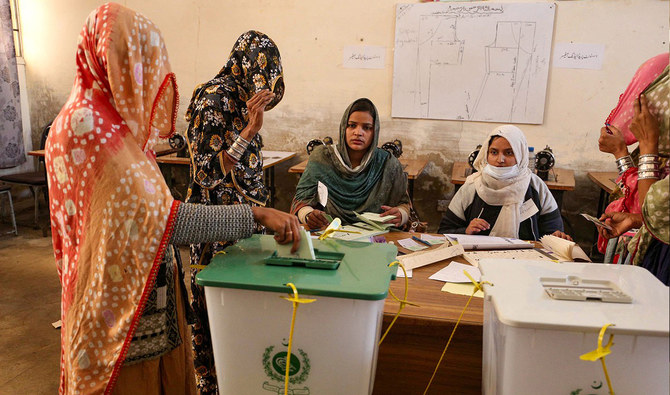
Pakistan’s women cast their ballots to vote during national elections, at a polling station in Multan on February 8, 2024. (AFP/File)
Short Url
Updated 19 May 2024
Follow

Vote count underway after polling ends for NA-148 by-election in Pakistan’s Multan

  • Yousaf Raza Gillani vacated the NA-148 seat after getting elected Senate chairman
  • Tough competition expected between SIC’s Taimur Malik and PPP’s Ali Musa Gillani

ISLAMABAD: The counting of votes was underway after polling ended for a by-election in National Assembly constituency, NA-148, in Pakistan’s Multan on Sunday, state-run media reported.

Former prime minister Yousaf Raza Gillani won the NA-148 seat in Multan in the contentious Feb. 8 national election. However, Gillani vacated the seat after he was elected to the post of Senate chairman in April.

Polling for Sunday’s by-election began at 8am and continued uninterrupted till 5pm. The constituency has a total of 444,231 registered voters, and 275 polling stations and 933 polling booths were set up for the exercise.

“Counting of votes is underway after polling for bye-election in NA-148 Multan-1 concluded at 5:00 pm,” the state-run Radio Pakistan broadcaster reported.

Eight candidates including the ex-PM Imran Khan-backed Sunni Ittehad Council (SIC) leader Taimur Malik and Pakistan Peoples Party’s (PPP) Ali Qasim Gillani, were vying for the seat.

Authorities made comprehensive security arrangements free, fair and transparent conduct of polls in the constituency.

Pakistan’s national election on Feb. 8 was marred by a countrywide shutdown of mobile phone services. The results of the polls, which were declared unfair by Khan and his party, threw up a hung parliament in which no political party emerged with the majority to form its government.

Khan’s Pakistan Tehreek-e-Insaf (PTI) party, which formed the largest bloc in the National Assembly after winning over 90 seats, said it won a two-thirds majority but was denied victory by Pakistan’s election regulator, accusing it of manipulating votes.

The Election Commission of Pakistan (ECP) denied the allegations and so did the caretaker government.


Pakistan lets oil companies regulate supply to curb hoarding amid Gulf tensions

Updated 04 March 2026
Follow

Pakistan lets oil companies regulate supply to curb hoarding amid Gulf tensions

  • Oil marketing companies to regulate supplies to retail outlets based on historical sales patterns, says regulator
  • Pakistan holds “adequate stocks of petrol and diesel,” assures regulator amid ongoing Middle East conflict

KARACHI: Pakistan’s Oil and Gas Regulatory Authority (OGRA) announced on Wednesday it was allowing oil marketing companies to regulate supply to retail outlets as a temporary move to prevent hoarding, as tensions in the Middle East surge following the ongoing military conflict involving Iran. 

The decision follows fears of fuel shortage in Pakistan after the Strait of Hormuz, a strategic waterway between Iran and Oman, was shut after escalating hostilities between Tehran and the US and Israel in the Gulf. The conflict has disrupted tanker traffic through one of the world’s most important oil chokepoints.

Pakistan relies heavily on Middle Eastern crude oil, with the majority of its energy imports typically transiting the strait, making any disruption a major risk to domestic fuel supplies.

“To ensure the uninterrupted availability of petroleum products and to discourage hoarding during periods of extreme price volatility, Oil Marketing Companies (OMCs) may temporarily regulate supplies to retail outlets based on their historical sales patterns,” OGRA spokesperson Imran Ghaznavi said in a press release.

“This measure is a standard supply management practice aimed at maintaining stability in the distribution system.”

The OGRA spokesperson clarified that Pakistan currently holds “adequate stocks of petrol and diesel, well within the required limits.”

He stressed that there is no shortage of petroleum products in the country.

“Citizens are advised not to pay attention to rumors and to rely only on information issued through official channels,” Ghaznavi said. 

Pakistan has moved quickly to ensure its stock of petroleum products does not take a massive hit. Pakistan’s Petroleum Minister Ali Pervaiz Malik met Saudi Ambassador Nawaf bin Said Al-Malki on Wednesday. 

Pakistan asked Saudi Arabia for help in securing crude oil supplies through the Red Sea port of Yanbu, the petroleum ministry said.

The Saudi ambassador reaffirmed Riyadh’s support, saying the Kingdom was aware of the evolving situation and would stand with Pakistan to meet any emergency requirements, the statement added.