NICOSIA, Cyprus: The governments of eight European Union member states said Friday the situation in Syria should be re-evaluated to allow for the voluntary return of Syrian refugees back to their homeland.
In a joint declaration, officials from Austria, the Czech Republic, Cyprus, Denmark, Greece, Italy, Malta and Poland said they agree on a re-assessment that would lead to “more effective ways of handling” Syrian refugees trying to reach European Union countries.
The eight countries, which held talks during a summit meeting in the Cypriot capital, said the situation in Syria has “considerably evolved,” even though complete political stability hasn’t been achieved.
Cyprus has in recent months seen an upsurge of Syrian refugees reaching the island nation primarily from Lebanon aboard rickety boats.
Earlier this month, the EU announced a 1 billion euro ($1.06 billion) aid package for Lebanon aimed at boosting border controls to halt the flow of asylum seekers and migrants to Cyprus and Italy.
The eight countries said the EU should further boost support for Lebanon to “mitigate the risk of even greater flows from Lebanon to the EU.”
“Decisions as to who has the right to cross a member state’s borders, should be taken by the government of the relevant member state and not by criminal networks engaged in migrant smuggling and trafficking in human beings,” the joint declaration said.
A Cypriot official said that any re-evaluation of conditions within Syria would not necessarily mean that Syrian refugees would be deported back to their country. Instead, Syrian refugees hailing from areas re-designated as safe would lose any allowances, benefits and the right to work, creating a disincentive to others to come to Cyprus.
The official was speaking on condition of anonymity because he wasn’t allowed to speak publicly about details of the proposal.
The countries said that while they “fully embrace” the need to support Syrian refugees in line with international law, they hoped their talks could open a wider debate within the 27-member bloc on the process of granting the migrants international protection.
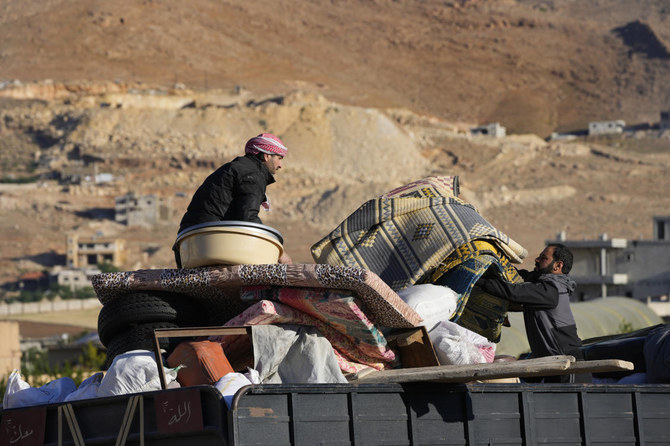
In Lebanon, where anti-refugee sentiment has been surging recently, more than 300 Syrian refugees returned to Syria in a convoy earlier this week.
Lebanese officials have long urged the international community to either resettle the refugees in other countries or help them return to Syria.


![]()

8 EU members say conditions in Syria should be reassessed to allow voluntary refugee returns
Short Url
https://arab.news/vcdkh
8 EU members say conditions in Syria should be reassessed to allow voluntary refugee returns
- Officials from Austria, the Czech Republic, Cyprus, Denmark, Greece, Italy, Malta and Poland said they agree on a re-assessment that would lead to “more effective ways of handling” Syrian refugees
- The eight countries said the EU should further boost support for Lebanon


Latest updates


© 2026 SAUDI RESEARCH & PUBLISHING COMPANY, All Rights Reserved And subject to Terms of Use Agreement.