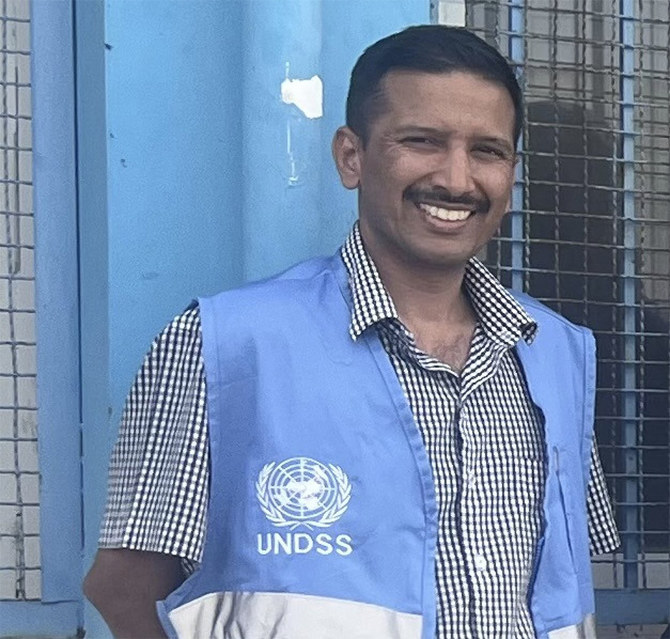

NEW DELHI: The killing of an Indian army veteran serving as a UN staffer in Gaza has stirred outrage in India and calls for the government to hold Israel accountable, with activists calling New Delhi’s reaction ‘inadequate.’
Col. Waibhav Anil Kale, a former peacekeeper, was on duty with the UN Department of Safety and Security when his UN-marked vehicle was hit on Monday en route to the European Hospital in Rafah by what the international organization said was Israeli tank fire.
The Indian government’s response was a condolence statement issued on Wednesday by the Ministry of External Affairs, saying it was “deeply saddened by the death” and “in touch with relevant authorities” regarding an investigation.
The statement did not issue a condemnation, unlike in July 2022, when two Indian peacekeepers were killed in an attack on a UN Organization Stabilization Mission base in the Democratic Republic of the Congo. At that time, India’s foreign minister said the perpetrators “must be held accountable and brought to justice” and convened a special meeting of the UN Security Council to discuss the attack.
Talmiz Ahmad, former Indian ambassador to Saudi Arabia, said the government’s response was “grossly inadequate” given what he called the “calculated killing” of an Indian army officer and UN staffer.
“The Indian government can hold Israel accountable. India is a sponsor of a resolution related to the protection of the UN personnel,” he told Arab News.
“This particular killing of a UN officer is a targeted killing because it was very obvious to Israelis that this was a UN vehicle, and it was on an official UN mission. A tank deliberately targeted this vehicle.”
New Delhi had always been sensitive to assaults on UN personnel given that it is one of the largest contributors to the organization’s peacekeepers.
The reaction to Kale’s killing was insufficient, according to Kavita Krishnan, a women’s rights activist.
“If a person is a UN employee, he is entitled to protection,” she said. “The Indian government should specifically hold Israel accountable for this killing. They cannot treat it just as a casualty of war or a collateral damage.”
“IT’S NOT A DEATH”
Since October last year, Israel’s deadly siege and bombardment of Gaza has killed more than 35,000 people, wounded 70,000, and left most of the enclave’s population starving and with no access to medical, food and water supplies.
The UN estimates that more than 190 of its staff members have also been killed in the ongoing onslaught. Kale was the first international UN employee to be killed.
“It’s condemnable that India does not name the fact of assassination. It’s not death. He did not die of illness. He was killed by Israel,” said Apoorvanand Jha, a public intellectual and professor at the University of Delhi.
“Israel kills people who are involved in the health services ... kills journalists, aid workers and kills workers involved in the peacekeeping forces. So, it does it knowingly. It is not a collateral damage. Israel does it knowingly — this is what has been recorded many times. Israel needs to be held accountable for all the individual crimes of assassinations and the collective crimes, mass deaths.”
From a legal point of view, the killing of UN personnel is against norms and customs of international law and international humanitarian law.
“New Delhi should tell Tel Aviv that it should respect international law,” said Anwar Sadat, a senior assistant professor at the Indian Society of International Law.
“The Indian government should issue a diplomatic demarche to the Israeli government.”
Since the beginning of its invasion of Gaza, Israel has revoked work permits for tens of thousands of Palestinian laborers and sought to facilitate their replacement with manpower from South Asia.
In November, the Indian government signed a three-year agreement with Tel Aviv on the “temporary employment” of workers in the construction and caregiving sector.
“If this is the statement that the Indian government can bring for an official who works with the UN, imagine what if it happens with any of the workers. No one is going to speak,” said N. Sai Balaji, assistant professor at Jawaharlal Nehru University.
“This seriously compromises India’s super-power ambitions, it seriously compromises India’s own foreign policy.”