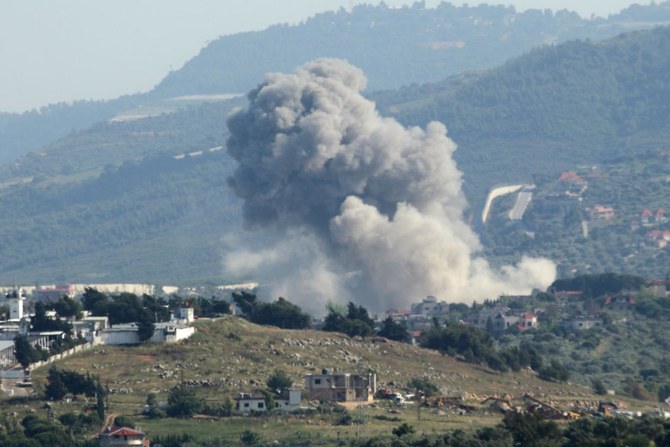
BEIRUT: Lebanon’s Iran-backed Hezbollah group said it launched dozens of rockets at military positions in northern Israel on Wednesday in response to the assassination of its senior field commander, Hussein Ibrahim Makki.
Israel and Hamas ally Hezbollah have exchanged near-daily fire since the Palestinian group’s Oct. 7 attack on southern Israel.
Israel claimed Makki was considered close to Mohammad Reza Zahedi, a senior figure in Iran’s Islamic Revolutionary Guard who was assassinated by Israel in Damascus last April.
Hezbollah said it attacked “the headquarters of the 91st Division in the Biranit Barracks with heavy Burkan missiles, achieving a direct hit and destroying part of it, and the headquarters of the Air Surveillance Unit at Meron Base with tens of Katyusha rockets, heavy missiles, and artillery shells, hitting its previous and newly acquired equipment, and disabling part of it completely.”
The party added it had targeted “the newly established technical systems and espionage equipment at Al-Radar site in the occupied Lebanese Shebaa Farms with appropriate weapons, causing direct hits and their destruction.”
On Tuesday night, Israeli warplanes targeted a car in the city of Tyre with two missiles, leading to the deaths of Makki and two of his companions.
Makki was described as a “massive databank” and a “strong arm” of Hezbollah chief Hassan Nasrallah in Syria. He was from the town of Beit Yahoun in southern Lebanon.
Israeli radio spoke of a “large-scale attack from Lebanese territory” and that “the rocket fire on the Meron Base does not stop.”
Other Israeli media outlets said the volley of 50 rockets was the most intense attack since the beginning of the war with Lebanon.
Meanwhile, Israeli artillery shelled Jabal Balat and Israeli warplanes shelled an unoccupied house on the outskirts of Aitarun.
On Tuesday, Hezbollah shot down an Israeli espionage balloon over the border town of Rmeish.
Israel has stepped up its targeting of Hezbollah field commanders over the past two weeks, particularly focusing on leaders within the party’s elite Radwan Brigade.
These targeted assassinations coincide with Israel’s heightened policy of the systematic destruction of border and front-line villages, part of a strategy framed as “displacing the population of the south in exchange for displacing the population of the north.”
Israeli media outlets reported that the north was experiencing significant losses and damage. More than 140 houses were destroyed in the settlement of Metula, with most of the damage caused by Hezbollah anti-tank missiles. Similar destruction had been witnessed in other settlements along the Lebanese border, said media reports, and five soldiers were injured in Adamit on Tuesday.
Lebanon is deeply concerned about the potential expansion of conflict in south, especially as diplomatic efforts to separate the southern front from the Gaza Strip have failed.
Additionally, there is Lebanese apprehension about the ongoing presence of 2.1 million Syrian refugees on its territory.
The Lebanese parliament has discussed the refugee issue and the potential acceptance of a €1 billion grant from the EU to host refugees.
It unanimously approved a recommendation to form a ministerial committee that would engage with international and regional parties to develop a comprehensive plan and timed program for refugees’ return, excluding cases protected by Lebanese law, as determined by the committee.
The MPs said that the issue had “become increasingly complex and dangerous, impacting Lebanon economically, financially, socially and environmentally, with growing concerns among the Lebanese people about demographic and societal changes.”
They stressed Lebanon was “ill-prepared constitutionally, legally or realistically to be a country of asylum.”
The MPs also mandated the Lebanese authorities to take necessary legal measures to hand over prisoners among the refugees to the Syrian authorities, under applicable laws and principles.


![]()

Hezbollah strikes Israel after death of senior field commander
Short Url
https://arab.news/9h2pk
Hezbollah strikes Israel after death of senior field commander
- Hezbollah said it attacked “the headquarters of the 91st Division in the Biranit Barracks with heavy Burkan missiles, achieving a direct hit and destroying part of it”
- Israeli radio spoke of a “large-scale attack from Lebanese territory” and that “the rocket fire on the Meron Base does not stop”


Latest updates


© 2026 SAUDI RESEARCH & PUBLISHING COMPANY, All Rights Reserved And subject to Terms of Use Agreement.