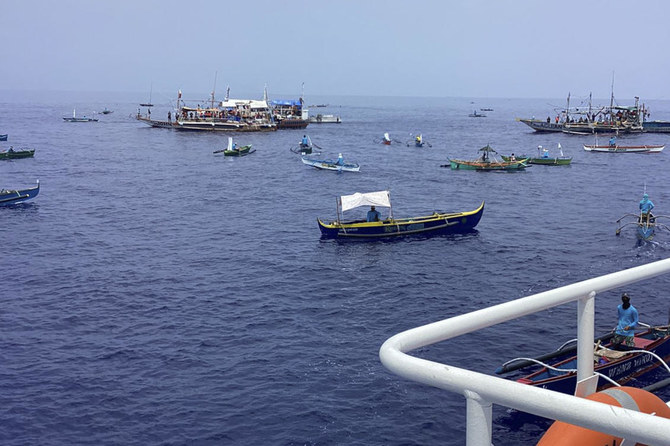
MANILA: A flotilla of about 100 mostly small fishing boats led by Filipino activists sailed Wednesday to a disputed shoal in the South China Sea, where Beijing’s coast guard and suspected militia ships have used powerful water cannons to ward off what they regard as intruders.
The Philippine coast guard and navy deployed one patrol ship each to keep watch from a distance on the activists and fishermen, who set off on wooden boats with bamboo outriggers to assert Manila’s sovereignty over the Scarborough Shoal. Dozens of journalists joined the three-day voyage.
Activists and volunteers, including a Roman Catholic priest, belonging to a nongovernment coalition called Atin Ito — Tagalog for This is Ours — planned to float small territorial buoys and distribute food packs and fuel to Filipino fishermen near the shoal, organizers said, adding they were prepared for contingencies.
“Our mission is peaceful based on international law and aimed at asserting our sovereign rights,” said Rafaela David, a lead organizer. “We will sail with determination, not provocation, to civilianize the region and safeguard our territorial integrity.”
In December, David’s group with boatloads of fishermen also tried to sail to another disputed shoal but cut short the trip after being tailed by a Chinese ship.
China effectively seized the Scarborough Shoal, a triangle-shaped atoll with a vast fishing lagoon ringed by mostly submerged coral outcrops, by surrounding it with its coast guard ships after a tense 2012 standoff with Philippine government ships.
Angered by China’s action, the Philippine government brought the disputes to international arbitration in 2013 and largely won with a tribunal in The Hague ruling three years later that China’s expansive claims based on historical grounds in the busy seaway were invalid under the 1982 UN Convention on the Law of the Sea.
The ruling declared the Scarborough Shoal a traditional fishing area for Chinese, Filipino and Vietnamese fishermen. In the past, fishermen have anchored in the shoal to avoid huge waves in the high seas in stormy weather.
China refused to participate in the arbitration, rejected the outcome and continues to defy it.
Two weeks ago, Chinese coast guard and suspected militia ships used water cannons on Philippine coast guard and fisheries boats patrolling the Scarborough Shoal, damaging both craft.
The Philippines condemned the Chinese coast guard’s action on the shoal, which lies in the Southeast Asian nation’s internationally recognized exclusive economic zone. The Chinese coast guard said it took a “necessary measure” after the Philippine ships “violated China’s sovereignty.”
The Chinese coast guard has also reinstalled a floating barrier across the entrance to the shoal’s vast fishing lagoon, the Philippine coast guard said. The Philippine coast guard removed a similar barrier in the past to allow Filipinos to fish there.
In addition to the Philippines and China, Vietnam, Malaysia, Brunei and Taiwan have also been involved in the territorial disputes.
Chinese coast guard ships had also ventured into waters close to Vietnam, Malaysia and Indonesia in the past, sparking tensions and protests, but the Southeast Asian nations with considerable economic ties with China have not been as aggressively critical against Beijing’s increasingly assertive actions.
The Philippines has released videos of its territorial faceoffs with China and invited journalists to witness the hostilities in the high seas in a strategy to gain international support, sparking a word war with Beijing.
The increasing frequency of the skirmishes between the Philippines and China has led to minor collisions, injured Filipino navy personnel and damaged supply boats in recent months. It has sparked fears the territorial disputes could degenerate into an armed conflict between China and the United States, a longtime treaty ally of the Philippines.


![]()

Filipino activists and fishermen sail in 100-boat flotilla to disputed shoal guarded by China
Short Url
https://arab.news/2ferx
Filipino activists and fishermen sail in 100-boat flotilla to disputed shoal guarded by China
- Philippine coast guard and navy deploy one patrol ship each to keep watch from a distance on the activists and fishermen
- China effectively seized the Scarborough Shoal, a triangle-shaped atoll with a vast fishing lagoon, in 2012


Latest updates


© 2026 SAUDI RESEARCH & PUBLISHING COMPANY, All Rights Reserved And subject to Terms of Use Agreement.