

Libya war crimes probe to advance next year: ICC prosecutor

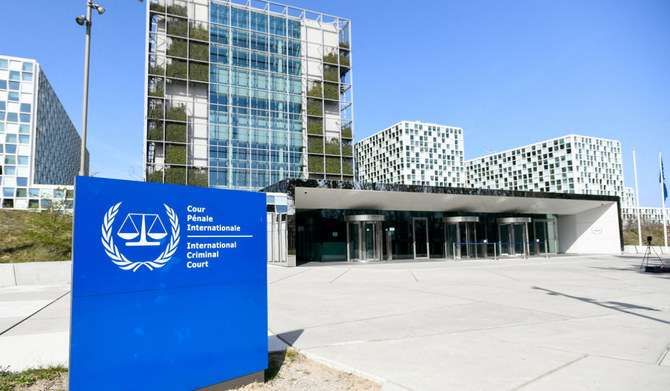
An exterior view of the International Criminal Court in The Hague, Netherlands, March 31, 2021. (REUTERS)
Short Url
Updated 15 May 2024
Follow

Libya war crimes probe to advance next year: ICC prosecutor

  • The Security Council referred the situation in Libya to the ICC in February 2011 following a violent crackdown on unprecedented protests against the regime of Muammar Qaddafi

UNITED NATIONS, United States: The International Criminal Court prosecutor probing war crimes committed in Libya since 2011 announced Monday his plans to complete the investigation phase by the end of 2025.
Presenting his regular report before the United Nations Security Council, Karim Khan said that “strong progress” had been made in the last 18 months, thanks in particular to better cooperation from Libyan authorities.
“Our work is moving forward with increased speed and with a focus on trying to deliver on the legitimate expectations of the council and of the people of Libya,” Khan said.
He added that in the last six months, his team had completed 18 missions in three areas of Libya, collecting more than 800 pieces of evidence including video and audio material.
Khan said he saw announcing a timeline to complete the investigation phase as a “landmark moment” in the case.
“Of course, it’s not going to be easy. It’s going to require cooperation, candor, a ‘can do’ attitude from my office but also from the authorities in Libya,” he added.
“The aim would be to give effect to arrest warrants and to have initial proceedings start before the court in relation to at least one warrant by the end of next year,” Khan said.
The Security Council referred the situation in Libya to the ICC in February 2011 following a violent crackdown on unprecedented protests against the regime of Muammar Qaddafi.
So far, the investigation opened by the court in March 2011 has produced three cases related to crimes against humanity and war crimes, though some proceedings were abandoned after the death of suspects.
An arrest warrant remains in place for Seif Al-Islam Qaddafi, the son of the assassinated Libyan dictator who was killed by rebel forces in October 2011.
Libya has since been plagued by fighting, with power divided between a UN-recognized Tripoli government and a rival administration in the country’s east.


Syrian government and SDF agree to de-escalate after Aleppo violence

Updated 23 December 2025
Follow

Syrian government and SDF agree to de-escalate after Aleppo violence

  • Turkiye views the US-backed SDF, which controls swathes of northeastern Syria, as a ⁠terrorist organization and has warned of military action if the group does not honor the agreement

DAMASCUS: Syrian government forces and the Kurdish-led Syrian Democratic Forces agreed to de-escalate on Monday evening in the northern city of Aleppo, after a wave of attacks that both sides blamed on each other left at least two civilians dead and several wounded.
Syria’s state news agency SANA, citing the defense ministry, said the army’s general command issued an order to stop targeting the SDF’s fire sources. The SDF said in a statement later that it had issued instructions to stop responding ‌to attacks ‌by Syrian government forces following de-escalation contacts.

HIGHLIGHTS

• SDF and Syrian government forces blame each other for Aleppo violence

• Turkiye threatens military action if SDF fails integration deadline

• Aleppo schools and offices closed on Tuesday following the violence

The Syrian health ministry ‌said ⁠two ​people ‌were killed and several were wounded in shelling by the SDF on residential neighborhoods in the city. The injuries included two children and two civil defense workers. The violence erupted hours after Turkish Foreign Minister Hakan Fidan said during a visit to Damascus that the SDF appeared to have no intention of honoring a commitment to integrate into the state’s armed forces by an agreed year-end deadline.
Turkiye views the US-backed SDF, which controls swathes of northeastern Syria, as a ⁠terrorist organization and has warned of military action if the group does not honor the agreement.
Integrating the SDF would ‌mend Syria’s deepest remaining fracture, but failing to do ‍so risks an armed clash that ‍could derail the country’s emergence from 14 years of war and potentially draw in Turkiye, ‍which has threatened an incursion against Kurdish fighters it views as terrorists.
Both sides have accused the other of stalling and acting in bad faith. The SDF is reluctant to give up autonomy it won as the main US ally during the war, which left it with control of Daesh prisons and rich oil resources.
SANA, citing the defense ministry, reported earlier that the SDF had launched a sudden attack on security forces ⁠and the army in the Sheikh Maqsoud and Ashrafiyah neighborhoods of Aleppo, resulting in injuries.
The SDF denied this and said the attack was carried out by factions affiliated with the Syrian government. It said those factions were using tanks and artillery against residential neighborhoods in the city.
The defense ministry denied the SDF’s statements, saying the army was responding to sources of fire from Kurdish forces. “We’re hearing the sounds of artillery and mortar shells, and there is a heavy army presence in most areas of Aleppo,” an eyewitness in Aleppo told Reuters earlier on Monday. Another eyewitness said the sound of strikes had been very strong and described the situation as “terrifying.”
Aleppo’s governor announced a temporary suspension of attendance in all public and private schools ‌and universities on Tuesday, as well as government offices within the city center.