Libya war crimes probe to advance next year: ICC prosecutor

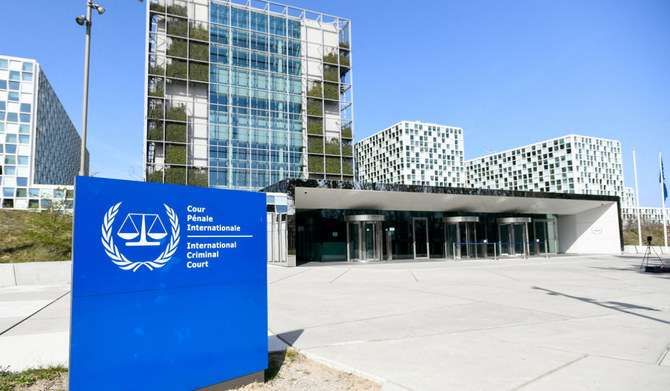
An exterior view of the International Criminal Court in The Hague, Netherlands, March 31, 2021. (REUTERS)
Short Url
Updated 15 May 2024
Follow

Libya war crimes probe to advance next year: ICC prosecutor

  • The Security Council referred the situation in Libya to the ICC in February 2011 following a violent crackdown on unprecedented protests against the regime of Muammar Qaddafi

UNITED NATIONS, United States: The International Criminal Court prosecutor probing war crimes committed in Libya since 2011 announced Monday his plans to complete the investigation phase by the end of 2025.
Presenting his regular report before the United Nations Security Council, Karim Khan said that “strong progress” had been made in the last 18 months, thanks in particular to better cooperation from Libyan authorities.
“Our work is moving forward with increased speed and with a focus on trying to deliver on the legitimate expectations of the council and of the people of Libya,” Khan said.
He added that in the last six months, his team had completed 18 missions in three areas of Libya, collecting more than 800 pieces of evidence including video and audio material.
Khan said he saw announcing a timeline to complete the investigation phase as a “landmark moment” in the case.
“Of course, it’s not going to be easy. It’s going to require cooperation, candor, a ‘can do’ attitude from my office but also from the authorities in Libya,” he added.
“The aim would be to give effect to arrest warrants and to have initial proceedings start before the court in relation to at least one warrant by the end of next year,” Khan said.
The Security Council referred the situation in Libya to the ICC in February 2011 following a violent crackdown on unprecedented protests against the regime of Muammar Qaddafi.
So far, the investigation opened by the court in March 2011 has produced three cases related to crimes against humanity and war crimes, though some proceedings were abandoned after the death of suspects.
An arrest warrant remains in place for Seif Al-Islam Qaddafi, the son of the assassinated Libyan dictator who was killed by rebel forces in October 2011.
Libya has since been plagued by fighting, with power divided between a UN-recognized Tripoli government and a rival administration in the country’s east.


UN votes to end mission in Yemeni city of Hodeida

Updated 28 January 2026
Follow

UN votes to end mission in Yemeni city of Hodeida

  • The resolution approved Tuesday, which was sponsored by Britain, stipulates that the UN mission in Hodeida — known as UNMHA — must close as of March 31

UNITED NATIONS, United States: The UN Security Council voted Tuesday to terminate a mission that tried to enforce a ceasefire in war-torn Yemen’s port city of Hodeida.
“Houthi obstructionism has left the mission without a purpose, and it has to close,” said Tammy Bruce of the US delegation, one of 13 on the 15 member council to support ending the mission’s mandate.
The UN mission is now scheduled to conclude in two months.
Yemen’s internationally recognized government is a patchwork of groups held together by their opposition to the Iran-backed Houthis, who ousted them from the capital Sanaa in 2014 and now rule much of the country’s north. They also hold Hodeida.
The Houthis have been at war with the government, backed by a Saudi-led coalition since 2015, in a conflict that has killed hundreds of thousands of Yemenis and triggered a major humanitarian crisis.
Since 2021 the Houthis have periodically detained UN staffers and still hold some of them.
The resolution approved Tuesday, which was sponsored by Britain, stipulates that the UN mission in Hodeida — known as UNMHA — must close as of March 31. It has been there since 2019.
Russia and China abstained from the vote.
“For six years, UNMHA has served as a critical stabilizing presence” in the region and “actively deterred and prevented a return to full scale conflict,” said Danish representative Christina Markus Lassen.
“The dynamics of the conflict have evolved, and the operating environment has significantly narrowed as UN personnel have become the target of the Houthis’ arbitrary detentions,” Lassen said.
The war in the poorest country in the Arabian peninsula has triggered the worst humanitarian crisis anywhere in the world, the United Nations says.
It expects things to get worse in 2026 as hungry Yemenis find it even harder to get food and international aid drops off.