

Israeli forces repeatedly target Gaza aid workers, says Human Rights Watch

1 / 6
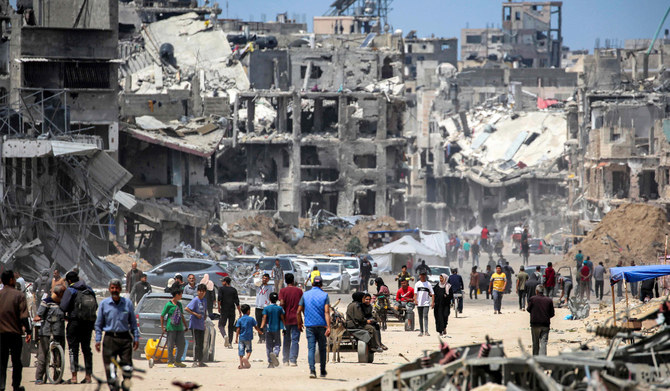
People move past destroyed buildings along a street in Khan Yunis in the southern Gaza Strip on May 14, 2024 amid the ongoing conflict in the Palestinian territory between Israel and Hamas. (AFP)
2 / 6
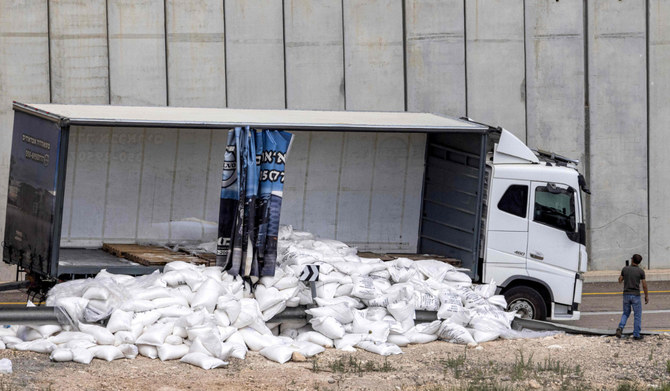
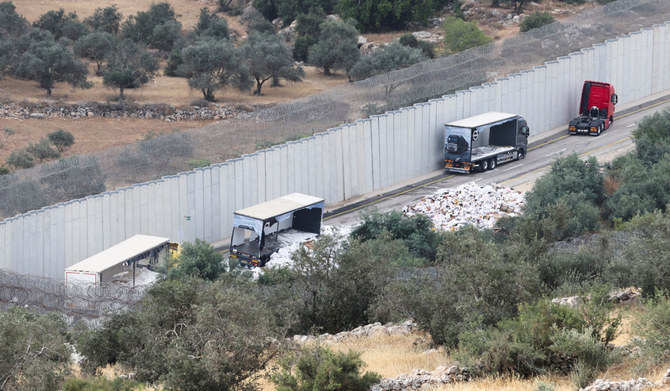
A man films with his phone a damaged trailer truck that was carrying humanitarian aid supplies parked along the Israeli side of Israel's controversial separation barrier with the West Bank near the village of Shekef on May 13, 2024, after it was vandalised by right-wing Israeli activists to protest against aid being sent to the Gaza Strip. (AFP)
3 / 6
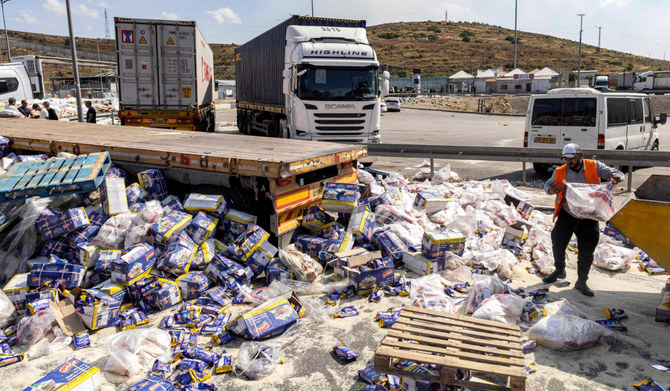
A worker clears spilled goods away from damaged trailer trucks that were carrying humanitarian aid supplies on the Israeli side of the Tarqumiyah crossing with the occupied West Bank on May 13, 2024, after they were vandalised by other activists to protest against aid being sent to the Gaza Strip. (AFP)
4 / 6
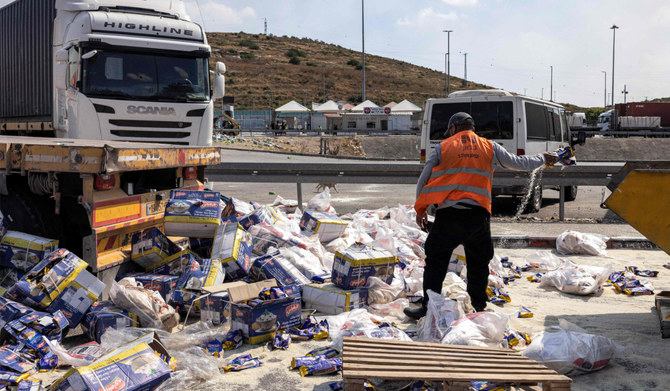
A worker clears spilled goods away from damaged trailer trucks that were carrying humanitarian aid supplies on the Israeli side of the Tarqumiyah crossing with the occupied West Bank on May 13, 2024, after they were vandalised by other activists to protest against aid being sent to the Gaza Strip. (AFP)
5 / 6
A youth walks near the damaged trailer trucks that were carrying humanitarian aid supplies on the Israeli side of the Tarqumiyah crossing with the occupied West Bank on May 13, 2024, after they were vandalised by right-wing Israeli activists to protest against aid being sent to the Gaza Strip. (AFP)
6 / 6
A view of trucks carrying aid to Gaza that were stopped after they were damaged by Israeli settlers near a checkpoint near Hebron in the Israeli-occupied West Bank May 14,2024. (REUTERS)
Short Url
Updated 14 May 2024
Follow

Israeli forces repeatedly target Gaza aid workers, says Human Rights Watch

  • They are among more than 250 aid workers who have been killed in Gaza since the war erupted more than seven months ago, according to UN figures
  • Israel has killed more than 35,000 Palestinians in Gaza, mostly women and children, according to the health ministry in the Hamas-run territory

JERUSALEM: Human Rights Watch said on Tuesday that Israel had repeatedly targeted known aid worker locations in Gaza, even after their coordinates were provided to Israeli authorities to ensure their protection.
The rights watchdog said that it had identified eight cases where aid convoys and premises were targeted, killing at least 15 people, including two children.
They are among more than 250 aid workers who have been killed in Gaza since the war erupted more than seven months ago, according to UN figures.
In all eight cases, the organizations had provided the coordinates to Israeli authorities, HRW said.
This reveals “fundamental flaws with the so-called deconfliction system, meant to protect aid workers and allow them to safely deliver life-saving humanitarian assistance in Gaza,” it said.
“On one hand, Israel is blocking access to critical lifesaving humanitarian provisions and on the other, attacking convoys that are delivering some of the small amount that they are allowing in,” Belkis Wille, HRW’s associate crisis, conflict and arms director, said in Tuesday’s statement.
HRW highlighted the case of the World Central Kitchen, a US-based charity who saw seven of its aid workers killed by an Israeli strike on their convoy on April 1.
This was not an isolated “mistake,” HRW said, pointing to the other seven cases it had identified where GPS coordinates of aid convoys and premises had been sent to Israeli authorities, only to see them attacked by Israeli forces “without any warning.”


Israel’s hostage forum releases AI-generated video of last Gaza captive

Updated 23 December 2025
Follow

Israel’s hostage forum releases AI-generated video of last Gaza captive

  • The Gaza ceasefire, which came into effect in October, remains fragile with both sides alleging violations, and mediators fearing that Israel and Hamas alike are stalling

JERUSALEM: An Israeli group representing the families of Gaza hostages released on Tuesday an AI-generated video of Ran Gvili, the last captive whose body is still being held in the Palestinian territory.
The one-minute clip, created whole cloth using artificial intelligence, purports to depict Gvili as he sits in a Gaza tunnel and appeals to US President Donald Trump to help bring his body back to Israel.
“Mr President, I’m asking you to see this through: Please bring me home. My family deserves this. I deserve the right to be buried with honor in the land I fought for,” says the AI-generated image of Gvili.
Gvili was 24 at the time of Hamas’s October 7, 2023 attack on Israel.
He was an officer in Israel’s Yasam elite police unit and was on medical leave when he learnt of the attack.
He decided to leave his home and brought his gun to counter the Hamas militants.
He was shot in the fighting at the Alumim kibbutz before he was taken to Gaza.
Israeli authorities told Gvili’s parents in January 2024 that he had not survived his injuries.
The AI clip was released by the Hostages and Missing Families Forum, the main group representing those taken captive to Gaza.
The Forum said it was published with the approval of Gvili’s family.
“Seeing and hearing Rani speak in his own voice is both moving and heartbreaking. I would give anything to hear, see and hold him again,” Gvili’s mother Talik said, quoted by the Forum.
“But all I can do now is plead that they don’t move to the next phase of the agreement before bringing Rani home — because we don’t leave heroes behind.”
The Gaza ceasefire, which came into effect in October, remains fragile with both sides alleging violations, and mediators fearing that Israel and Hamas alike are stalling.
In the first stage, Palestinian militants were expected to return all of the remaining 48 living and dead hostages held in Gaza.
Since the ceasefire came into effect on October 10, militants have released 47 hostages.
In the next stages of the truce, Israel is supposed to withdraw from its positions in Gaza, an interim authority is to govern the Palestinian territory instead of Hamas, and an international stabilization force is to be deployed.
Israeli Prime Minister Benjamin Netanyahu is expected to meet Trump in Florida later this month to discuss the second phase of the deal.