

Pakistan PM to visit Azad Kashmir ‘in few days’ to review situation after violent protests

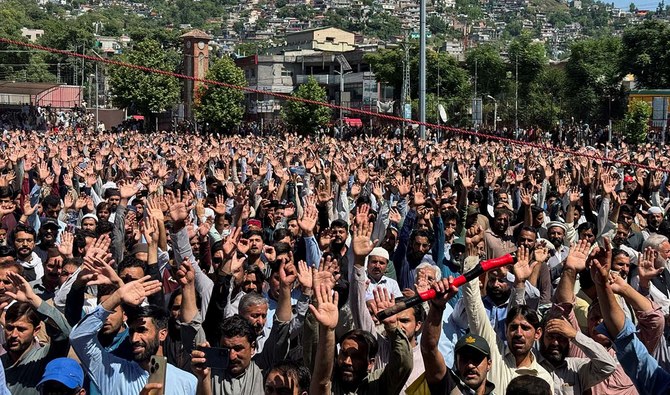
People raise their hands as they chant slogans while attending the funeral of people, who were killed during a protest by an alliance of civil rights groups, demanding the subsidy on electricity and wheat prices in the face of rising inflation, in Muzaffarabad, Pakistan-ruled Kashmir, Pakistan May 14, 2024. (REUTERS)
Short Url
Updated 14 May 2024
Follow

Pakistan PM to visit Azad Kashmir ‘in few days’ to review situation after violent protests

  • At least four people were killed in protests over subsidized wheat flour and electricity that began on May 11
  • The protests were called off on Tuesday after Pakistan approved $83 million subsidies for the disputed region

ISLAMABAD: Pakistan Prime Minister Shehbaz Sharif has announced visiting Azad Jammu and Kashmir (AJK) “in a few days” to personally review the situation after days-long violent protests over subsidies, Pakistani state media reported on Tuesday.

At least three protesters and a police officer were killed and several others wounded in days of clashes between demonstrators demanding subsidies on wheat flour and electricity and law enforcement.

The protests were called off on Tuesday, a day after Pakistan announced $83 million subsidies and prompted the regional government to notify a reduction in prices of wheat flour and electricity.

On Tuesday, Sharif presided over a meeting of his cabinet to discuss the situation in Azad Kashmir, the state-run Radio Pakistan broadcaster reported.

“Prime Minister Shehbaz Sharif has announced to visit Azad Jammu and Kashmir in a few days to personally review the ground situation and promote the tendency of resolving issues at the dialogue table,” the report read.

“He said Kashmir is the jugular vein of Pakistan as declared by the founder of Pakistan, and maintaining law and order there is the top priority.”

The Himalayan territory of Kashmir has been divided between India and Pakistan since their independence from Britain in 1947, with both countries ruling part of the territory but claiming it in full.

The western portion of the larger Kashmir region is administered by Pakistan as a nominally self-governing entity, while India rules the southern portion as a union territory.

While the Indian portion has faced an ongoing insurgency for decades and multiple armed attempts by the state to quell it, the Pakistani side has remained relatively calm over the decades, though it is also highly militarized.

The Jammu Kashmir Joint Awami Action Committee (JAAC) had organized the protests that began on May 11. “On the appeal of the Awami Action Committee, it has been decided to end the ongoing lockdown and wheel-jam strike across Azad Kashmir,” Amjad Ali Khan, a member of the JAAC core committee, told Arab News on Tuesday.

Presiding over the cabinet meeting, Sharif commended the AJK government for demonstrating restraint to foil “nefarious designs of the elements, who intend to sabotage the situation under the pretext of protests,” according to the Radio Pakistan report.

He thanked Pakistan President Asif Ali Zardari and AJK PM Anwar-ul-Haq for their cooperation in resolving the issue “amicably.”


Pakistan, global crypto exchange discuss modernizing digital payments, creating job prospects 

Updated 05 December 2025
Follow

Pakistan, global crypto exchange discuss modernizing digital payments, creating job prospects 

  • Pakistani officials, Binance team discuss coordination between Islamabad, local banks and global exchanges
  • Pakistan has attempted to tap into growing crypto market to curb illicit transactions, improve oversight

ISLAMABAD: Pakistan’s finance officials and the team of a global cryptocurrency exchange on Friday held discussions aimed at modernizing the country’s digital payments system and building local talent pipelines to meet rising demand for blockchain and Web3 skills, the finance ministry said.

The development took place during a high-level meeting between Finance Minister Muhammad Aurangzeb, Pakistan Virtual Assets Regulatory Authority (PVARA) Chairman Bilal bin Saqib, domestic bank presidents and a Binance team led by Global CEO Richard Teng. The meeting was held to advance work on Pakistan’s National Digital Asset Framework, a regulatory setup to govern Pakistan’s digital assets.

Pakistan has been moving to regulate its fast-growing crypto and digital assets market by bringing virtual asset service providers (VASPs) under a formal licensing regime. Officials say the push is aimed at curbing illicit transactions, improving oversight, and encouraging innovation in blockchain-based financial services.

“Participants reviewed opportunities to modernize Pakistan’s digital payments landscape, noting that blockchain-based systems could significantly reduce costs from the country’s $38 billion annual remittance flows,” the finance ministry said in a statement. 

“Discussions also emphasized building local talent pipelines to meet rising global demand for blockchain and Web3 skills, creating high-value employment prospects for Pakistani youth.”

Blockchain is a type of digital database that is shared, transparent and tamper-resistant. Instead of being stored on one computer, the data is kept on a distributed network of computers, making it very hard to alter or hack.

Web3 refers to the next generation of the Internet built using blockchain, focusing on giving users more control over their data, identity and digital assets rather than big tech companies controlling it.

Participants of the meeting also discussed sovereign debt tokenization, which is the process of converting a country’s debt such as government bonds, into digital tokens on a blockchain, the ministry said. 

Aurangzeb called for close coordination between the government, domestic banks and global exchanges to modernize Pakistan’s payment landscape.

Participants of the meeting also discussed considering a “time-bound amnesty” to encourage users to move assets onto regulated platforms, stressing the need for stronger verifications and a risk-mitigation system.

Pakistan has attempted in recent months to tap into the country’s growing crypto market, crack down on money laundering and terror financing, and promote responsible innovation — a move analysts say could bring an estimated $25 billion in virtual assets into the tax net.

In September, Islamabad invited international crypto exchanges and other VASPs to apply for licenses to operate in the country, a step aimed at formalizing and regulating its fast-growing digital market.