Saudi Arabia’s ICT spending surges 20% to $11bn

The latest report from the Kingdom’s Digital Government Authority revealed that the increase in spending has contributed to enhancing the efficiency of digital government services and improving the experience of beneficiaries.  
Short Url
Updated 14 May 2024
Follow

Saudi Arabia’s ICT spending surges 20% to $11bn

RIYADH: Saudi Arabia has witnessed a 20 percent year-on-year increase in government spending on information and communications technology in 2023, reaching SR41.87 billion ($11.16 billion), according to new data. 

The latest report from the Kingdom’s Digital Government Authority revealed that the increase in spending has contributed to enhancing the efficiency of digital government services and improving the experience of beneficiaries.  

Additionally, this investment has had a positive impact on the digital economy, marking a milestone in the Kingdom’s transformation journey. 

“ICT spending is one of the supporting factors for innovative and flexible solutions that we aspire to provide to all citizens and residents of Saudi Arabia, ensuring the effectiveness of the immense human wealth that populates the country and achieving a high quality of life,” said Faisal bin Ahmed Bakhshwin, deputy minister for digital transformation at the Ministry of Human Resource and Social Development. 

On the other hand, Musaed Al-Otaibi, deputy minister for digital transformation and smart cities at the Ministry of Municipal and Rural Affairs and Housing, emphasized: “Digital transformation is one of the pillars of our work at the ministry. ICT spending has enabled us to provide mature and high-quality services with added value through innovative models for citizens.” 

Al-Otaibi stated that the ministry continues to strive to improve services and meet the needs of urban residents by providing services that enrich and facilitate their daily lives.  

The deputy minister mentioned the government’s attention and interest in citizens’ feedback, incorporating it into the design of suitable services.  

Al-Otaibi explained that the ministry aims to achieve a “higher quality of life and enhance innovation in service development” by using emerging technologies that reduce service implementation time and increase operational efficiency for the sector. 

The report revealed that government ICT expenditure between 2019 and 2023 totaled an estimated SR120.15 billion, reflecting an overall upward trend. This indicates growth in the field and investment in transformational projects within this vital sector. 

The DGA data revealed that over a five-year period, the health and social development sector accounted for the highest portion of government ICT spend, totaling SR20.14 billion or 17 percent of the total expenditure. 

Moreover, the military came next as the Kingdom’s technology spending in the sector reached SR19.92 billion from 2019 to 2023, accounting for 17 percent of the total expenditure during the period.   

The infrastructure and transportation sector followed, with ICT expenditure totaling SR18.22 billion during the period, reflecting 15 percent of the total amount.  

According to the report, over the past five years, Saudi Arabia has witnessed a significant and sustained increase in expenditure on cloud computing and emerging technologies such as artificial intelligence, big data, and the Internet of Things. 

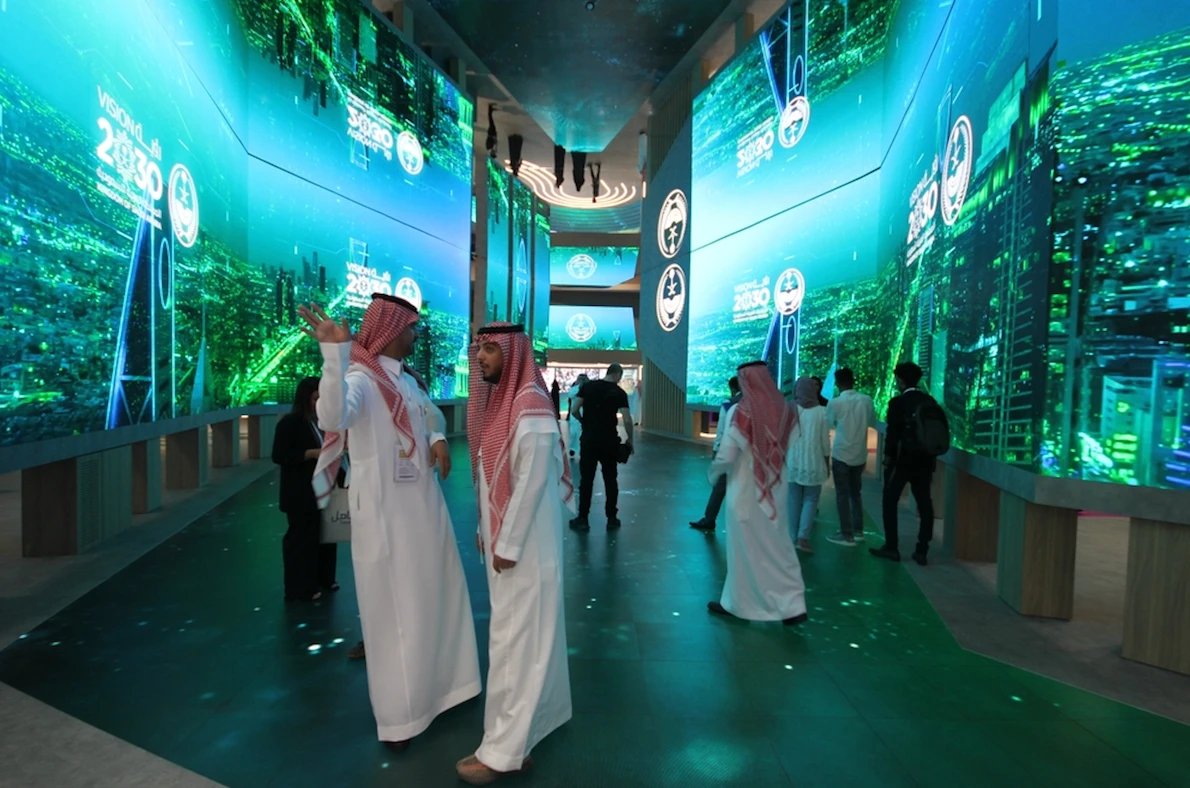
This growth reflects the Kingdom’s aspirations to become a global hub for technological innovation and digital services, as envisioned in the pillars of Vision 2030. 

Lucid’s move into Alkhobar marks a new phase in Saudi Arabia’s EV transition

Updated 38 min 17 sec ago
Follow

Lucid’s move into Alkhobar marks a new phase in Saudi Arabia’s EV transition

ALKHOBAR: Lucid opened its first showroom in Alkhobar on Dec. 5, completing its presence across Saudi Arabia’s three largest regions and underscoring the rapid progress of the Kingdom’s electric-mobility push under Vision 2030.

The new Eastern Province location targets one of the nation’s highest-spending markets and reflects the deepening US-Saudi partnership behind Lucid in manufacturing, research and development, and talent.

For the EV maker, the move reflects pure market demand, according to interim CEO Marc Winterhoff.

“We didn’t have any coverage of the eastern region. It’s the third-largest market in KSA, and therefore it’s important for us to be here as well, closer to our customers,” he said.

Saudi Arabia has become one of Lucid’s most critical markets globally, not only as a buyer, but as a manufacturing base and a long-term strategic partner.

Winterhoff said the company is “super important in all of those categories,” highlighting how the Public Investment Fund’s backing enabled Lucid to grow jobs in the US while establishing its first international facility in the Kingdom.

“It’s widely known that we are majority funded by PIF, meaning the Kingdom of Saudi Arabia, which enabled us to build actually a lot of jobs in the US. Over 90 percent of our jobs … are in the US,” he said.

Lucid interim CEO Marc Winterhoff. Khalil Alazwari

At the same time, Lucid is expanding its assembly plant in King Abdullah Economic City and preparing to hire “thousands of people” as it ramps up production by the end of next year.

Alignment with Vision 2030, particularly the shift toward sustainability and the creation of entirely new industries, is becoming a defining pillar of Lucid’s strategy in the Kingdom. “Our vision is very much aligned with Vision 2030,” Winterhoff said.

He pointed to the emergence of a Saudi automotive cluster for the first time, with Lucid among the first manufacturers and others now entering the market. “There was no automotive industry before … and yeah, that wouldn’t be possible without the support.”

Regionally, Lucid Middle East President Faisal Sultan said the Gulf is entering a new phase of EV adoption driven by consumer readiness and government action.

“The whole country is going through a transformation right now. There is a renewed focus on sustainability and diversification to non-oil GDP,” he said.

While global supply chain issues briefly slowed EV momentum, demand in Saudi Arabia is now growing faster than in several other GCC countries.

Sultan said the Alkhobar showroom will play a direct role in accelerating adoption by exposing more customers to the vehicles.

“Once the customer is inside the car and sees a beautiful car that has amazing performance attributes, then the conversion is a sure deal,” he said.

Market behavior also shaped the decision to expand east. Many Eastern Province customers had been traveling to Riyadh to buy vehicles, a barrier Lucid sought to address. “It is a little bit of an inconvenience … so we really needed to be here,” Sultan explained.

The location’s economic weight also played a role. “There’s a lot of buying power here, and Lucid vehicles are a highly technological luxury vehicle. So it is the right place for Lucid to be.”

On charging, Lucid is working on a two-track approach: building infrastructure and educating customers. The company is pushing back against common assumptions around range anxiety by highlighting its vehicles’ capabilities.

“We are the longest-range vehicle in the world — 835 (km) to 838 km on a single charge,” Sultan said. He added that many drivers can travel from Alkhobar to Riyadh and might even go back on one charge.

The Lucid Air showcased inside the new Alkhobar studio. Khalil Alazwari

Lucid now provides a free home charger and free installation with every purchase, ensuring most customers rarely run low on battery in daily use.

The company is also expanding public charging through partnerships with hotels and offices. “We have about 50 of them across the country, and anybody can use it,” he said.

The localization push, a major pillar of Vision 2030, is another area where Lucid is scaling quickly. “We are 70-plus percent Saudized. That is an amazing feat because we are a technological company,” Sultan said.

The firm is also investing in a new R&D center in Riyadh, training Saudi engineers in the US through Human Resources Development Fund’s programs, and building a talent pipeline with institutions including KAUST, King Abdullah Economic City’s training academy NAVA, and technical universities.

Sultan said this effort is essential as the plant transitions next year from assembly to a complete build-unit factory with a planned annual capacity of 150,000 vehicles.

“You’re gonna need a large workforce,” he said. “This is all in preparation to localize the workforce and having the right skills available.”

With the Eastern Province now covered, Lucid’s footprint matches the Kingdom’s three economic engines: Riyadh, Jeddah, and Alkhobar, positioning the company at the center of Saudi Arabia’s EV transition.

And as both executives made clear, the Kingdom is not just a sales market for Lucid, but a core part of its global future.