

Islamabad High Court halts government move to block phone SIMs of non-tax filers

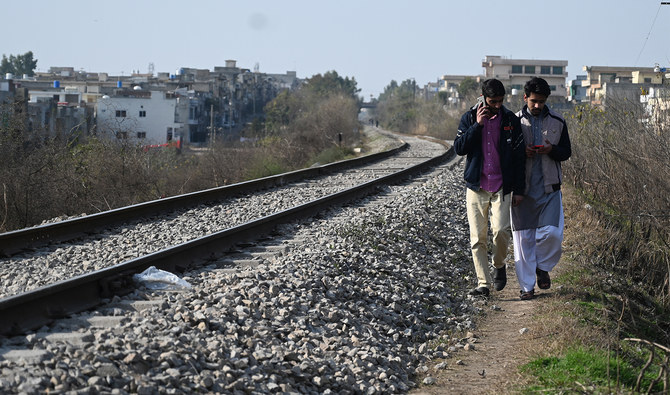
Men use their mobile phones as they walk alongside a railway track in Rawalpindi on January 23, 2021. (REUTERS/File)
Short Url
Updated 14 May 2024
Follow

Islamabad High Court halts government move to block phone SIMs of non-tax filers

  • Pakistan’s tax collection body asked the country’s telecom authority to block over half a million SIMs last month
  • The court issued a stay order until May 27 after a telecom firm challenged the decision and called it unconstitutional

ISLAMABAD: A Pakistani court on Tuesday issued a stay order against a government directive to block cellphone SIMs of users who did not file their tax returns in 2023, as the lawyer of a telecom company argued the decision was taken in violation of the constitution.

Last month, the Federal Board of Revenue (FBR), the country’s tax collection body, ordered the Pakistan Telecommunication Authority (PTA) to block over half a million SIMs belonging to people required to file taxes but who were not appearing on the active taxpayers’ list.

However, telecom companies were reluctant to implement the directives affecting so many subscribers, prompting the PTA to urge the FBR to revisit its directive.

The discussion continued until the telecom companies decided last Friday to initiate a manual process of disabling the SIMs in small batches. It was widely reported in the local media on Tuesday the Islamabad High Court (IHC) had stayed the implementation of the cellphone blockage until May 27.

“Blocking more than 500,000 SIMs will result in a loss of Rs1 billion annually,” Advocate Salman Akram Raja was quoted as saying by Pakistan’s Geo News channel.

Raja, who was representing Zong, told the court the decision taken by the government was in violation to Article 18 of the constitution, which guaranteed freedom of trade, business and profession.

Pakistan has traditionally faced the challenge of convincing people to file tax returns, but the government has now decided to implement stringent measures to address the problem, particularly in the context of negotiations for a new International Monetary Fund (IMF) loan program.

The IMF has urged Pakistan in the past to enhance revenue collection from non-filers as part of broader economic reforms to support social and development initiatives.

In response, the FBR is taking steps like blocking the SIM cards and considering other punitive measures to enforce tax compliance and widen the tax net.


IMF board to meet tomorrow to consider $1.2 billion disbursement for Pakistan

Updated 11 sec ago
Follow

IMF board to meet tomorrow to consider $1.2 billion disbursement for Pakistan

  • Pakistan, IMF reached a Staff-Level Agreement for second review of $7 billion loan program 
  • Economists view disbursement crucial for cash-strapped Pakistan as it tackles economic crisis

ISLAMABAD: The International Monetary Fund’s (IMF) Executive Board will meet tomorrow, Monday, to consider and approve a $1.2 billion disbursement for Pakistan, according to the global lender’s official schedule. 

The meeting takes place nearly two months after the Fund reached a Staff-Level Agreement (SLA) with Pakistan for the second review of its $7 billion Extended Fund Facility (EFF) and the first review of its $1.4 billion Resilience and Sustainability Facility (RSF). 

The SLA followed a mission led by IMF’s Iva Petrova, who held discussions with Pakistani authorities during a Sept. 24–Oct. 8 visit to Karachi, Islamabad and Washington, DC.

“The International Monetary Fund’s (IMF) Executive Board will convene on Dec. 8 to consider Pakistan’s request for a $1.2 billion disbursement under the Extended Fund Facility (EFF) and the Resilience and Sustainability Facility (RSF), according to the Fund’s updated schedule,” the state-run Pakistan TV reported on Sunday.

Economists view IMF’s bailout packages as crucial for cash-strapped Pakistan, which has relied heavily on financing from bilateral partners such as Saudi Arabia, China and the United Arab Emirates, as well as multilateral lenders including the IMF, World Bank, Asian Development Bank and Islamic Development Bank. 

The South Asian country has been grappling with a prolonged macroeconomic crisis that has drained its financial resources and triggered a balance of payments crisis. Islamabad, however, has recorded some financial gains since 2022, which include recording a surplus in its current account and bringing inflation down considerably. 

Speaking to Arab News last month, Pakistan’s former finance adviser Khaqan Najeeb said the $1.2 billion disbursement will further stabilize Pakistan’s near-term external position and unlock additional official inflows. 

“Continued engagement also reinforces macro stability, as reflected in recent improvements in inflation, the current account, and reserve buffers,” Najeeb said. 

Pakistan came close to sovereign default in mid-2023, when foreign exchange reserves fell below three weeks of import cover, inflation surged to a record 38 percent in May, and the country struggled to secure external financing after delays in its IMF program. Fuel shortages, import restrictions, and a rapidly depreciating rupee added to the pressure, while ratings agencies downgraded Pakistan’s debt and warned of heightened default risk.

The crisis eased only after Pakistan reached a last-minute Stand-By Arrangement with the IMF in June 2023, unlocking emergency support and preventing an immediate default.