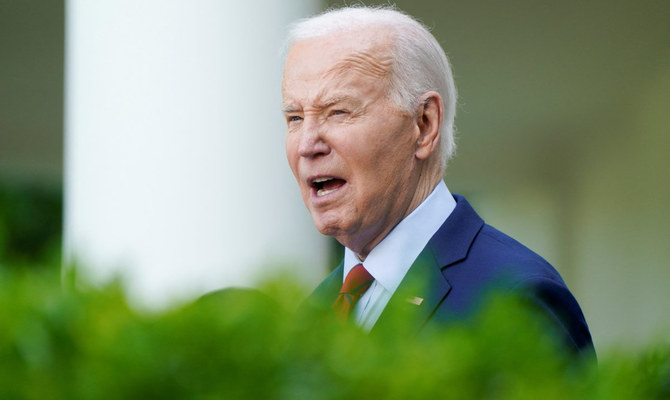
WASHINGTON: President Joe Biden signed a ban on Russian enriched uranium into law on Monday, the White House said, in the latest effort by Washington to disrupt President Vladimir Putin’s invasion of Ukraine.
The ban on imports of the fuel for nuclear power plants begins in about 90 days, although it allows the Department of Energy to issue waivers in case of supply concerns.
Russia is the world’s top supplier of enriched uranium, and about 24 percent of the enriched uranium used by US nuclear power plants come from the country.
The law also unlocks about $2.7 billion in funding in previous legislation to build out the US uranium fuel industry.
“Today, President Biden signed into law a historic series of actions that will strengthen our nation’s energy and economic security by reducing, and ultimately eliminating, our reliance on Russia for civilian nuclear power,” Jake Sullivan, the national security adviser, said in a statement.
Sullivan said the law “delivers on multilateral goals we have set with our allies and partners,” including a pledge last December with Canada, France, Japan and the United Kingdom to collectively invest $4.2 billion to expand enrichment and conversion capacity of uranium.
The waivers, if implemented by the Energy Department, allow all the Russian uranium imports the US normally imports through 2027.


![]()


Biden signs ban on imports of Russian nuclear reactor fuel into law
Short Url
https://arab.news/g6hs4
Biden signs ban on imports of Russian nuclear reactor fuel into law
- Russia is the world’s top supplier of enriched uranium, and about 24 percent of the enriched uranium used by US nuclear power plants come from the country


Trump to decide ‘soon’ on sending weapons to Taiwan
ABOARD AIR FORCE ONE: US President Donald Trump said Monday he would decide soon on whether to send more weapons to Taiwan, after Chinese President Xi Jinping warned him not to do so.
“I’m talking to him about it. We had a good conversation, and we’ll make a determination pretty soon,” Trump said, adding that he has a “good relationship” with the Chinese leader, whose country claims the self-ruled island of Taiwan as its territory.
In a phone call with Trump on February 4, Xi called for “mutual respect” in relations with the United States, while warning Washington about arms sales to the democratically run island.
“The Taiwan question is the most important issue in China-US relations... The US must handle arms sales to Taiwan with caution,” Xi said, according to China’s state broadcaster.
Trump and Xi are due to meet in Beijing in April.
China’s Communist Party has never ruled Taiwan, but Beijing claims the island of 23 million people is part of its territory and has not ruled out the use of force to annex it.
Washington does not officially recognize Taiwan, but is the island territory’s main military backer — although the tone of that support has softened slightly under Trump.
The United States approved $11-billion worth of arms to Taiwan in December, Taipei said.
Shortly thereafter, China launched major live-fire drills to simulate a blockade around Taiwan’s key ports.
While Trump has adopted a softer tone on support for Taiwan in his second term, the issue remains a thorn in US-China relations.
On Saturday, Beijing’s top diplomat Wang Yi warned the United States against “plotting” on Taiwan, saying it could lead to a “confrontation” with China.
Speaking at the Munich Security Conference in Germany, Foreign Minister Wang said that in the future, the United States could adopt a China policy that involves “instigating and plotting to split China through Taiwan, crossing China’s red line.”
Taiwan has spent many billions of dollars upgrading its military in the past decade, but faces growing US pressure to do more to protect itself against China.
Taiwan’s President Lai Ching-te has proposed $40 billion in extra defense spending by his government over eight years, but the plan has been blocked by the opposition-controlled parliament 10 times since early December.
On Thursday, dozens of US lawmakers urged Taiwan’s opposition political parties to end their blocking of the move.
In an exclusive interview with AFP last week, President Lai said he was confident the defense budget would be passed.
“I’m talking to him about it. We had a good conversation, and we’ll make a determination pretty soon,” Trump said, adding that he has a “good relationship” with the Chinese leader, whose country claims the self-ruled island of Taiwan as its territory.
In a phone call with Trump on February 4, Xi called for “mutual respect” in relations with the United States, while warning Washington about arms sales to the democratically run island.
“The Taiwan question is the most important issue in China-US relations... The US must handle arms sales to Taiwan with caution,” Xi said, according to China’s state broadcaster.
Trump and Xi are due to meet in Beijing in April.
China’s Communist Party has never ruled Taiwan, but Beijing claims the island of 23 million people is part of its territory and has not ruled out the use of force to annex it.
Washington does not officially recognize Taiwan, but is the island territory’s main military backer — although the tone of that support has softened slightly under Trump.
The United States approved $11-billion worth of arms to Taiwan in December, Taipei said.
Shortly thereafter, China launched major live-fire drills to simulate a blockade around Taiwan’s key ports.
While Trump has adopted a softer tone on support for Taiwan in his second term, the issue remains a thorn in US-China relations.
On Saturday, Beijing’s top diplomat Wang Yi warned the United States against “plotting” on Taiwan, saying it could lead to a “confrontation” with China.
Speaking at the Munich Security Conference in Germany, Foreign Minister Wang said that in the future, the United States could adopt a China policy that involves “instigating and plotting to split China through Taiwan, crossing China’s red line.”
Taiwan has spent many billions of dollars upgrading its military in the past decade, but faces growing US pressure to do more to protect itself against China.
Taiwan’s President Lai Ching-te has proposed $40 billion in extra defense spending by his government over eight years, but the plan has been blocked by the opposition-controlled parliament 10 times since early December.
On Thursday, dozens of US lawmakers urged Taiwan’s opposition political parties to end their blocking of the move.
In an exclusive interview with AFP last week, President Lai said he was confident the defense budget would be passed.
Latest updates


Recommended



© 2026 SAUDI RESEARCH & PUBLISHING COMPANY, All Rights Reserved And subject to Terms of Use Agreement.