

IMF, Pakistani officials begin formal talks in Islamabad for fresh bailout program

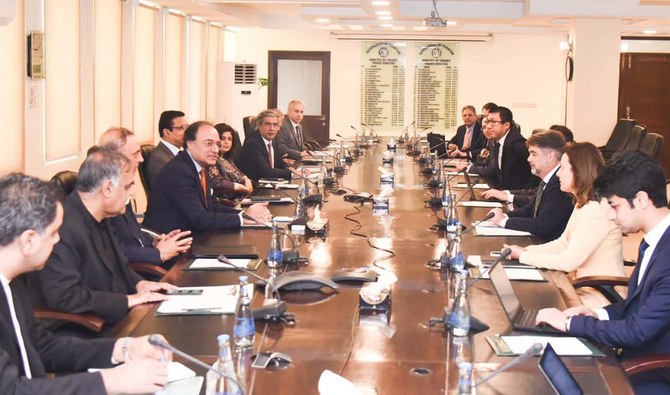
Federal Minister for Finance & Revenue Muhammad Aurangzeb in a Meeting with IMF Delegation led by IMF Mission Chief Mr. Nathan Porter in Islamabad on May 13th, 2024. (Photo courtesy: Government of Pakistan)
Short Url
Updated 13 May 2024
Follow

IMF, Pakistani officials begin formal talks in Islamabad for fresh bailout program

  • The South Asian country last month completed a short-term $3 billion IMF program that helped stave off a sovereign default
  • While Islamabad expects a staff-level agreement by July, both sides have refrained from commenting on the size of the program

ISLAMABAD: A team of the International Monetary Fund (IMF) and Pakistani officials on Monday began formal talks in Islamabad for a fresh, longer-term bailout program for the cash-strapped South Asian country, the Pakistani finance ministry said.

The South Asian country, which has been facing low foreign exchange reserves, currency devaluation and high inflation, last month completed a short-term $3 billion IMF program that helped stave off a sovereign default, but the incumbent government of PM Shehbaz Sharif has stressed the need for a fresh, longer-term program.

While Islamabad has said it expects a staff-level agreement by July, both Pakistani and IMF officials have refrained from commenting on the size of the program. The South Asian country is expected to seek around $7-8 billion bailout from the global lender.

On Monday, the IMF team, led by Mission Chief Nathan Porter, met Pakistan Finance Minister Muhammad Aurangzeb, central bank governor, chairman of the Federal Board of Revenue and other officials to kickstart discussions on further engagement with the lender.

“The Finance Minister welcomed the IMF team and thanked them for the successful completion of the [$3 billion] Standby Arrangement (SBA),” the Pakistani finance ministry said in a statement.

“The Finance Minister apprised the IMF team of the improvement in the macro-economic indicators over the course of the SBA and underscored the government’s commitment to continue with and expand upon the reform agenda.”

Pakistan narrowly averted a default last summer and its $350 billion economy has slightly stabilized after the completion of the last IMF program, with inflation coming down to around 17 percent in April from a record high of 38 percent in May last year.

However, the South Asian country is still dealing with a high fiscal shortfall and while it has controlled its external account deficit through import control mechanisms, it has come at the expense of stagnating growth, which is expected to be around 2 percent this year, compared to negative growth last year.

Wall Street Bank Citi expects Pakistan to reach an agreement with the IMF of up to $8 billion program by end-July, and recommends going long on the country’s 2027 international bond.

“While longer-term challenges pertain, we see several positive catalysts supporting the Eurobonds,” Nikola Apostolov at Citi wrote in a note to clients.

“First, a larger and longer IMF EFF (Extended Fund Facility) program could be finalized by July – possibly a $7-8 billion 4-year program and secondly and a possible inflow of Saudi investments,” Apostolov said after a team from Citi visited Pakistan and met policymakers, including Finance Minister Muhammad Aurangzeb.

Citi said it expected Pakistan’s international 2027 bond to offer a sweet spot to investors with sufficient liquidity and large upside as risks of default dissipate further.

— With additional inputs from Reuters.


Pakistan targets January launch of first-ever Panda bond

Updated 4 sec ago
Follow

Pakistan targets January launch of first-ever Panda bond

  • $1 billion yuan bond program to diversify funding, ease external financing pressures
  • Inaugural $250m tranche planned pending Chinese regulatory approvals

KARACHI: Pakistan is aiming to launch its first-ever Panda bond — a yuan-denominated bond issued in China’s domestic market — in January, as the government looks to diversify external funding sources and strengthen debt sustainability under ongoing economic reforms, the finance ministry said on Friday.

The planned issuance would mark Pakistan’s debut in China’s onshore bond market and comes as Islamabad seeks alternatives to dollar-denominated borrowing amid tight global financial conditions and continued reliance on multilateral support.

Panda bonds are renminbi-denominated instruments sold to Chinese investors by foreign governments or companies, offering issuers access to China’s deep domestic capital markets while reducing exposure to foreign-exchange volatility.

“The Panda Bond program is being pursued as a structured and programmatic financing strategy, aligned with prudent debt management objectives,” the finance ministry said in a statement after Finance Minister Muhammad Aurangzeb chaired a review meeting on the planned issuance.

The ministry said Pakistan envisages a Panda bond program of around $1 billion, with an inaugural tranche equivalent to $250 million, subject to final regulatory approvals from Chinese authorities expected by early January. It added that preparatory work for subsequent issuances under a second phase of the program has already begun.

According to the statement, approvals from multilateral partners have been secured and engagement with Chinese institutional investors has so far been “constructive,” reflecting confidence in Pakistan’s macroeconomic stabilization efforts and reform framework. Pricing will be finalized closer to market engagement once regulatory requirements are completed.

Pakistan is operating under a $7 billion, 37-month bailout program with the International Monetary Fund that requires fiscal consolidation, stronger tax collection and structural reforms across energy, state-owned enterprises and the investment climate. The country has faced elevated borrowing costs in international markets in recent years, prompting the government to explore alternative and market-based financing channels, including yuan-denominated instruments.

The finance ministry said the Panda bond would support Pakistan’s medium-term debt sustainability goals by broadening the investor base and reducing reliance on traditional external borrowing sources.