

Not an ‘exam robot,’ says British-Pakistani girl who broke O-level record with 34 A*s

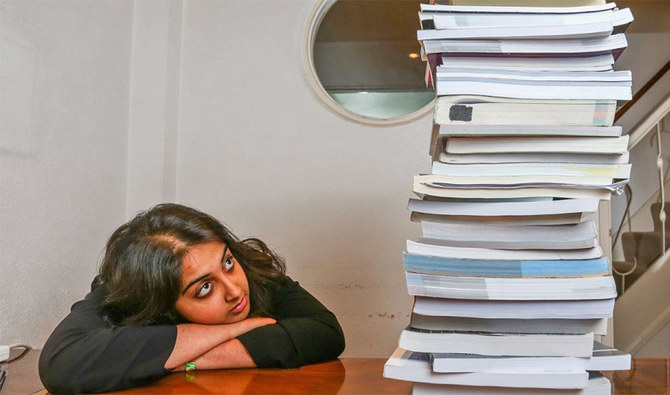
The picture shared by South West News Service via Reuters on May 13, 2024, shows British-Pakistani schoolgirl Mahnoor Cheema. (South West News Service via Reuters)
Short Url
Updated 13 May 2024
Follow

Not an ‘exam robot,’ says British-Pakistani girl who broke O-level record with 34 A*s

  • Mahnoor Cheema, 17, is said to be Britain’s smartest teen, grabbed headlines last year when she got 34 O-level A*s
  • Cheema has an IQ higher than Stephen Hawking and Einstein, has her sights set on studying at Oxford University

British-Pakistani schoolgirl Mahnoor Cheema, who grabbed headlines last year after scoring a record 34 A*s in O-levels, recently spoke about the ‘misconception’ she was an ‘exam robot,’ saying many of the subjects she was pursuing required analysis and creativity.

Cheema, 17, has an IQ higher than Stephen Hawking and Albert Einstein and has her sights set on studying at Oxford University. After sitting 34 GCSEs, she began sixth form in September last year and enrolled in 28 courses. 

She completed four A-levels in November and scored four A*s in environmental management, marine science, English language and thinking skills. She will be sitting for the final exams for eight more courses next month, including math, further math, chemistry, biology and film studies.

“A big misconception is I’m just an exam robot, but loads of the subjects I do require analysis too,” Cheema said in a recent interview to the South West News Service. “For film studies, I have to create a film, edit, write the script. And with English you have to develop your own critical stance.”

Cheema was born in the UK but moved to Pakistan’s eastern city of Lahore with her parents in 2010 before her family moved back to the UK in 2016. By the age of six, Mahnoor had read all seven Harry Potter books, and, by 11, had memorized the entire Oxford English Dictionary.

She studied 24 GCSEs in her own time alongside 10 at Langley Grammar School and scored 33 nines and one eight — equivalent to 33 A*s and one A/A*.

“I just read the book and it goes into my head. I don’t really take notes, I find them to be a waste of time,” Mahnoor, who dreams of doing a TED talk one day, said. “I don’t think my memory is photographic, but it’s good!”

As a budding medicine student, her favorite subjects are math and sciences but she’s also studying film studies and French:

“The main enjoyment for me is studying the subject and the rich knowledge — the exam is just the qualification.”

Her mother, Tayyaba Cheema, who has a masters in economics, said her daughter was “quite different” from a young age and she had created a study timetable to make sure she made time to see friends, travel and enjoy hobbies. 

And there was no “no pressure” from her or husband Usman Cheema, 48, a barrister, for Mahnoor to do anything more than what she wanted.

“I have given her the choice, I just say ‘whatever you do in life, do it the best you can’,” Tayyaba said. 

“BURNOUT IS A CHOICE”

Cheema said she had no regrets about taking on so many subjects and would be “bored and understimulated” if she only did the standard three A-levels. 

“Absorbing content and analyzing and evaluating things comes naturally to me. I’m busy but I don’t take on so much that it’ll cause me stress or pressure — I try to do everything within my capabilities,” she said, explaining that she took so many subjects because she had “loads of interests.”

“I think if you have the capability to do more, it should be explored.”

“Burnout is a big thing for some people but I’m just motivated and driven and it doesn’t affect me,” the pupil added. “I see burnout as a choice. It’s not burnout if you enjoy what you’re doing.”


Pakistani, Bangladeshi officials discuss trade, investment and aviation as ties thaw

Updated 28 December 2025
Follow

Pakistani, Bangladeshi officials discuss trade, investment and aviation as ties thaw

  • Pakistan and Bangladesh were once one nation, but they split in 1971 as a result of a bloody civil war
  • Ties between Pakistan, Bangladesh have warmed up since last year and both nations have resumed sea trade

ISLAMABAD: Pakistan's High Commissioner to Bangladesh Imran Haider on Sunday met Chief Adviser Muhammad Yunus in Dhaka, the latter's office said on, with the two figures discussing trade, investment and aviation.

Pakistan and Bangladesh were once one nation, but they split in 1971 as a result of a bloody civil war, which saw the part previously referred to as East Pakistan seceding to form the independent nation of Bangladesh.

Ties between Pakistan and Bangladesh have warmed up since former prime minister Sheikh Hasina’s ouster as a result of a student-led uprising in August 2024. Relations remain frosty between Dhaka and New Delhi over India’s decision to grant asylum to Hasina.

Pakistan has attempted to forge closer ties with Bangladesh in recent months and both South Asian nations last year began sea trade, followed by efforts to expand government-to-government commerce.

"During the meeting, both sides discussed ways to expand cooperation in trade, investment, and aviation as well as scaling up cultural, educational and medical exchanges to further strengthen bilateral relations between the two South Asian nations," Yunus's office said in a statement on X.

In 2023-24 Pakistan exported goods worth $661 million to Bangladesh, while its imports were only $57 million, according to the Trade Development Authority of Pakistan. In Aug. this year, the Pakistani and Bangladeshi commerce ministries signed a memorandum of understanding to establish a Joint Working Group on Trade, aiming to raise their bilateral trade volume to $1 billion in the financial year that began in July.

The Pakistani high commissioner noted that bilateral trade has recorded a 20 percent growth compared to last year, with business communities from both countries actively exploring new investment opportunities, according to the statement.

He highlighted a significant increase in cultural exchanges, adding that Bangladeshi students have shown strong interest in higher education opportunities in Pakistan, particularly in medical sciences, nanotechnology, and artificial intelligence. Haider also said that Dhaka-Karachi direct flights are expected to start in January.

"Chief Adviser Professor Muhammad Yunus welcomed the growing interactions between the two countries and emphasized the importance of increased visits as well as cultural, educational and people-to-people exchanges among SAARC (South Asian Association for Regional Cooperation) member states," the statement read.

"Professor Yunus also underscored the need to further boost Bangladesh–Pakistan trade and expressed hope that during Mr. Haider’s tenure, both countries would explore new avenues for investment and joint venture businesses."