

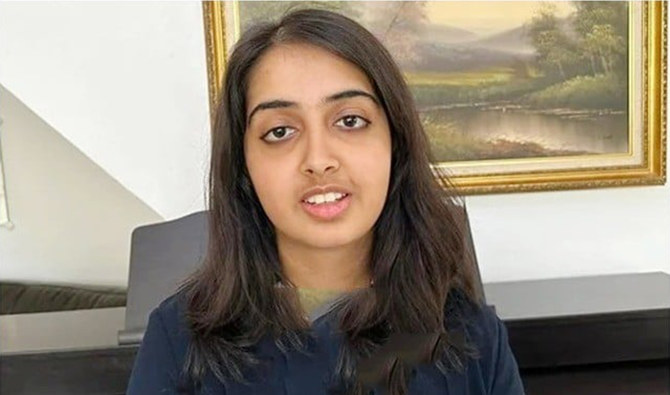
British-Pakistani girl, 16, sets record by passing 34 subjects in GCSE exam 

The photo taken on August 25, 2023, shows Mahnoor Cheema, a 16-year-old British-Pakistani girl, who has set a new record by passing 34 subjects at the General Certificate of Secondary Education (GCSE) level in the United Kingdom. (Photo courtesy: @PTANews_/Twitter)
Short Url
Updated 27 August 2023
Follow

British-Pakistani girl, 16, sets record by passing 34 subjects in GCSE exam 

  • This is the highest number of subjects ever cleared by a student at the General Certificate of Secondary Education-level 
  • Mahnoor Cheema, whose parents belong to Lahore, says she wanted to attempt the GCSE exam in around 50 subjects 

ISLAMABAD: Mahnoor Cheema, a 16-year-old British-Pakistani girl, has set a new record by passing 34 subjects at the General Certificate of Secondary Education (GCSE) level in the United Kingdom (UK), Pakistani media reported on Friday. 

This is the highest number of subjects ever taken by a student in the history of the UK and European Union (EU) GCSEs. The 16-year-old cleared 17 subjects with A* grade as a private candidate in year 10, while on Thursday, she added another 17 to the list, setting a new record. 

“I have done 34 subjects on GCSE-level and I have secured A* in all those subjects. I am the first student to have secured such an achievement,” Cheema told Pakistan's Geo News channel in an interview.

“I have done six languages and such a record never existed in the world before.” 

Cheema’s father, Barrister Usman Cheema, and mother, Tayyaba Cheema, hail from the eastern Pakistani city of Lahore. The couple moved to the UK in 2006 in order to pursue further education at Lincoln’s Inn and SOAS, respectively. 

Cheema, who studied at the Langley Grammar School in West London, said she had decided to attempt the GCSE exam in around 50 subjects. 

“I had planned from the start that I have to do a lot of subjects. I had planned to do around 50, but unfortunately the British education system did not cooperate with me despite multiple requests [and] I had to drop several subjects,” she said. 

“Last year, I cleared 17 subjects and this year too I cleared 17; 10 via school and seven privately.” 

Cheema’s mother, Tayyaba, said ever since her daughter entered the 9th year, she wanted to do “something for humanity” and was passionate about medicine. 

“When she entered the 9th grade, she said ‘I want do something for humanity’,” Tayyaba said of her daughter. “She was passionate about medicine, chose the subjects herself. While studying one subject... she chose the rest along with it.” 

In 2021, Cheema undertook an IQ test by Mensa, the largest and oldest high-IQ society in the world, in which she scored 161 — ahead of renowned scientist Albert Einstein, who was said to have an IQ of 160. 

“Einstein’s IQ was rumored to be 160, mine was 161 [in Mensa test]. I have a lot of interest in medicine, not just to further career for myself but to do something for humanity,” the 16-year-old said. 

“I always had this idea since I was young to leave a mark on the world and my parents have always supported me in this endeavor.” 

Cheema said she was an Oxford University aspirant and was hopeful of going to the prestigious institute in the next two years. 


Pakistan’s deputy PM says country will not send forces to Gaza to disarm Hamas

Updated 27 December 2025
Follow

Pakistan’s deputy PM says country will not send forces to Gaza to disarm Hamas

  • Ishaq Dar says Pakistan open to peacekeeping but Gaza’s internal security is Palestinian responsibility
  • Pakistan’s top religious clerics from different schools have warned against sending forces to Palestine

ISLAMABAD: Deputy Prime Minister Ishaq Dar said on Saturday Pakistan was willing to contribute to an international peacekeeping force in Gaza, though it would not deploy troops to disarm or de-weaponize Hamas.

The statement follows media reports saying Washington views Pakistan as a potentially significant contributor given its battle-hardened military and wants it to be part of International Stabilization Force (ISF), which is part of United States President Donald Trump’s 20-point framework for a Gaza peace plan.

The plan announced by Trump at the White House on September 29 was formally adopted at the Sharm El-Sheikh Peace Summit in October. Co-chaired by Trump and Egyptian President Abdel Fattah El-Sisi, the summit brought together leaders from 27 countries to sign the “Trump Declaration for Enduring Peace and Prosperity.”

Deployment of troops from Muslim-majority countries during a transitional stabilization phase is a key part of the plan before the war-ravaged Palestinian territory moves toward reconstruction and a longer-term political settlement.

“If they say that we should go and start fighting, disarm Hamas, de-weaponize them, and go and destroy the tunnels that Hamas has built until now, that is not our job,” Dar, who is also the country’s foreign minister, told reporters during a year-end briefing in Islamabad.

He emphasized there was clarity between Pakistan’s civil and military leadership over the matter.

“We have a very complete understanding on this matter that we cannot do that kind of work,” he added.

The deputy prime minister said Pakistan had been using the term “peacekeeping” and had never used the phrase “peace enforcement” while discussing the force.

“I have been very clear: Pakistan will be happy to join if the mandate is not peace enforcement and disarming and de-weaponizing Hamas.”

The government’s stance comes amid growing domestic pressure over the issue.

On Monday, a group of Pakistan’s top religious leaders, chaired by prominent scholar Mufti Taqi Usmani, warned the government against yielding to what they described as international pressure to send forces to Gaza.

In a joint statement from Karachi, the clerics — representing Deobandi, Barelvi, Ahl-e-Hadees and Shia schools of thought — said that Washington wanted Muslim countries to send their forces to Gaza to disarm Hamas.

“Several Muslim governments have already refused this, and pressure is being increased on Pakistan,” it added.

Addressing such concerns, Dar said Pakistan would not land its forces in Palestine to “fight Muslims.”

Israel has repeatedly called for the disarmament of Hamas as a precondition for any long-term settlement, and the United Nations Security Council has also endorsed the ISF framework in November.

However, Dar maintained during the media briefing the internal security of Gaza was the Palestinian responsibility.

“The Palestinian Authority, their government, it is their job, it is the job of their law enforcement agency,” he said

The deputy prime minister also highlighted Pakistan’s involvement in the “Arab Islamic Group of Eight,” including Saudi Arabia, Jordan, Egypt, the United Arab Emirates, Qatar, Turkiye and Indonesia, which has been coordinating on the crisis.

He said the efforts of these countries had brought some peace to Palestine and reduced bloodshed.

“Our declared policy is that there should be an independent two-state solution,” he continued while calling for pre-1967 borders.