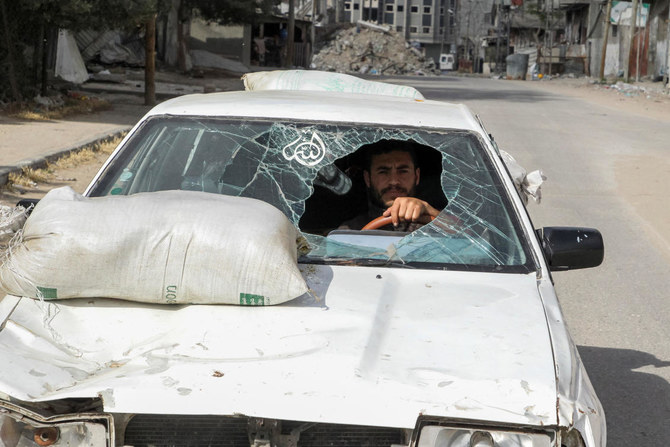
KUWAIT CITY: A conference of international donors in Kuwait pledged over $2 billion in aid to Gaza Sunday as UN Secretary-General Antonio Guterres called for an “immediate” ceasefire in the Israel-Hamas war.
The conference, organized by the International Islamic Charitable Organization (IICO) and UN humanitarian coordination agency OCHA, said the funds would be dispersed over two years, with the possibility of an extension.
The initiative is designed “to mobilize efforts to support life-saving humanitarian interventions in the Gaza Strip, and to support the prospects for early recovery for the population,” IICO general manager Bader Saud Al-Sumait said.
It would be applied on five different tracks — “life-saving interventions, shelter, health, education, and economic empowerment,” Sumait said as he read the conference’s final statement.
Guterres urged an immediate halt to the war, the return of hostages held in Gaza and a “surge” in humanitarian aid to the besieged Palestinian territory.
“I repeat my call, the world’s call for an immediate humanitarian ceasefire, the unconditional release of all hostages and an immediate surge in humanitarian aid,” Guterres said in a video address.
“But a ceasefire will only be the start. It will be a long road back from the devastation and trauma of this war,” he added.
Israeli strikes on Gaza continued on Sunday after it expanded an evacuation order for Rafah despite an international outcry over its military incursion into eastern areas of the city, effectively shutting a key aid crossing.
“The war in Gaza is causing horrific human suffering, devastating lives, tearing families apart and rendering huge numbers of people homeless, hungry and traumatized,” Guterres said.
Meeting Kuwait’s Emir Sheikh Meshal Al-Ahmed Al-Sabah, the UN chief accepted an honorary shield “on behalf of the United Nations, and especially on behalf of the almost 200 members of the UN that were killed in Gaza.”
On Friday in Nairobi, Guterres warned that Gaza faced an “epic humanitarian disaster” if Israel launched a full-scale ground operation in Rafah.
Gaza’s bloodiest-ever war began following Hamas’s unprecedented October 7 attack on Israel that resulted in the deaths of more than 1,170 people, mostly civilians, according to an AFP tally of Israeli official figures.
Vowing to destroy Hamas, Israel launched a retaliatory offensive that has killed more than 35,034 people in Gaza, mostly women and children, according to the Hamas-run territory’s health ministry.

Donors pledge over $2 billion for Gaza at Kuwait conference
https://arab.news/g9vt6
Donors pledge over $2 billion for Gaza at Kuwait conference
- The conference said the funds would be dispersed over two years, with the possibility of an extension
- The initiative is designed “to mobilize efforts to support life-saving humanitarian interventions in the Gaza Strip”
Why US-Syrian coordination is more important than ever
- A deadly Daesh attack on a joint patrol strengthens the case for cooperation between Washington and Damascus, say analysts
- They say as Syria joins global anti-Daesh coalition, sustained US and international support is vital to dismantle the Assad regime legacy
LONDON: A deadly terrorist attack that targeted a joint patrol of Syrian security forces and US troops near the ancient city of Palmyra has drawn strong condemnation across the Arab world, while also highlighting the importance and potential of emerging cooperation between Damascus and Washington.
Saturday’s attack in Palmyra, in Syria’s central Homs countryside, struck a joint Syrian-US patrol during a field tour of the area. The city, home to UNESCO-listed ruins, was occupied by Daesh during two periods between 2015 and 2017, marked by systematic cultural destruction, public executions and severe repression of civilians.
According to official accounts, the assailant opened fire on the patrol, killing two US soldiers and a civilian interpreter, and wounding three US troops and two Syrian security personnel. US Central Command said the attacker was an alleged Daesh militant who was subsequently killed.
In a post on the social-media platform X, Syria’s Foreign Minister Asaad Al-Shaibani condemned the attack, calling it a “terrorist” assault on a joint counterterrorism patrol. He extended condolences to the families of the victims and to the US government and people, and wished the injured a swift recovery.
On Sunday, Syria’s Interior Ministry said the attacker was a member of the security forces who had been identified for dismissal over extremist views. Noureddine Al-Baba, a ministry spokesperson, said the individual had served for more than 10 months, had been posted to several cities, and was due to be fired for holding “extremist Islamist ideas.”
US President Donald Trump, meanwhile, warned of “very serious retaliation,” describing the incident as a Daesh attack in a part of Syria “not fully controlled” by Damascus. He added that Syria’s interim president, Ahmad Al-Sharaa, was “extremely angry and disturbed” by the assault.
For Ghassan Ibrahim, a Syria expert and founder of the Global Arab Network, the attack exposes long-standing structural problems rather than a sudden failure. “These problems are not new; what is happening now is that we are uncovering them,” he told Arab News.
He said extremism and the resurgence of Daesh were rooted in the legacy of the deposed regime of Bashar Assad, compounded by years of international disengagement and mismanagement of the Syrian conflict. “Daesh, extremism and similar threats are the direct result of that failure,” he said, adding that the current moment should be used to confront, rather than evade, these realities.
Ibrahim argued that the Palmyra incident must be understood in the context of a rapidly rebuilt security apparatus. The Syrian government, he said, has been working under intense pressure to reconstruct its army and internal security forces after years of war. “What happened was largely a consequence of the urgency of that rebuilding process,” he said.
Crucially, he added, the incident could ultimately strengthen cooperation with Washington. Syrian officials, through ongoing contacts with US counterparts, understand that despite the tragedy, the attack could serve as a catalyst for deeper coordination. “The Americans understand this does not point to a systemic security gap,” Ibrahim said. “Incidents like this can occur in any army, especially one that is barely a year old.”
KEY DATES IN US-SYRIA POLICY SHIFT
• May 13: President Trump announces US will end sanctions on Syria.
• May 23: Caesar Act sanctions waived for 180 days.
• July 1: Comprehensive US sanctions on Syria formally terminated.
• Nov. 10: Caesar Act waiver extended for an additional 180 days.
Both Ibrahim and Ibrahim Hamidi, editor-in-chief of the Arabic magazine Al-Majalla, stressed that the Palmyra attack underscores the inseparable link between security and development.
Central Syria, particularly the vast and sparsely populated areas around Palmyra stretching toward the Euphrates, remains vulnerable to Daesh remnants, Ibrahim said. Many militants, he noted, escaped from prisons or camps once controlled by Kurdish-led forces in the northeast, sometimes through bribery, and now operate with relative freedom.
“Eliminating Daesh is essential for sustainable development,” Ibrahim said. “Without security, development cannot be sustained.” He added that this dual imperative explains Syria’s decision to join the international coalition against Daesh — a strategy aimed at restoring stability while laying the groundwork for long-term recovery.
Hamidi echoed that assessment, saying US talk of “retaliation” would likely be interpreted in Damascus as a signal of readiness for closer cooperation rather than confrontation. Such cooperation, he said, could involve intelligence sharing, operational coordination, and stricter vetting of new recruits in Syria’s General Security services.
But he cautioned that cooperation is a delicate process. “It is built quietly,” Hamidi said, noting that Syria formally joined the Global Coalition Against Daesh during interim President Al-Sharaa’s visit to Washington and his meeting with Trump on Nov. 10. The Palmyra attack, he added, is a major test of whether trust can be institutionalized.
Hamidi said when he met Al-Sharaa in August, the Syrian leader, who has survived three attempts on his life by Daeshs, identified the group as his enemy number one, citing the loss of 2,000 men so far. Damascus, he added, expects greater US support given that Syrian government forces are Sunni conservatives and direct partners in the fight against Daesh, unlike other regional actors.
Addressing the deeper question of Syria’s need for international backing, Hamidi said dismantling the legacy of the former regime — built over five or six decades — cannot be achieved quickly or in isolation. “The Palmyra attack is the first in which both American and Syrian victims were killed, but it will not be the last,” he said. “Joint counterterrorism operations will reduce the risks.”
That message was echoed by Tom Barrack, the US ambassador to Turkiye and special envoy for Syria, who said the attack underscored Daesh’s enduring global threat. Washington’s strategy, he said, is to empower capable Syrian partners with limited US operational support, keeping the fight local while preventing a resurgence of the group.
Meanwhile, Arab states have strongly condemned the attack in Syria. Saudi Arabia, the UAE, Bahrain and Jordan all issued statements rejecting terrorism and expressing solidarity with Syria and the US, underscoring regional backing for stability and counterterrorism cooperation.
The attack came amid a broader recalibration of US policy toward Syria following the fall of the Assad’s regime on Dec. 8, 2024. Sanctions have been eased, the Caesar Act partially suspended, and Syria has been reintegrated into international frameworks, including the Global Coalition Against Daesh as its 90th member.
While Syria’s formal participation in the anti-Daesh coalition is new, coordination with the US began shortly after the fall of Bashar Assad’s regime, when the extremist group appeared to be regrouping and expanding its operations.
Daesh mounted at least 660 attacks across Syria in 2024 — its most active year since its territorial defeat in 2019 — according to data compiled by Syria Weekly.
On Nov. 8, two days before President Al-Sharaa’s trip to Washington, Syria’s Interior Ministry said it had carried out 61 nationwide raids targeting Daesh cells. The operations resulted in 71 arrests and the seizure of weapons and explosives, the ministry told state-run Al-Ekhbariya TV.


