

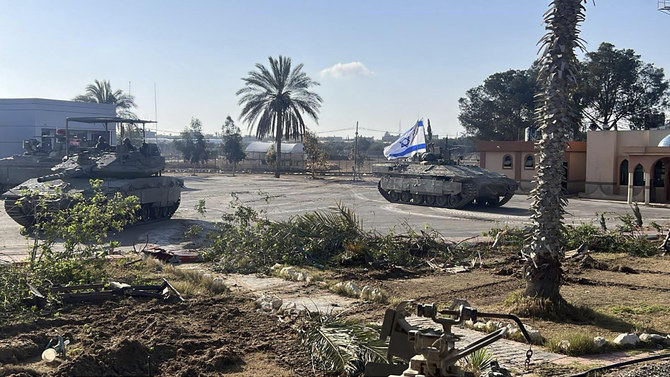
Israeli troops drive further into Rafah as tanks split city in two

1 / 2
This handout picture released by the Israeli army on May 10, 2024 shows Israeli troops of the Givati Brigade inside Palestinian territory in eastern Rafah in the southern Gaza Strip. (AFP)
2 / 2
This photo provided by the Israel Defense Forces shows an Israeli tank entering the Gazan side of the Rafah border crossing on May 7, 2024. (AP)
Short Url
Updated 11 May 2024
Follow

Israeli troops drive further into Rafah as tanks split city in two

  • Four Israeli soldiers killed as Hamas and Islamic Jihad put up a fierce resistance
  • Israel’s move into Rafah has been short of the full-scale invasion that it threatened

JEDDAH: Israeli troops pushed further into Rafah in southern Gaza on Friday as its tanks split the city in two and encircled the eastern half.

The Israeli forces faced fierce resistance from Hamas and Islamic Jihad fighters, and battles also resumed in northern Gaza, where Hamas has regrouped after being forced out earlier in the war. Four Israeli soldiers were killed in fighting there.
Israel’s move into Rafah has been short of the full-scale invasion that it threatened. The US and other Israeli allies are deeply opposed to a major offensive, and Washington has threatened to hold back arms to shipments to Israel.
But the heavy fighting has shaken the city and spread fear that a bigger assault is coming.


The UN agency for Palestinian refugees said more than 110,000 people had fled Rafah, and families who had already moved numerous times during the war were doing so again.
“The full invasion hasn’t started and things have already gotten below zero,” said Raed Al-Fayomi, a refugee in Rafah. “There’s no food or water.”
Those fleeing erected new tent camps in Khan Younis, which was half destroyed in an earlier Israeli offensive, and the town of Deir Al-Balah.
The charity Project Hope said there had been a surge in people from Rafah seeking care for blast injuries, infections and pregnancies in its clinic in Deir Al-Balah.
“People are evacuating to nothing. There are no homes or proper shelters for people to go to,” said the group’s Gaza team leader in Rafah, Moses Kondowe.

UN aid official Georgios Petropoulos said humanitarian workers had no supplies to set up in new locations.
“We simply have no tents, we have no blankets, no bedding, none of the items that you would expect a population on the move to be able to get from the humanitarian system,” he said.
The fighting in Rafah has left crucial nearby aid crossings inaccessible, and food and other supplies were running critically low, aid agencies said.
The World Food Program will run out of food for distribution in southern Gaza by Saturday, Petropoulos said.
Aid groups have said fuel will also be depleted soon, forcing hospitals to shut down critical operations and bringing to a halt trucks delivering aid across south and central Gaza.


Halt to MSF work will be ‘catastrophic’ for people of Gaza: MSF chief

Updated 36 sec ago
Follow

Halt to MSF work will be ‘catastrophic’ for people of Gaza: MSF chief

GENEVA: Israel’s ban on Doctors Without Borders’ humanitarian operation in Gaza spells deeper catastrophe for the Palestinian territory’s people, the head of the medical charity told AFP on Monday.
Israel announced on Sunday that it was terminating all the activities in Gaza and the West Bank by the organization, known by its French acronym MSF, after it failed to provide a list of its Palestinian staff.
MSF slammed the move, which takes effect on March 1, as a “pretext” to obstruct aid.
“This is a decision that was made by the Israeli government to restrict humanitarian assistance into Gaza and the West Bank at the most critical time for Palestinians,” MSF secretary-general Christopher Lockyear warned in an interview with AFP at the charity’s Geneva headquarters.
“We are at a moment where Palestinian people need more humanitarian assistance, not less,” he said. “Ceasing MSF activities is going to be catastrophic for the people of the Gaza Strip and the West Bank.”
MSF has been a key provider of medical and humanitarian aid in Gaza, particularly since war broke out after Hamas’s October 7, 2023 attack on Israel.
The charity says it currently provides at least 20 percent of hospital beds in the territory and operates around 20 health centers.
In 2025 alone, it carried out more than 800,000 medical consultations, treated more than 100,000 trauma cases and assisted more than 10,000 infant deliveries.
It also provided more than 700 million liters of water, Lockyear pointed out.
’Impossible choice’
Israel announced in December that it planned to prevent 37 aid organizations, including MSF, from working in Gaza for failing to submit detailed information about their Palestinian employees. The move drew widespread condemnation from NGOs and the United Nations.
It had alleged that two MSF employees had links with Palestinian militant groups Hamas and Islamic Jihad, which the medical charity vehemently denies.
“If Israel has any evidence of such things, then they should share that evidence,” Lockyear said, insisting that “there’s been no proof given to us.”
He decried “an orchestrated campaign to delegitimize us,” calling on other countries to defend efforts to bring desperately-needed humanitarian aid into Gaza.
“They should be speaking to Israel, pressuring Israel to ensure that there is a reverse of any banning of humanitarian organizations.”
Lockyear said MSF, which counts around 1,100 staff inside Gaza, had been trying to engage with Israeli authorities for nearly a year over the requested lists.
But it had been left with “an impossible choice,” he said.
“We’ve been forced to choose between the safety and security of our staff and being able to reach patients.”
’Can only get worse’
The organization said it decided not to hand over staff names “because Israeli authorities failed to provide the concrete assurances required to guarantee our staff’s safety, protect their personal data, and uphold the independence of our medical operation.”
Lockyear insisted that was a “very rational” decision, pointing out that 15 MSF staff had been killed in Gaza during the war, out of more than 500 humanitarian workers and more than 1,700 medical workers killed in the Strip.
Lockyear highlighted that without independent humanitarian organizations in Gaza, an already “catastrophic” situation “can only get worse.”
“We need to increase massively the humanitarian assistance that’s going into Gaza,” he said, “not restrict it, not block it.”