

PM orders immediate rebuilding of girls school bombed by militants in northwestern Pakistan

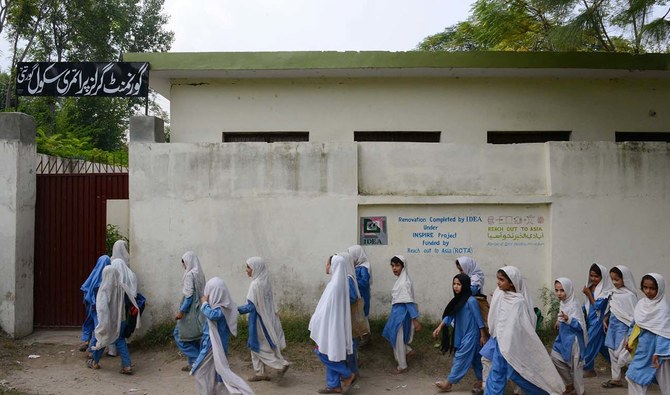
Pakistani girls arrive for class at a school in Mingora, a town in Swat valley, on October 9, 2013, the first anniversary of the shooting of Malala Yousafzai by the Taliban. (AFP/File)
Short Url
Updated 10 May 2024
Follow

PM orders immediate rebuilding of girls school bombed by militants in northwestern Pakistan

  • Attackers beat up school guard before setting off explosives at private Aafia Islamic Girls Model School in North Waziristan
  • Pakistan witnessed multiple attacks on girls schools until 2019, especially in Swat Valley and elsewhere in northwest

ISLAMABAD: Pakistani Prime Minister Shehbaz Sharif on Friday ordered that a girls school bombed by militants this week in a former stronghold of the Pakistani Taliban should be immediately rebuild, vowing to provide women with equal opportunities for education.

There was no immediate claim of responsibility for the attack late Wednesday that targeted the only girls school in Shawa, a town in the North Waziristan district in the Khyber Pakhtunkhwa province bordering Afghanistan.

Suspicion is likely to fall on the Pakistani Taliban, or Tehreek-e-Taliban Pakistan (TTP), who have targeted girls schools in the province in the past, saying that women should not be educated.

The TTP group was evicted from northwest Pakistan’s Swat and other regions in recent years after successive military operations. The TTP are a separate group but a close ally of the Afghan Taliban, who seized power in Afghanistan in 2021. The Taliban takeover in neighboring Afghanistan has emboldened the Pakistani Taliban, the Pakistan government says. 

“Prime Minister directed to immediately identify the people involved in the incident and ensure that they are punished,” a statement from Sharif’s office said, adding that the PM had instructed that the part of the school destroyed in the attack be “immediately” rebuilt at government expense.

“The nefarious ambitions of terrorists to stop the education of girls will never be allowed to succeed,” the statement quoted Sharif as saying. “Terrorist elements who are trying to create obstacles in the education of the daughters of the nation will be brought to justice.”

Pakistan witnessed multiple attacks on girls schools until 2019, especially in the Swat Valley and elsewhere in the northwest where the Pakistani Taliban long controlled the former tribal regions. In 2012, the insurgents attacked Malala Yousafzai, a teenage student and advocate for the education of girls who went on to win the Nobel Peace Prize.

In the latest incident, police said the attackers first beat up the school guard before setting off the explosives at the private Aafia Islamic Girls Model School, which has 150 students.

In a statement, Abdullah Fadil, the UNICEF representative in Pakistan, said the “destruction of a girls’ school in a remote and underserved area is a heinous crime detrimental to national progress.” He cited Sharif’s statement on Wednesday declaring an education emergency and pledging to work toward enrolling 26 million out-of-school children.

With inputs from AP


At ECO meeting, Pakistan proposes ‘Regional Innovation Hub’ to curb natural disasters

Updated 21 January 2026
Follow

At ECO meeting, Pakistan proposes ‘Regional Innovation Hub’ to curb natural disasters

  • Pakistan hosts high-level 10th ECO Ministerial Meeting on Disaster Risk Reduction in Islamabad
  • Innovation hub to focus on early warning technologies, risk informed infrastructure planning

ISLAMABAD: Pakistan has proposed to set up a “Regional Innovation Hub on Disaster Risk Reduction” that focuses on early warning technologies and risk informed infrastructure planning, the Press Information Department (PID) said on Wednesday, as Islamabad hosts a high-level meeting of the Economic Cooperation Organization (ECO).

The ECO’s 10th Ministerial Meeting on Disaster Risk Reduction (DRR) is being held from Jan. 21-22 at the headquarters of the National Disaster Management Authority (NDMA) in Pakistan’s capital. 

The high-level regional forum brings together ministers, and senior officials from ECO member states, representatives of the ECO Secretariat and regional and international partner organizations. The event is aimed to strengthen collective efforts toward enhancing disaster resilience across the ECO region, the PID said. 

“Key agenda items include regional cooperation on early warning systems, disaster risk information management, landslide hazard zoning, inclusive disaster preparedness initiatives, and Pakistan’s proposal to establish a Regional Innovation Hub on Disaster Risk Reduction, focusing on early warning technologies, satellite data utilization, and risk-informed infrastructure planning,” the statement said. 

The meeting was attended by delegations from ECO member states including Pakistan, Türkiye, Azerbaijan, Iran, Kyrgyzstan, Tajikistan, Turkmenistan and Uzbekistan. Representatives of regional and international organizations and development partners were also in attendance.

Discussions focused on enhancing regional coordination, harmonizing disaster risk reduction frameworks, and strengthening collective preparedness against transboundary and climate-induced hazards impacting the ECO region, the PID said. 

ECO members states such as Pakistan, Türkiye, Afghanistan and others have faced natural calamities such as floods and earthquakes in recent years that have killed tens of thousands of people. 

Heavy rains triggered catastrophic floods in Pakistan in 2022 and 2025 that killed thousands of people and caused damages to critical infrastructure, inflicting losses worth billions of dollars. 

Islamabad has since then called on regional countries to join hands to cooperate to avert future climate disasters and promote early warning systems to avoid calamities in future.