Iraq requests end of UN assistance mission by end-2025

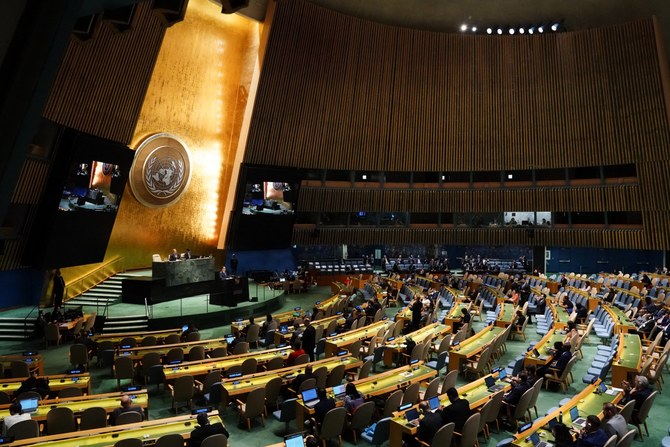
File photo of Iraqi Prime Minister Mohamed Shia al-Sudani addresses the 78th United Nations General Assembly at UN headquarters in New York City on September 22, 2023. (AFP)
Short Url
Updated 10 May 2024
Follow

Iraq requests end of UN assistance mission by end-2025

  • Prime PM said Iraq wanted to deepen cooperation with other UN organizations but there was no longer a need for the political work of the UN assistance mission

BAGHDAD: Iraq has requested that a United Nations assistance mission set up after the 2003 US-led invasion of the country end its work by the end of 2025, saying it was no longer needed because Iraq had made significant progress toward stability.
The mission, headquartered in Baghdad’s heavily fortified Green Zone, was set up with a wide mandate to help develop Iraqi institutions, support political dialogue and elections, and promote human rights.
Prime Minister Mohammed Shia Al-Sudani said Iraq wanted to deepen cooperation with other UN organizations but there was no longer a need for the political work of the UN assistance mission, known as UNAMI.
The mission’s head in Iraq often shuttles between top political, judicial and security officials in work that supporters see as important to preventing and resolving conflicts but critics have often described as interference.
“Iraq has managed to take important steps in many fields, especially those that fall under UNAMI’s mandate,” Sudani said in a letter to UN Secretary-General Antonio Guterres.
Iraq’s government has since 2023 moved to end several international missions, including the US-led coalition created in 2014 to fight Islamic State and the UN’s mission established to help promote accountability for the jihadist group’s crimes.
Iraqi officials say the country has come a long way from the sectarian bloodletting after the US-led invasion and Islamic State’s attempt to establish a caliphate, and that it no longer needs so much international help.
Some critics worry about the stability of the young democracy, given recurring conflict and the presence of many heavily armed military-political groups that have often battled on the streets, the last time in 2022.
Some diplomats and UN officials also worry about human rights and accountability in a country that frequently ranks among the world’s most corrupt and where activists say freedom of expression has been curtailed in recent years.
Iraq’s government says it is working to fight corruption and denies there is less room for free expression.
Somalia’s government also requested the termination of a UN political mission this week. In a letter to the Security Council, the country’s foreign minister called for the departure of the Nations Assistance Mission in Somalia (UNSOM), which has advised the government on peace-building, security reforms and democracy for over a decade. He provided no reason.


Fledgling radio station aims to be ‘voice of the people’ in Gaza

Updated 15 February 2026
Follow

Fledgling radio station aims to be ‘voice of the people’ in Gaza

  • The electricity crisis is one of the most serious and difficult problems in the Gaza Strip, says Shereen Khalifa Broadcaster

DEIR EL-BALAH: From a small studio in the central city of Deir El-Balah, Sylvia Hassan’s voice echoes across the Gaza Strip, broadcast on one of the Palestinian territory’s first radio stations to hit the airwaves after two years of war.

Hassan, a radio host on fledgling station “Here Gaza,” delivers her broadcast from a well-lit room, as members of the technical team check levels and mix backing tracks on a sound deck. “This radio station was a dream we worked to achieve for many long months and sometimes without sleep,” Hassan said.

“It was a challenge for us, and a story of resilience.”

Hassan said the station would focus on social issues and the humanitarian situation in Gaza, which remains grave in the territory despite a US-brokered ceasefire between Israel and Hamas since October.

“The radio station’s goal is to be the voice of the people in the Gaza Strip and to express their problems and suffering, especially after the war,” said Shereen Khalifa, part of the broadcasting team.

“There are many issues that people need to voice.” Most of Gaza’s population of more than 2 million people were displaced at least once during the gruelling war.

Many still live in tents with little or no sanitation.

The war also decimated Gaza’s telecommunications and electricity infrastructure, compounding the challenges in reviving the territory’s local media landscape. “The electricity problem is one of the most serious and difficult problems in the Gaza Strip,” said Khalifa.

“We have solar power, but sometimes it doesn’t work well, so we have to rely on an external generator,” she added.

The station’s launch is funded by the EU and overseen by Filastiniyat, an organization that supports Palestinian women journalists, and the media center at the An-Najah National University in Nablus, in the occupied West Bank.

The station plans to broadcast for two hours per day from Gaza and for longer from Nablus. It is available on FM and online.

Khalifa said that stable internet access had been one of the biggest obstacles in setting up the station, but that it was now broadcasting uninterrupted audio.

The Gaza Strip, a tiny territory surrounded by Israel, Egypt, and the Mediterranean Sea, has been under Israeli blockade even before the attack on Oct. 7, 2023, which sparked the war. Despite the ceasefire, Israel continues to strictly control the entry of all goods and people to the territory.

“Under the siege, it is natural that modern equipment necessary for radio broadcasting cannot enter, so we have made the most of what is available,” she said.