

Suspected militants bomb school for girls in northwestern Pakistan

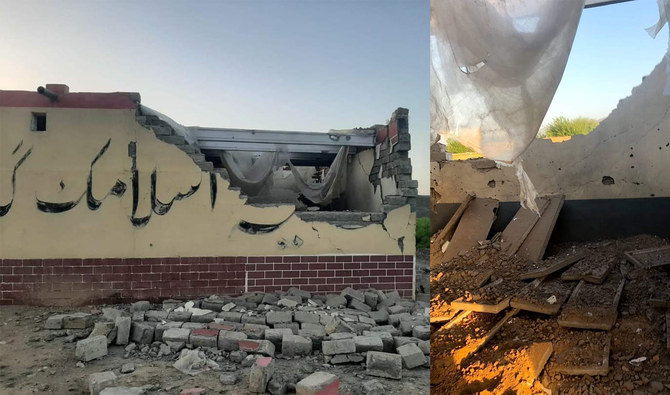
The collage of images shows the destroyed walls of Aafia Islamic Girls Model School blown up by suspected militants in a former stronghold of the Pakistani Taliban in Shawa, a town in the North Waziristan district in the Khyber Pakhtunkhwa province. (@DI313_/X)
Short Url
Updated 09 May 2024
Follow

Suspected militants bomb school for girls in northwestern Pakistan

  • No one harmed as militants blow up girls school in North Waziristan district, say police
  • Pakistan witnessed attacks on girls’ schools until 2019 by militants opposed to female education

DERA ISMAIL KHAN, Pakistan: Militants detonated a bomb at a girls school in a former stronghold of the Pakistani Taliban in the country’s volatile northwest, badly damaging the structure, police said Thursday. No one was harmed in the overnight attack.

There was no immediate claim of responsibility for the attack late Wednesday that targeted the only girls school in Shawa, a town in the North Waziristan district in the Khyber Pakhtunkhwa province bordering Afghanistan, local police chief Amjad Wazir said.

UNICEF condemned the bombing as “despicable and cowardly act that could jeopardize the future of many young and talented girls.”

According to the police chief, the attackers first beat up the school guard before setting off the explosives at the private Aafia Islamic Girls Model School, which has 150 students.

Suspicion is likely to fall on Islamic militants and specifically the Pakistani Taliban, who have targeted girls schools in the province in the past, saying that women should not be educated.

In a statement, Abdullah Fadil, the UNICEF representative in Pakistan, said the “destruction of a girls’ school in a remote and underserved area is a heinous crime detrimental to national progress.” He cited Prime Minister Shehbaz Sharif statement on Wednesday declaring an education emergency and pledging to work toward enrolling 26 million out-of-school children.

Pakistan witnessed multiple attacks on girls schools until 2019, especially in the Swat Valley and elsewhere in the northwest where the Pakistani Taliban long controlled the former tribal regions. In 2012, the insurgents attacked Malala Yousafzai, a teenage student and advocate for the education of girls who went on to win the Nobel Peace Prize.

The Pakistani Taliban, known as Tehreek-e-Taliban Pakistan or TTP, were evicted from Swat and other regions in recent years. The TTP are a separate group but a close ally of the Afghan Taliban, who seized power in Afghanistan in 2021.

The Taliban takeover in neighboring Afghanistan has emboldened the Pakistani Taliban.


IMF hails Pakistan privatization drive, calls PIA sale a ‘milestone’

Updated 10 January 2026
Follow

IMF hails Pakistan privatization drive, calls PIA sale a ‘milestone’

  • Fund backs sale of national airline as key step in divesting loss-making state firms
  • IMF has long urged Islamabad to reduce fiscal burden posed by state-owned entities

KARACHI: The International Monetary Fund (IMF) on Saturday welcomed Pakistan’s privatization efforts, describing the sale of the country’s national airline to a private consortium last month as a milestone that could help advance the divestment of loss-making state-owned enterprises (SOEs).

The comments follow the government’s sale of a 75 percent stake in Pakistan International Airlines (PIA) to a consortium led by the Arif Habib Group for Rs 135 billion ($486 million) after several rounds of bidding in a competitive process, marking Islamabad’s second attempt to privatize the carrier after a failed effort a year earlier.

Between the two privatization attempts, PIA resumed flight operations to several international destinations after aviation authorities in the European Union and Britain lifted restrictions nearly five years after the airline was grounded following a deadly Airbus A320 crash in Karachi in 2020 that killed 97 people.

“We welcome the authorities’ privatization efforts and the completion of the PIA privatization process, which was a commitment under the EFF,” Mahir Binici, the IMF’s resident representative in Pakistan, said in response to an Arab News query, referring to the $7 billion Extended Fund Facility.

“This privatization represents a milestone within the authorities’ reform agenda, aimed at decreasing governmental involvement in commercial sectors and attracting investments to promote economic growth in Pakistan,” he added.

The IMF has long urged Islamabad to reduce the fiscal burden posed by loss-making state firms, which have weighed public finances for years and required repeated government bailouts. Beyond PIA, the government has signaled plans to restructure or sell stakes in additional SOEs as part of broader reforms under the IMF program.

Privatization also remains politically sensitive in Pakistan, with critics warning of job losses and concerns over national assets, while supporters argue private sector management could improve efficiency and service delivery in chronically underperforming entities.

Pakistan’s Cabinet Committee on State-Owned Enterprises said on Friday that SOEs recorded a net loss of Rs 122.9 billion ($442 million) in the 2024–25 fiscal year, compared with a net loss of Rs 30.6 billion ($110 million) in the previous year.