

Arab League affirms its solidarity with Palestinian journalists

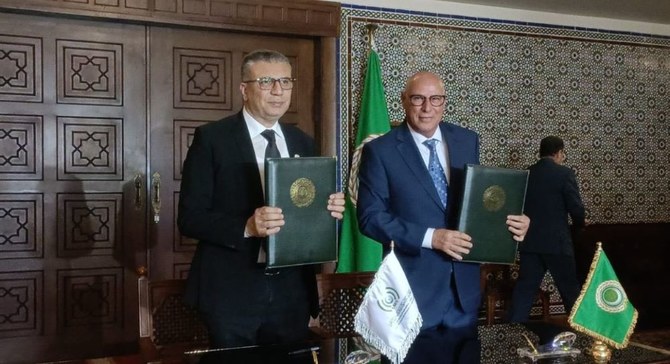
Ahmed Rashid Khattabi, right, and the Director General of the Islamic Broadcasting Union Amr Ellissy. (X/@osbu_org)
Short Url
Updated 09 May 2024
Follow

Arab League affirms its solidarity with Palestinian journalists

  • Ahmed Rashid Khattabi urges global organizations to support freedom of the press
  • Khattabi criticized the Israeli authorities for closing down Al Jazeera in Israel and confiscating its equipment

CAIRO: The League of Arab States has expressed solidarity with Palestinian journalists in Gaza, the West Bank, and East Jerusalem, and called for their protection.

May 11 has been designated a day of global solidarity with the Palestinian media as it marks two years since the Israeli occupation forces’ assassination of journalist Shireen Abu Akleh while she was carrying out her duties with the Al Jazeera Media Network.

Ambassador Ahmed Rashid Khattabi, the league’s assistant secretary-general and supervisor of the Media and Communication Sector, said the move “symbolizes a powerful demonstration of solidarity with the Palestinian media community.”

This support is particularly significant given the plight of the Palestinians and the continued Israeli aggression in the Gaza Strip.

The aggression has resulted in the deaths of more than 34,000 people, including 142 journalists, since October.

This figure exceeds the number of journalists who lost their lives in areas of armed conflict worldwide in 2023, a total of 99, according to the US Committee to Protect Journalists.

Khattabi urged global organizations to support the freedom of the press and protect Palestinian journalists covering the conflict.

Khattabi said it was imperative to ensure journalists’ safety under the principles of international humanitarian law, given the grave conditions in which they work.

He criticized the Israeli authorities for closing down Al Jazeera in Israel and confiscating its equipment, viewing these actions as illegal measures against the Palestinian media and other media institutions, and constituting a blatant violation of international conventions.

He added that it was unacceptable to violate fundamental rights as enshrined in the Universal Declaration of Human Rights and other international declarations promoting freedom of opinion and access to information.

These violations acted against the UN Plan of Action on the Safety of Journalists and the  International Federation of Journalists’ declaration, he said.


University of Hong Kong hosts the first Saudi Economic Forum to boost China–Saudi ties

Updated 17 December 2025
Follow

University of Hong Kong hosts the first Saudi Economic Forum to boost China–Saudi ties

  • The high-level event served as a new platform for bilateral dialogue and cross-sector collaboration

RIYADH: The University of Hong Kong (HKU) has hosted the first-ever Saudi Economic Forum in Riyadh, bringing together nearly 100 senior officials, academics, and business leaders to deepen cooperation between China and Saudi Arabia in education, innovation, and economic growth.

Held under the theme “Enhancing the Global Competitiveness of Chinese and Saudi Institutions,” the forum marked a significant milestone in advancing strategic alignment between China’s Belt and Road Initiative and Saudi Vision 2030.

The high-level event served as a new platform for bilateral dialogue and cross-sector collaboration, with participants exploring joint opportunities in investment, technology, renewable energy, and artificial intelligence.

Professor Hongbin Cai, dean of the faculty of business and economics at HKU, said the university aspires to become a “knowledge bridge” between the two nations, leveraging its global standing and extensive international networks. He noted that educational collaboration would be a cornerstone of the Saudi–Chinese partnership.

Saudi Arabia’s Assistant Deputy Minister of Investment, Fahad Al-Hashem, emphasized the depth of the China–Saudi partnership, noting that bilateral trade now exceeds $150 billion, with a growth rate of around 30 percent annually.

He reaffirmed the Kingdom’s openness to partnerships with China’s leading universities and technology companies, particularly in future-focused sectors aligned with Vision 2030, including education, digital transformation, AI, and clean energy.

The forum featured panel discussions on cross-border education, global city development, and technology transfer, with experts stressing the importance of joint ventures in the digital economy and smart infrastructure.

Participants said Saudi Arabia could benefit from China’s successful experiences in energy transition, infrastructure modernization, and innovation ecosystems as it builds globally competitive cities and institutions.

The Saudi Economic Forum concluded with calls for sustained academic and corporate partnerships to enhance institutional excellence and global competitiveness. Organizers said the initiative will continue to facilitate knowledge exchange and support national transformation goals in both countries, namely in the fields of technology and innovation.
