

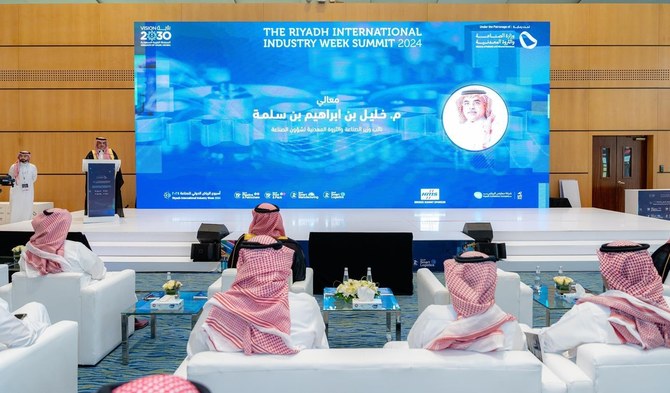

RIYADH: Saudi Arabia aims to bolster private sector investment in the manufacturing industry, capitalizing on the Kingdom’s swift growth, according to a top official.
During his opening speech on the second day of the Riyadh International Industry Week 2024, Deputy Minister of Industry and Mineral Resources for Industrial Affairs Khalil bin Salamah pointed out that partnership with non-government bodies is of great importance in achieving industrial development in the Kingdom.
He affirmed that building strategic partnerships with the private sector contributes to driving economic growth in the Kingdom, and the integration and harmony of work between government and non-government entities contributes to overcoming the obstacles, according to the Saudi Press Agency.
Bin Salamah added: “We look forward to leading the private sector in increasing investment in the manufacturing sector and leveraging the rapid growth in the Kingdom.”
Private sector investments in Saudi Arabia’s industrial field more than doubled in the first quarter of 2024, surpassing SR7 billion ($1.8 billion), according to a report released by the Saudi Authority for Industrial Cities and Technology Zones, also known as MODON, in April.
The deputy minister went on to explain that the national industrial strategy was built primarily in partnership with the private sector, and there is a partnership-based business model within the industrial system.
The Kingdom is set to boost private sector investments with the desire to enhance cooperation between core and transformational companies to develop businesses and create new opportunities, the top official affirmed.
Bin Salamah stated: “We are currently working on maximizing current production capacities, where a committee has been established to integrate petrochemical supply chains, addressing challenges related to the availability and competitiveness of petrochemical materials.”
He added: “We encourage all companies in the sector to collaborate with us to address challenges and contribute to finding appropriate solutions.”
The deputy minister highlighted that the Kingdom is a leading country in the petrochemical industry, enabling it to expand supply chains to support economic growth and enhance supply chains of related industries.
He added that the Ministry of Industry and Mineral Resources is working with the Ministry of Energy and the government system to empower the sector by enhancing the integration of petrochemical supply chains in the Kingdom.
These efforts, according to Bin Salamah, aim to ensure the availability and competitiveness of petrochemical materials used to produce specialized products, enabling sector growth and enhancing supply chain integration.
He further explained that the Kingdom aims to strengthen its industrial base and diversify its economy, with attracting private sector investments being a fundamental part of its industrial strategy.
The deputy minister emphasized that the industrial system plays a pivotal role in enabling growth and development in the industrial sector in the Kingdom through enhancing integration between sectors and their supply chains, developing basic and specialized infrastructure and facilities, and encouraging investment in joint projects between companies operating in various sectors.
He pointed out that the ministry is keen on creating continuous industrial momentum in the Kingdom, noting that the Industry Week includes four major industrial exhibitions under one roof, including the Saudi Plastics & Petrochem, Saudi Print & Pack, Saudi Smart Manufacturing, and Smart Logistics Services.


