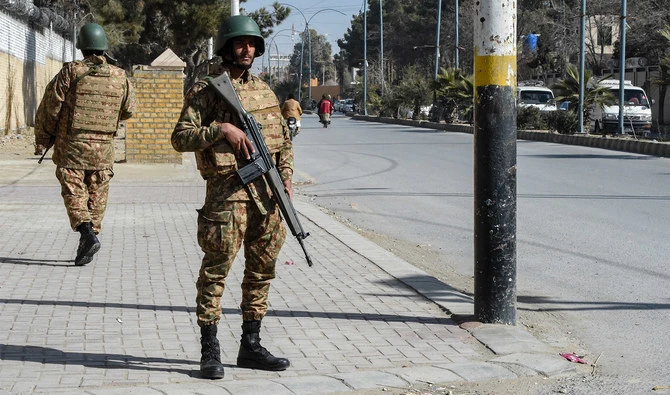
- The assailants targeted the seven hair-salon workers while they were sleeping in a residential quarter
- No group have claimed the attack, though Baloch separatists have targeted Punjabi workers in the past
QUETTA: A group of unidentified gunmen attacked a residential quarter in Gwadar, a coastal town in Pakistan, in the early hours of Thursday, killing seven laborers from Punjab province, confirmed a local administration official.
The attack, which occurred about 24 kilometers from central Gwadar city, targeted hair-salon workers from Khanewal district in Punjab while they were sleeping.
Speaking to Arab News, Deputy Commissioner of Gwadar Hamood-ur-Rehman said the assailants stormed the quarter around 4 AM and opened fire on the occupants.
“The attackers killed seven laborers belonging to Punjab province before escaping from the area,” he said. “One worker was injured in the attack and has been transferred to District Headquarter Hospital Gwadar for medical treatment.”
Rehman also mentioned the district administration and law enforcement agencies had started investigating the incident. So far, no group has claimed responsibility for the attack.
This is the third attack against laborers from Punjab within a month in Pakistan’s restive southwestern Balochistan province, which shares porous borders with Iran and Afghanistan and has experienced a low-scale insurgency by Baloch separatist groups against the Pakistani state.
In April, the proscribed Baloch Liberation Army (BLA) claimed responsibility for the killings of nine Punjab residents traveling to Iran from Quetta, the capital of Balochistan. In another incident last month, two Punjabi garage workers were targeted.
Baloch nationalists have long accused the Pakistani government and Punjab province of monopolizing profits from Balochistan’s abundant natural resources, saying it has led to political marginalization and economic exploitation.
However, Pakistani administrations have denied these allegations, citing several development initiatives launched in the province to improve local living conditions.
Gwadar, located on the Arabian Sea coast, plays a pivotal role in the multibillion-dollar China Pakistan Economic Corridor (CPEC) that is envisaged to enhance regional connectivity.
Despite being resource-rich, Balochistan remains Pakistan’s most sparsely populated and impoverished province.
“The slain laborers were shot multiple times,” Dr. Hafeez Baloch, the medical superintendent at DHQ Gwadar, told Arab News. “We found bullet injuries on their heads and bodies.”
“One injured individual, who was in stable condition, has been referred to Karachi for better treatment,” he added. “The bodies of the slain laborers have been returned to their native village in Punjab.”
Prime Minister Shahbaz Sharif condemned the killings, describing the incident as “a cowardly attack on the country by its enemies.”
“We will eradicate terrorism from the country and stand with the families who lost their loved ones in Gwadar,” he declared in a statement.
Meer Sarfaraz Bugti, the provincial chief minister, vowed to pursue the attackers, saying: “We will use all our might against these terrorists and establish the writ of the state.”