

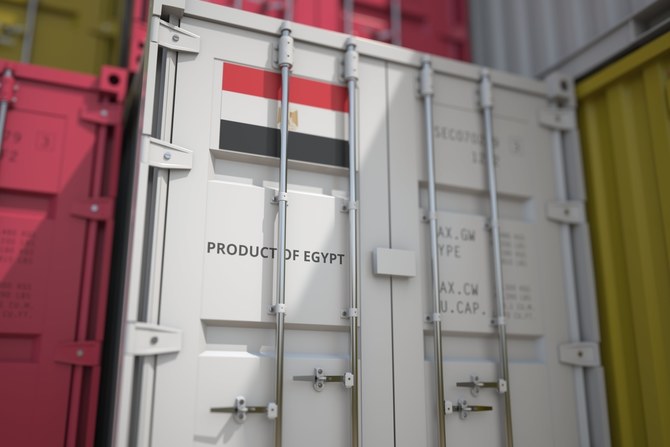
Egypt’s non-oil business shrinks for 41st straight month, PMI shows

The S&P Global Purchasing Managers’ Index for Egypt edged down to 47.4 in April from 47.6 in March, remaining below the 50.0 threshold that separates growth from contraction for a 41st consecutive month.Shutterstock
Short Url
Updated 09 May 2024
Follow

Egypt’s non-oil business shrinks for 41st straight month, PMI shows

CAIRO: Egypt’s non-oil private sector continued to shrink in April despite a $35 billion investment deal signed with the UAE in February and an $8 billion International Monetary Fund agreement in March, a survey showed on Wednesday.

The S&P Global Purchasing Managers’ Index for Egypt edged down to 47.4 in April from 47.6 in March, remaining below the 50.0 threshold that separates growth from contraction for a 41st consecutive month.

“Business activity once again fell markedly as firms commented on difficult market conditions, with the decline leading to a renewed drop in employment,” S&P Global said.

The employment sub-index slipped to 49.7 in April from 50.8 in March.

Egypt signed an agreement with the IMF on March 6, with an initial $820 million payout received in April and a second, $820 million payout expected after an IMF review in June.

In granting the financial support, the IMF cited shocks to the Egyptian economy from the crisis in neighboring Gaza. Egypt devalued its currency on March 6 and hiked interest rates by 600 basis points as part of the deal.

The output sub-index climbed to 44.8 in April from 44.5 in March and the new orders index improved to 45.5 from 45.0. Business sentiment also improved, with the future output expectations index climbing to 55.3 in April from 52.2 in March.

“Sentiment was at a six-month high, reflecting hopes of exchange rate stability, lower prices and better material availability,” S&P Global said.

Meanwhile, global ratings agency Fitch last week revised Egypt’s outlook to positive from stable.

The agency affirmed Egypt’s rating at ‘B-,’ citing reduced external financing risks and stronger foreign direct investment.

Foreign investors have poured billions of dollars into Egyptian treasury bills since the country announced the IMF loan program. After the investment in the country’s foreign portfolio and the support from the UAE, Egypt’s net foreign assets deficit shrank by $17.8 billion in March.

Fitch said that initial steps to contain off-budget spending should help to reduce public debt sustainability risks.

The country straddles North Africa and West Asia and has been grappling with an ongoing economic crisis linked to persistent foreign currency shortages. In the fourth quarter, its foreign debt climbed by $3.5 billion to $168.0 billion.

Meanwhile, Moody’s also revised its outlook on Egypt to “positive” in early March while affirming its ratings due to the high government debt ratio and weaker debt affordability compared to its peers.


PIF’s Humain invests $3bn in Elon Musk’s xAI prior to SpaceX acquisition

Updated 18 February 2026
Follow

PIF’s Humain invests $3bn in Elon Musk’s xAI prior to SpaceX acquisition

JEDDAH: Humain, an artificial intelligence company owned by Saudi Arabia’s Public Investment Fund, invested $3 billion in Elon Musk’s xAI shortly before the startup was acquired by SpaceX.

As part of xAI’s Series E round, Humain acquired a significant minority stake in the company, which was subsequently converted into shares of SpaceX, according to a press release.

The transaction reflects PIF’s broader push to position Saudi Arabia as a central hub in the global AI ecosystem, as part of its Vision 2030 diversification strategy.

Through Humain, the fund is seeking to combine capital deployment with infrastructure buildout, partnerships with leading technology firms, and domestic capacity development to reduce reliance on oil revenues and expand into advanced industries.

The $3 billion commitment offers potential for long-term capital gains while reinforcing the company’s role as a strategic, scaled investor in transformative technologies.

CEO Tareq Amin said: “This investment reflects Humain’s conviction in transformational AI and our ability to deploy meaningful capital behind exceptional opportunities where long-term vision, technical excellence, and execution converge, xAI’s trajectory, further strengthened by its acquisition by SpaceX, one of the largest technology mergers on record, represents the kind of high-impact platform we seek to support with significant capital.” 

The deal builds on a large-scale collaboration announced in November at the US-Saudi Investment Forum, where Humain and xAI committed to developing over 500 megawatts of next-generation AI data center and computing infrastructure, alongside deploying xAI’s “Grok” models in the Kingdom.

In a post on his X handle, Amin said: “I’m proud to share that Humain has invested $3 billion into xAI’s Series E round, just prior to its historic acquisition by SpaceX. Through this transaction, Humain became a significant minority shareholder in xAI.”

He added: “The investment builds on our previously announced 500MW AI infrastructure partnership with xAI in Saudi Arabia, reinforcing Humain’s role as both a strategic development partner and a scaled global investor in frontier AI.”

He noted that xAI’s trajectory, further strengthened by SpaceX’s acquisition, exemplifies the high-impact platforms Humain aims to support through strategic investments.

Earlier in February, SpaceX completed the acquisition of xAI, reflecting Elon Musk’s strategy to integrate AI with space exploration.

The combined entity, valued at $1.25 trillion, aims to build a vertically integrated innovation ecosystem spanning AI, space launch technology, and satellite internet, as well as direct-to-device communications and real-time information platforms, according to Bloomberg.

Humain, founded in August, consolidates Saudi Arabia’s AI initiatives under a single entity. From the outset, its vision has extended beyond domestic markets, participating across the global AI value chain from infrastructure to applications.

The company represents a strategic initiative by PIF to diversify the Kingdom’s economy and reduce oil dependence by investing in knowledge-based and advanced technologies.