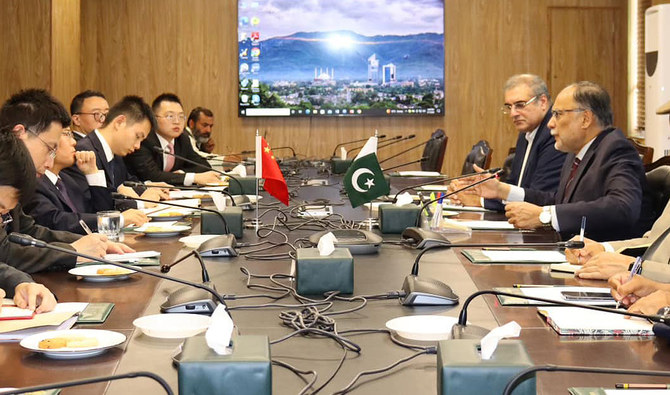
ISLAMABAD: Pakistan’s planning minister has invited China to collaborate with Islamabad in setting up industrial zones to manufacture electric cars amid a renewed push to attract foreign investment, state news agency APP reported on Wednesday.
The government of Pakistan approved an ambitious National Electric Vehicles Policy (NEVP) in 2019 with the goal of electric vehicles comprising 30 percent of all passenger vehicle and heavy-duty truck sales by 2030, and an even more ambitious target of 90 percent by 2040. For two- and three-wheelers, as well as buses, the policy set a goal of achieving 50 percent of new sales by 2030 and 90 percent by 2040.
In a meeting with Chinese officials on Tuesday, Planning Minister Ahsan Iqbal invited them to collaborate on the production of electric cars.
“He emphasized Pakistan’s aim to establish industrial zones for the manufacturing of electric cars in collaboration with China, leveraging Pakistan’s competitive advantage to reduce overall production costs and create employment opportunities for Pakistani workers,” APP reported.
Earlier this year, Sazgar Engineering, one of Pakistan’s leading car manufacturers, unveiled the electric vehicle “ORA 3,” manufactured in collaboration with Chinese car manufacturer Great Wall Motors (GWM).
The urban areas of Pakistan exhibit some of the world’s highest levels of air pollution, primarily due to sub-2.5 μm particulate emissions. This issue significantly impairs both the country’s economy and the quality of life of its residents. Road transport is a significant contributor to air pollution as around 23 percent of Pakistan’s greenhouse gas emissions originate from vehicles.
On Tuesday, Prime Minister Shehbaz Sharif also met a delegation of Japanese industrialists in Islamabad and invited them to invest in Pakistan’s electric automotive industry.
“There is a wide potential for investment in the electric vehicle industry in Pakistan and Japanese companies with the best technology can take full advantage of it,” Sharif told the Japanese group.


![]()

Pakistan invites China to establish industrial zones for electric car manufacturing
Short Url
https://arab.news/c7abz
Pakistan invites China to establish industrial zones for electric car manufacturing
- Earlier this year, Pakistani car maker Sazgar Engineering unveiled electric car made in collaboration with China
- Road transport is significant contributor to pollution as around 23 percent of Pakistan’s greenhouse gases come from vehicles
Latest updates


© 2026 SAUDI RESEARCH & PUBLISHING COMPANY, All Rights Reserved And subject to Terms of Use Agreement.