ISLAMABAD: Pakistan’s planning minister has invited China to collaborate with Islamabad in setting up industrial zones to manufacture electric cars amid a renewed push to attract foreign investment, state news agency APP reported on Wednesday.
The government of Pakistan approved an ambitious National Electric Vehicles Policy (NEVP) in 2019 with the goal of electric vehicles comprising 30 percent of all passenger vehicle and heavy-duty truck sales by 2030, and an even more ambitious target of 90 percent by 2040. For two- and three-wheelers, as well as buses, the policy set a goal of achieving 50 percent of new sales by 2030 and 90 percent by 2040.
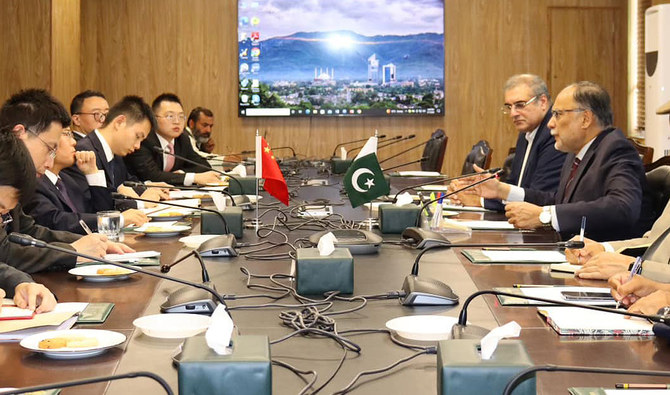
In a meeting with Chinese officials on Tuesday, Planning Minister Ahsan Iqbal invited them to collaborate on the production of electric cars.
“He emphasized Pakistan’s aim to establish industrial zones for the manufacturing of electric cars in collaboration with China, leveraging Pakistan’s competitive advantage to reduce overall production costs and create employment opportunities for Pakistani workers,” APP reported.
Earlier this year, Sazgar Engineering, one of Pakistan’s leading car manufacturers, unveiled the electric vehicle “ORA 3,” manufactured in collaboration with Chinese car manufacturer Great Wall Motors (GWM).
The urban areas of Pakistan exhibit some of the world’s highest levels of air pollution, primarily due to sub-2.5 μm particulate emissions. This issue significantly impairs both the country’s economy and the quality of life of its residents. Road transport is a significant contributor to air pollution as around 23 percent of Pakistan’s greenhouse gas emissions originate from vehicles.
On Tuesday, Prime Minister Shehbaz Sharif also met a delegation of Japanese industrialists in Islamabad and invited them to invest in Pakistan’s electric automotive industry.
“There is a wide potential for investment in the electric vehicle industry in Pakistan and Japanese companies with the best technology can take full advantage of it,” Sharif told the Japanese group.

Pakistan invites China to establish industrial zones for electric car manufacturing
https://arab.news/c7abz
Pakistan invites China to establish industrial zones for electric car manufacturing
- Earlier this year, Pakistani car maker Sazgar Engineering unveiled electric car made in collaboration with China
- Road transport is significant contributor to pollution as around 23 percent of Pakistan’s greenhouse gases come from vehicles
Kazakh president meets Pakistan PM to discuss bilateral trade, regional connectivity
- Kazakhstan seeks access to Arabian Sea ports as Pakistan pushes role as regional transit hub
- Commerce ministers discuss connectivity challenges as Pakistan-Kazakhstan trade push grows
KARACHI: Kazakhstan President Kassym-Jomart Tokayev arrived at Prime Minister Shehbaz Sharif’s official residence in Islamabad on Wednesday for talks with Pakistan’s top political leadership on bilateral trade, cooperation and regional connectivity, with both sides expected to sign several memoranda of understanding (MoUs).
Tokayev arrived in Pakistan a day earlier on a two-day official visit as landlocked Kazakhstan seeks access to maritime trade routes through Pakistan’s southern ports on the Arabian Sea. Islamabad, meanwhile, has been positioning itself as a regional transit hub, with an emphasis on improving physical connectivity with Central Asian states.
Pakistan’s Deputy Prime Minister (DPM) and Foreign Minister (FM) Ishaq Dar called on the Kazakh president earlier in the day to welcome him to the country.
“Welcoming him to Pakistan, DPM/FM extended warm greetings from the President, Prime Minister, Government and people of Pakistan,” the foreign office said in a social media post.
It said Dar underscored Pakistan’s appreciation for the growing momentum of high-level political exchanges and reaffirmed a shared commitment to expand bilateral cooperation across political, economic and people-to-people domains, while working together for durable peace, stability and development in the region.
According to the Kazakh government, bilateral trade between the two countries stood at $53.7 million in 2024. Pakistan’s main exports to Kazakhstan include citrus fruits, pharmaceutical products, garments, soap and sports equipment, while imports largely comprise onions and garlic, dried legumes, oats, buckwheat, seeds and fruits.
Pakistan’s foreign office said a day earlier that Tokayev’s visit would offer an important opportunity to explore new avenues for cooperation, with MoUs expected in areas of mutual interest.
Federal Minister for Commerce Jam Kamal Khan separately held talks on Wednesday with Kazakhstan’s Minister of Trade and Integration Arman Shaqqaliev to review bilateral trade and connectivity.
“The meeting focused extensively on addressing connectivity challenges between Pakistan and Central Asia and identifying practical solutions to unlock the full trade potential between the two countries,” the commerce ministry said.
“Both sides agreed that improved rail, road and multimodal connectivity is fundamental to strengthening Pakistan–Kazakhstan trade and enabling sustainable, long-term economic engagement,” it added.
Shaqqaliev highlighted the strategic importance of major infrastructure projects, particularly rail and road corridors, saying such initiatives could generate trade and investment flows of about $5 billion, create jobs and strengthen regional supply chains.
Khan said Pakistan was keen to enhance direct connectivity with Central Asia through Turkmenistan and Afghanistan, while acknowledging regional and geopolitical challenges.
“Improved transit routes would not only benefit Pakistan and Kazakhstan but also open broader opportunities for regional and global trade, including access to African and ASEAN markets through Pakistan’s ports,” he was quoted as saying.
The two sides discussed cooperation in sectors including agriculture and food security, pharmaceuticals, textiles, sports goods, leather, mining, energy and infrastructure development.
Kazakhstan expressed interest in joint ventures in food processing, agriculture value chains and pharmaceuticals, while Pakistan invited Kazakh investment in mining, minerals and agri-based industries under its investment facilitation framework.
Both ministers also stressed the need for structured business-to-business engagement, agreeing that trade promotion bodies should focus on linking firms, sharing market intelligence and facilitating matchmaking without adding regulatory hurdles.
“They reaffirmed their shared commitment to transforming Pakistan–Kazakhstan economic relations from potential to performance, with a strong focus on connectivity, investment-led growth and regional integration,” the commerce ministry said, adding that sustained coordination and private-sector engagement could significantly boost trade and investment in coming years.