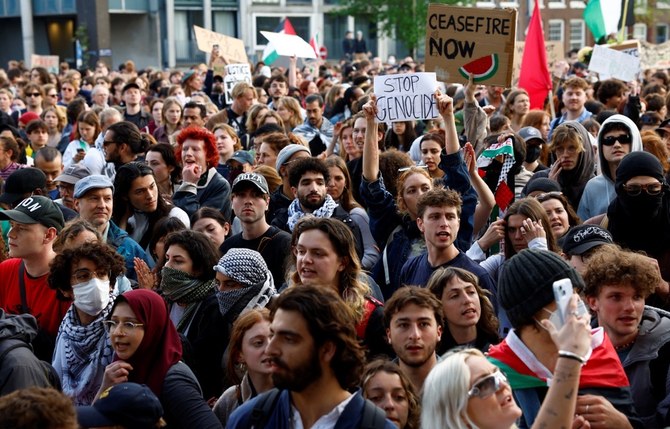
AMSTERDAM: Student protests to demand that universities sever ties with Israel over the Gaza war spread in Europe on Tuesday, sparking clashes and arrests as fresh protests broke out in the Netherlands, Germany, France, Switzerland and Austria.
Students at various European universities, inspired by ongoing demonstrations at US campuses, have been occupying halls and facilities, demanding an end to partnerships with Israeli institutions because of Israel’s punishing assault on Gaza.
Several hundred protesters resumed a demonstration on Tuesday evening around the University of Amsterdam campus, where police the previous night were filmed baton-charging them and smashing up their tents after they refused to leave the campus.
As protests resumed on Tuesday night, demonstrators erected barriers to access routes watched over by a heavy police deployment.
Police said in a statement that a total of 169 people had been arrested when officers broke up Monday night’s protests.
All had been released apart from two who remain in custody on suspicion of public disorder offenses.
Violence had briefly erupted on Monday evening when a small group of counter-protesters wielding flares stormed the main protest.
Around 50 demonstrators were also protesting on Tuesday outside the library in Utrecht University and a few dozen at the Technical University of Delft, according to local news agency ANP.
In the eastern German city of Leipzig, the university said in a statement that 50 to 60 people occupied a lecture hall on Tuesday afternoon, waving banners that read: “University occupation against genocide.”
Protesters barricaded the lecture hall doors from the inside and erected tents in the courtyard, according to the university.
The university called in the police in the afternoon, and filed a criminal complaint.
A pro-Israeli counter-protest also took place in the area, involving about 40 people, police said.
Criminal proceedings have been initiated against 13 people who were in the lecture hall on suspicion of trespassing. No arrests have been made so far.
Earlier, at Berlin’s Free University, police cleared a demonstration after up to 80 people erected a protest camp in a courtyard of the campus.
The protesters, some of whom wore the keffiyeh scarf that has long been a symbol of the Palestinian cause, sat in front of tents and waved banners.
They later tried to enter rooms and lecture halls and occupy them, according to the university, which said it then called in the police to clear the protest.
The university said property was damaged while classes in some buildings were suspended for the day.
Berlin police said they made some arrests for incitement to hatred and trespassing.
In Paris, police on Tuesday twice intervened at Paris’s prestigious Sciences Po university to disperse about 20 students who had barricaded themselves in the university’s main hall.
Police moved in to allow other students to take their exams and made two arrests, according to Paris prosecutors. The university said the exams were able to proceed without incident.
Police have intervened several times over the past week at Sciences Po, where protesters are demanding the university reveal its partnerships with Israeli institutions. Some 13 students are on a hunger strike, according to the university.
At the nearby Sorbonne university building, police moved on Tuesday evening to eject about a hundred students who had occupied an amphitheater for two hours to protest about Gaza, police sources said.
In Switzerland, protests on Tuesday spread to three universities in Lausanne Geneva and Zurich.
The University of Lausanne said in a statement that it “considers that there is no reason to cease these relations” with Israeli universities as protesters demand.
In Austria, dozens of protesters have been camped on the campus of Vienna University, putting up tents and stringing up banners since late on Thursday.
The war in the Gaza Strip was sparked by an unprecedented October 7 attack on Israel by the Palestinian group Hamas, which resulted in the deaths of more than 1,170 people, mostly civilians, according to an AFP tally of Israeli official figures.
Vowing to destroy Hamas, Israel launched a retaliatory offensive that has killed at least 34,789 people in Gaza, mostly women and children, according to the Hamas-run territory’s health ministry.


![]()


Europe student Gaza protests spread, sparking clashes, arrests
Short Url
https://arab.news/mhasn
Europe student Gaza protests spread, sparking clashes, arrests


Hezbollah says targeted Israeli bases, tanks after strikes on Lebanon
BEIRUT: Lebanese militant group Hezbollah said Tuesday it targeted several Israeli military bases and tanks in response to Israeli strikes on the group’s strongholds in Lebanon, including the south Beirut suburbs.
Israel continues to carry out successive air raids, particularly on Beirut’s southern suburbs and the south of the country, after issuing evacuation warnings to residents, while Lebanese authorities on Monday recorded the displacement of more than 58,000 people from areas hit by the strikes.
Israel announced Tuesday morning it had begun a new round of “simultaneous strikes in Tehran and Beirut.”
It announced later that day that it hit “approximately 60” targets “belonging to the Hezbollah and Hamas terrorist organizations.”
The Israeli military also said it had deployed troops to several locations in southern Lebanon in what it described as a “forward defense” measure along the border.
Defense Minister Israel Katz said he “authorized the Israel Defense Forces (IDF) to advance and take control of additional strategic positions in Lebanon in order to prevent attacks on Israeli border communities.”
Lebanon was drawn into the regional war on Monday after an initial attack on Israel by Hezbollah, which said it wanted to “avenge” the killing of Iranian supreme leader Ayatollah Ali Khamenei during the US-Israeli strikes.
Israel promptly launched large-scale strikes on Lebanon, where the government on Monday declared an immediate ban on Hezbollah’s military activities.
In separate statements, Hezbollah on Tuesday claimed responsibility for 11 attacks on Israel, saying it targeted at least five Israeli tanks, three of them in Lebanese territory using guided missiles and “appropriate weapons.”
The group also said it used attack drones and rocket salvos to target several bases in northern Israel and the Golan Heights, occupied by Israel since 1967.
Additionally, it claimed to have downed an Israeli drone over the southern city of Nabatiyeh.
These attacks came “in response to the criminal Israeli aggression on dozens of Lebanese cities and towns,” Hezbollah said.
Since the early morning hours, Beirut’s southern suburbs have been subjected to a series of air strikes targeting several buildings after evacuation warnings.
AFP photographers saw huge plumes of smoke rising into the air and obscuring the sky.
Hezbollah’s Al-Manar TV broadcaster said its Beirut headquarters had been targeted overnight and announced Tuesday morning that Israel targeted the offices of Hezbollah’s Al-Nour radio broadcaster as well.
In a statement, Hezbollah condemned the strikes on “two civilian media outlets” saying they were aimed at “silencing the voice and image of the resistance.”
The southern city of Sidon, largely spared during the last Hezbollah-Israel war, was struck twice on Tuesday.
One strike hit a headquarters belonging to Jamaa Islamiya, an Islamist group allied with Hamas and Hezbollah, and the other came after an evacuation warning elsewhere in the city.
The surroundings of Tyre, further south, were also struck after evacuation warnings.
Israel continues to carry out successive air raids, particularly on Beirut’s southern suburbs and the south of the country, after issuing evacuation warnings to residents, while Lebanese authorities on Monday recorded the displacement of more than 58,000 people from areas hit by the strikes.
Israel announced Tuesday morning it had begun a new round of “simultaneous strikes in Tehran and Beirut.”
It announced later that day that it hit “approximately 60” targets “belonging to the Hezbollah and Hamas terrorist organizations.”
The Israeli military also said it had deployed troops to several locations in southern Lebanon in what it described as a “forward defense” measure along the border.
Defense Minister Israel Katz said he “authorized the Israel Defense Forces (IDF) to advance and take control of additional strategic positions in Lebanon in order to prevent attacks on Israeli border communities.”
Lebanon was drawn into the regional war on Monday after an initial attack on Israel by Hezbollah, which said it wanted to “avenge” the killing of Iranian supreme leader Ayatollah Ali Khamenei during the US-Israeli strikes.
Israel promptly launched large-scale strikes on Lebanon, where the government on Monday declared an immediate ban on Hezbollah’s military activities.
In separate statements, Hezbollah on Tuesday claimed responsibility for 11 attacks on Israel, saying it targeted at least five Israeli tanks, three of them in Lebanese territory using guided missiles and “appropriate weapons.”
The group also said it used attack drones and rocket salvos to target several bases in northern Israel and the Golan Heights, occupied by Israel since 1967.
Additionally, it claimed to have downed an Israeli drone over the southern city of Nabatiyeh.
These attacks came “in response to the criminal Israeli aggression on dozens of Lebanese cities and towns,” Hezbollah said.
Since the early morning hours, Beirut’s southern suburbs have been subjected to a series of air strikes targeting several buildings after evacuation warnings.
AFP photographers saw huge plumes of smoke rising into the air and obscuring the sky.
Hezbollah’s Al-Manar TV broadcaster said its Beirut headquarters had been targeted overnight and announced Tuesday morning that Israel targeted the offices of Hezbollah’s Al-Nour radio broadcaster as well.
In a statement, Hezbollah condemned the strikes on “two civilian media outlets” saying they were aimed at “silencing the voice and image of the resistance.”
The southern city of Sidon, largely spared during the last Hezbollah-Israel war, was struck twice on Tuesday.
One strike hit a headquarters belonging to Jamaa Islamiya, an Islamist group allied with Hamas and Hezbollah, and the other came after an evacuation warning elsewhere in the city.
The surroundings of Tyre, further south, were also struck after evacuation warnings.
Latest updates


© 2026 SAUDI RESEARCH & PUBLISHING COMPANY, All Rights Reserved And subject to Terms of Use Agreement.