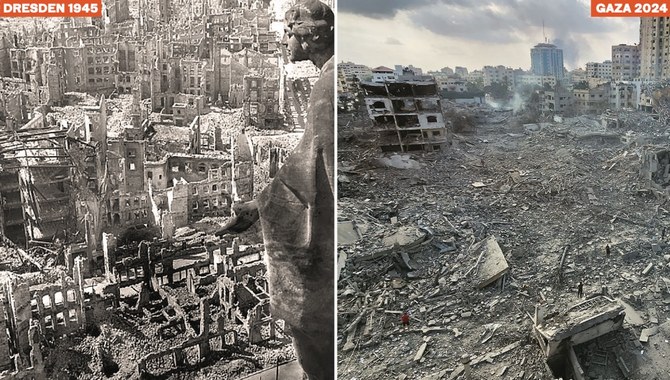
Worse than Dresden 1945: Israel’s Gaza rampage leaves 75% of buildings damaged or destroyed

Short Url
Updated 07 May 2024
Follow

Worse than Dresden 1945: Israel’s Gaza rampage leaves 75% of buildings damaged or destroyed

  • Destruction of Gaza compared to controversial bombing of German city at end of Second World War
  • Israel seizes control of Rafah crossing with Egypt, halting aid

JEDDAH: Israel’s seven-month bombardment of Gaza has caused more destruction than the controversial firebombing of the German city of Dresden near the end of the Second World War, analysts of satellite images said on Tuesday.

Nearly 75 percent of buildings in Gaza City have been damaged or destroyed, five hospitals have been completely destroyed, fewer than one in three hospitals are even partially functioning, 408 schools out of 563 have been damaged and 53 completely destroyed, and more than 60 percent of mosques have been reduced to rubble.

“The fastest rates of destruction were in the first two to three months of the bombardment,” said Corey Scher, a satellite image analyst at the City University of New York in the US. “The rate of damage being registered is unlike anything we have studied before. It is much faster and more extensive than anything we have mapped.”

In comparison, four air raids on Dresden in February 1945 destroyed just under 60 percent of the city’s buildings. US and British bombers dropped more than 3,900 tonnes of high-explosive and incendiary devices that devastated more than 6.5 km2 of the city in one of the most controversial acts of the war.

In Gaza on Tuesday, Israeli forces seized the Rafah border crossing between Egypt and the enclave, shutting down a vital aid route. Tanks rolled through the crossing complex and the Israeli flag was raised on the Gaza side.
There was heavy tank shelling on Tuesday evening in eastern Rafah. “They have gone crazy, tanks are firing shells and smoke bombs cover the skies and with smoke over Al-Salam and Jneinah neighborhoods,” said Emad Joudat, 55, a refugee from Gaza City. “I am now seriously thinking of heading north, maybe to the central Gaza area. If they move further into Rafah it will be the mother of massacres.”

The seizure of the crossing came despite weeks of calls from allies and international bodies for Israel to hold off from a major offensive in the city. Israel’s military said it was conducting a limited operation in Rafah to kill Hamas fighters and dismantle its infrastructure.

Meanwhile there was confusion in Israel after Prime Minister Benjamin Netanyahu rejected a ceasefire proposal that Hamas accepted on Monday night. One Israeli official said the plan was almost identical to Israel’s own truce proposal submitted at the end of April, with some minor amendments.

However, Netanyahu said on Tuesday that the ceasefire plan fell “far short” of Israel’s demands. Talks on a truce continue in Cairo.


Death toll in Iran protests over 3,000, rights group says

Updated 7 sec ago
Follow

Death toll in Iran protests over 3,000, rights group says

  • The protests erupted on December 28 over economic hardship and swelled into widespread demonstrations calling for the end of clerical rule
  • President Donald Trump, who had threatened ‘very strong action’ if Iran executed protesters, said Tehran’s leaders had called off mass hangings

DUBAI: More than 3,000 people have died in Iran’s nationwide protests, rights activists said on Saturday, while a “very slight rise” in Internet activity was reported in the country after an eight-day blackout.

The US-based HRANA ​group said it had verified 3,090 deaths, including 2,885 protesters, after residents said the crackdown appeared to have broadly quelled protests for now and state media reported more arrests.

The capital Tehran has been comparatively quiet for four days, said several residents reached by Reuters. Drones were flying over the city, but there were no signs of major protests on Thursday or Friday, said the residents, who asked not to be identified ‌for their safety.

A ‌resident of a northern city on the ‌Caspian ⁠Sea ​said ‌the streets there also appeared calm.

The protests erupted on December 28 over economic hardship and swelled into widespread demonstrations calling for the end of clerical rule in the Islamic Republic, culminating in mass violence late last week. According to opposition groups and an Iranian official, more than 2,000 people were killed in the worst domestic unrest since Iran’s 1979 Islamic Revolution.

“Metrics show a very ⁠slight rise in Internet connectivity in #Iran this morning” after 200 hours of shutdown, the ‌Internet monitoring group NetBlocks posted on X. Connectivity ‍remained around 2 percent of ordinary levels, ‍it said.

A few Iranians overseas said on social media that ‍they had been able to message users living inside Iran early on Saturday.

US President Donald Trump, who had threatened “very strong action” if Iran executed protesters, said Tehran’s leaders had called off mass hangings.

“I greatly respect the fact that all scheduled ​hangings, which were to take place yesterday (Over 800 of them), have been canceled by the leadership of Iran. Thank you!” he ⁠posted on social media.

Iran had not announced plans for such executions or said it had canceled them.

Indian students and pilgrims returning from Iran said they were largely confined to their accommodations while in the country, unable to communicate with their families back home.

“We only heard stories of violent protests, and one man jumped in front of our car holding a burning baton, shouting something in the local language, with anger visible in his eyes,” said Z Syeda, a third-year medical student at a university in Tehran.

India’s External Affairs Ministry said on Friday that commercial flights were available and that ‌New Delhi would take steps to secure the safety and welfare of Indian nationals.