

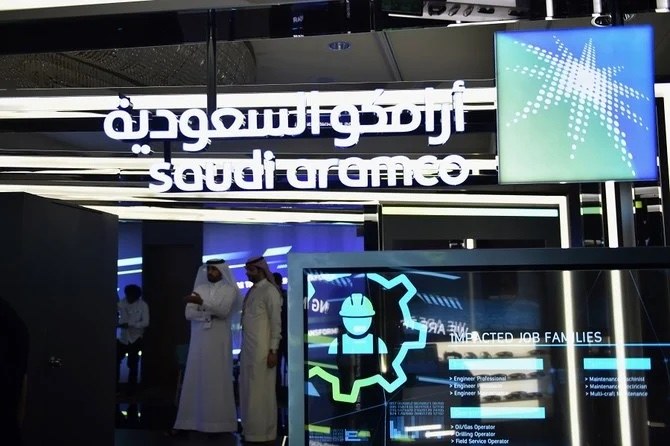

RIYADH: Energy giant Saudi Aramco reported a net profit of $27.27 billion in the first three months of this year, marking a 2.04 percent increase compared to the previous quarter.
According to the company’s statement, the state-owned oil firm’s total revenue for the the three months to the end of March stood at $107.21 billion, with the total operating income for the period reaching $58.88 billion.
Amin Nasser, president and CEO of Saudi Aramco, said: “Our first quarter performance reflects the resilience and strength of Aramco, reinforcing our position as a leading supplier of energy to economies, to industries and to people worldwide.”
However, when compared with the first quarter of the previous year, the net profit of the Tadawul-listed firm declined by 14.44 percent by the end of March 2024.
Despite lower net income, Aramco declared a base dividend of $20.3 billion for the first three months of the year and anticipates distributing its fourth performance-linked dividend of $10.8 billion in the second quarter.
The statement added that the company expects total dividends of $124.3 billion to be declared in 2024, comprising a base dividend of $81.2 billion and a performance-linked dividend of $43.1 billion.
Nasser revealed that Saudi Aramco made significant progress in its gas business during the first quarter.
“We also continue to execute our long-term strategy, and in the first quarter made significant progress on expanding our gas business and growing our globally-integrated downstream value chain, while maintaining our focus on consistently delivering value for our shareholder,” he added.
In February, the energy giant discovered an additional 15 trillion standard cubic feet of gas and 2 billion barrels of condensate in the Kingdom’s Jafurah Field.
Additionally, the statement noted that Saudi Aramco awarded $7.7 billion worth of engineering, procurement, and construction contracts for the expansion of the Fadhili Gas Plant, aiming to increase its processing capacity by 1.5 billion standard cubic feet per day.
Moreover, Aramco completed the acquisition of a 100 percent equity stake in Chilean retailer Esmax in the third quarter of 2023, bolstering the company's downstream expansion efforts.
“Looking ahead, I expect our portfolio to continue to evolve as we aim to contribute to an energy transition that offers solutions to climate challenges, but at the same time recognizes the need for affordable, reliable, and flexible energy supplies,” added Nasser.
The statement further added that Saudi Aramco is well-positioned to help meet the world’s growing need for affordable and reliable energy, emphasizing that oil and gas will continue to play a significant role in the global energy mix.
Additionally, the company noted that it achieved a total hydrocarbon production of 12.4 million barrels of oil equivalent in the first quarter of this year.
Highlighting Aramco’s commitment to sustainability, the energy giant announced its intention to ramp up its utilization of renewable energy sources, aiming to invest in up to 12 gigawatts of solar photovoltaic and wind projects by 2030.
In January, the Sudair Solar PV Plant, one of the largest solar installations in the region boasting a capacity of 1.5 GW, achieved full-capacity operation. This project is a joint venture between Aramco, Saudi Arabia’s sovereign wealth fund, and utility developer ACWA Power.


