

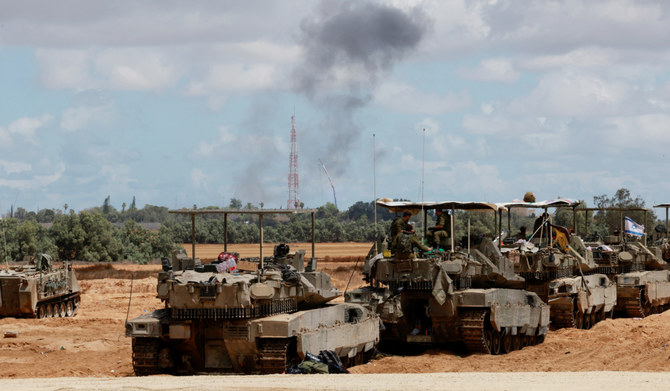


JERUSALEM: A Palestinian security official and an Egyptian official say Israeli tanks entered the southern Gaza town of Rafah, reaching as close as 200 meters (yards) from its crossing with neighboring Egypt.
The Egyptian official said the operation appeared to be limited in scope. He and Hamas’ Al-Aqsa TV said Israeli officials informed the Egyptians that the troops would withdraw after completing the operation.
The Israeli military declined to comment. On Sunday, Hamas fighters near the Rafah crossing fired mortars into southern Israel, killing four Israeli soldiers.
The Egyptian official, located on the Egyptian side of Rafah, and the Palestinian security official spoke on condition of anonymity because they were not authorized to talk to the press.
The Associated Press could not independently verify the scope of the operation.
Earlier Monday, Israel’s War Cabinet decided to push ahead with a military operation in Rafah, after Hamas announced its acceptance of an Egyptian-Qatari proposal for a ceasefire deal. The Israeli military said it was conducting “targeted strikes” against Hamas in Rafah without providing details.
Hamas announced its acceptance Monday of an Egyptian-Qatari ceasefire proposal, but Israel said the deal did not meet its “core demands” and that it was pushing ahead with an assault on the southern Gaza town of Rafah. Still, Israel said it would continue negotiations.
The high-stakes diplomatic moves and military brinkmanship left a glimmer of hope alive — but only barely — for an accord that could bring at least a pause in the 7-month-old war that has devastated the Gaza Strip. Hanging over the wrangling was the threat of an all-out Israeli assault on Rafah, a move the United States strongly opposes and that aid groups warn will be disastrous for some 1.4 million Palestinians taking refuge there.
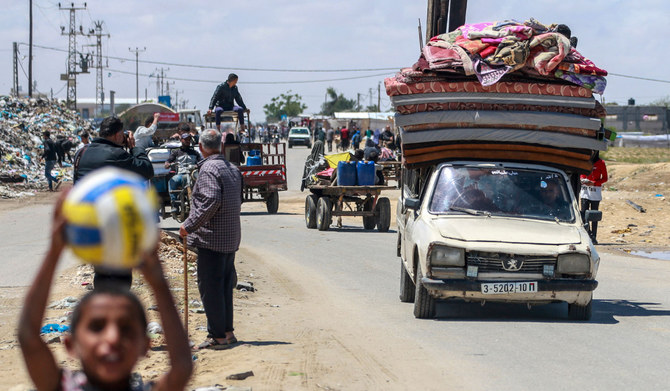
Hamas’s abrupt acceptance of the ceasefire deal came hours after Israel ordered an evacuation of some 100,000 Palestinians from eastern neighborhoods of Rafah, signaling an invasion was imminent.
Israel’s War Cabinet decided to continue the Rafah operation, Prime Minister Benjamin Netanyahu’s office said. At the same time, it said that while the proposal Hamas agreed to “is far from meeting Israel’s core demands,” it would send negotiators to Egypt to work on a deal.
The Israeli military said it was conducting “targeted strikes” against Hamas in eastern Rafah. The nature of the strikes was not immediately known, but the move appeared aimed at keeping the pressure on as talks continue.
President Joe Biden spoke with Prime Minister Benjamin Netanyahu and reiterated US concerns about an invasion of Rafah. US State Department spokesman Matthew Miller said American officials were reviewing the Hamas response “and discussing it with our partners in the region.” An American official said the US was examining whether what Hamas agreed to was the version signed off to by Israel and international negotiators or something else.
It was not immediately known if the proposal Hamas agreed to was substantially different from one that US Secretary of State Antony Blinken pressed the militant group to accept last week, which Blinken said included significant Israeli concessions.
Egyptian officials said that proposal called for a ceasefire of multiple stages starting with a limited hostage release and partial Israeli troop pullbacks within Gaza. The two sides would also negotiate a “permanent calm” that would lead to a full hostage release and greater Israeli withdrawal out of the territory, they said.
Hamas sought clearer guarantees for its key demand of an end to the war and complete Israeli withdrawal in return for the release of all hostages, but it wasn’t clear if any changes were made.
Israeli leaders have repeatedly rejected that trade-off, vowing to keep up their campaign until Hamas is destroyed after its Oct. 7 attack on Israel that triggered the war.
Netanyahu is under pressure from hard-line partners in his coalition who demand an attack on Rafah and could collapse his government if he signs onto a deal. But he also faces pressure from the families of hostages to reach a deal for their release.
Thousands of Israelis rallied around the country Monday night calling for an immediate agreement. About a thousand protesters swelled near the defense headquarters in Tel Aviv, where police tried to clear the road. In Jerusalem, about a hundred protesters marched toward Netanyahu’s residence with a banner reading, “The blood is on your hands.”
Israel says Rafah is the last significant Hamas stronghold in Gaza, and Netanyahu said Monday that the offensive against the town was vital to ensuring the militants can’t rebuild their military capabilities.
But he faces strong American opposition. Miller said Monday the US has not seen a credible and implementable plan to protect Palestinian civilians. “We cannot support an operation in Rafah as it is currently envisioned,” he said.
The looming operation has raised global alarm. Aid agencies have warned that an offensive will bring a surge of more civilian deaths in an Israeli campaign that has already killed 34,000 people and devastated the territory. It could also wreck the humanitarian aid operation based out of Rafah that is keeping Palestinians across the Gaza Strip alive, they say.
UN High Commissioner for Human Rights Volker Türk on Monday called the evacuation order “inhumane.”
“Gazans continue to be hit with bombs, disease, and even famine. And today, they have been told that they must relocate yet again,” he said. “It will only expose them to more danger and misery.”
Israeli leaflets, text messages and radio broadcasts ordered Palestinians to evacuate eastern neighborhoods of Rafah, warning that an attack was imminent and anyone who stays “puts themselves and their family members in danger.”
The military told people to move to an Israel-declared humanitarian zone called Muwasi, a makeshift camp on the coast. It said Israel has expanded the size of the zone and that it included tents, food, water and field hospitals.
It wasn’t immediately clear, however, if that was already in place.
Around 450,000 displaced Palestinians already are sheltering in Muwasi. The UN agency for Palestinian refugees, known as UNRWA, said it has been providing them with aid. But conditions are squalid, with few sanitation facilities in the largely rural area, forcing families to dig private latrines.
Jan Egeland, secretary-general of the Norwegian Refugee Council, condemned the “forced, unlawful” evacuation order to Muwasi.
“The area is already overstretched and devoid of vital services,” Egeland said.
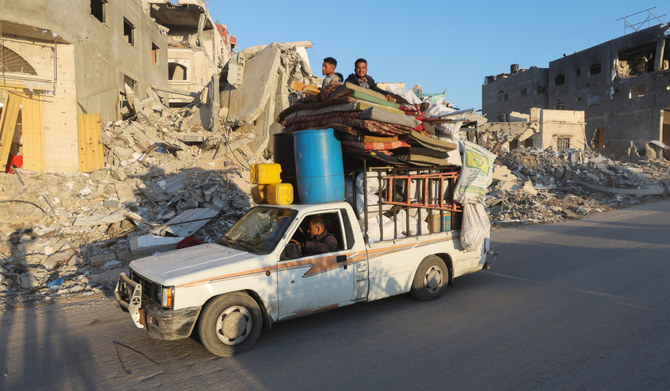
The evacuation order left Palestinians in Rafah wrestling with having to uproot their families once again for an unknown fate, exhausted after months living in sprawling tent camps or crammed into schools or other shelters in and around the city. Israeli airstrikes on Rafah early Monday killed 22 people, including children and two infants.
Mohammed Jindiyah said that at the beginning of the war, he tried to hold out in his home in northern Gaza under heavy bombardment before fleeing to Rafah.
He is complying with Israel’s evacuation order this time, but was unsure whether to move to Muwasi or elsewhere.
“We are 12 families, and we don’t know where to go. There is no safe area in Gaza,” he said.
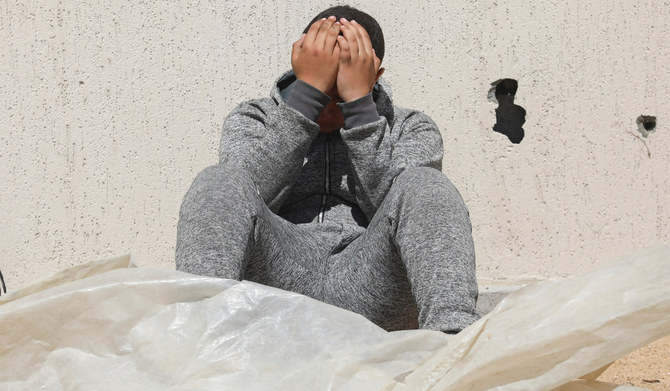
Sahar Abu Nahel, who fled to Rafah with 20 family members, including her children and grandchildren, wiped tears from her cheeks, despairing at a new move.
“I have no money or anything. I am seriously tired, as are the children,” she said. “Maybe it’s more honorable for us to die. We are being humiliated.”
Israel’s bombardment and ground offensives in Gaza have killed more than 34,700 Palestinians, around two-thirds of them children and women, according to Gaza health officials. The tally doesn’t distinguish between civilians and combatants. More than 80 percent of the population of 2.3 million have been driven from their homes, and hundreds of thousands in the north are on the brink of famine, according to the UN
The war was sparked by the unprecedented Oct. 7 raid into southern Israel in which Palestinian militants killed around 1,200 people, mostly civilians, and abducted some 250 hostages. After exchanges during a November ceasefire, Hamas is believed to still hold about 100 Israelis as well the bodies of around 30 others.


