

New York’s Columbia University cancels graduation ceremony as students remain defiant

1 / 2
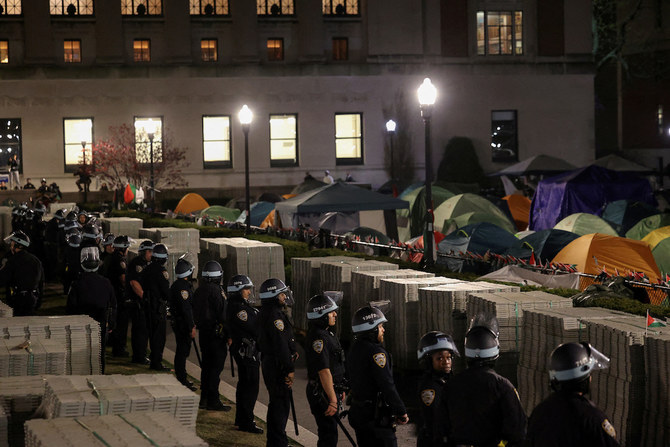
Police stand guard near an encampment of protesters supporting Palestinians on the grounds of Columbia University in New York, April 30, 2024. (Reuters)Police stand guard near an encampment of protesters supporting Palestinians on the grounds of Columbia University in New York, April 30, 2024. (Reuters)
2 / 2
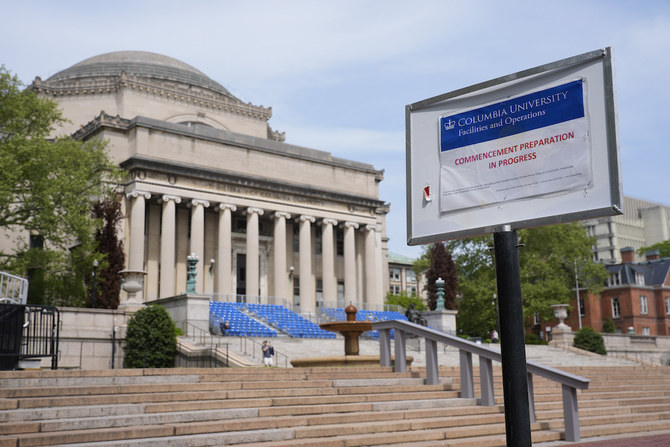
A sign notifies pedestrians of preparations for a large graduation ceremony on the campus of Columbia University in New York, May 6, 2024. (AP)
Short Url
Updated 06 May 2024
Follow

New York’s Columbia University cancels graduation ceremony as students remain defiant

  • Pro-Palestinian protests put paid to event planned for May 15

NEW YORK: New York’s prestigious Columbia University has announced that it is canceling its main graduation ceremony, scheduled for next week, because of ongoing pro-Palestinian protests.

The announcement on Monday is the latest development in a movement that began nearly three weeks ago at Columbia and has swept college campuses nationwide.

The graduation ceremony had been scheduled for May 15 on the south lawn of the Manhattan campus, where protest encampments had been based before authorities dismantled them last week.

The Ivy League institution said it would “forego the university-wide ceremony” and hold a series of smaller events instead.

“We are determined to give our students the celebration they deserve, and that they want,” Columbia announced, saying “smaller-scale, school-based celebrations are most meaningful to them and their families.”

The university added: “We will focus our resources on those school ceremonies and on keeping them safe, respectful, and running smoothly. A great deal of effort is already underway to reach that goal.”

Students across the US have protested and set up tents at dozens of universities to register their opposition to the war in Gaza, while calling on President Joe Biden to do more to stop the bloodshed.

They have also demanded their institutions cease supporting companies that support Israel’s government.

Maya James, a psychology student at Columbia, told Arab News: “Seeing the university’s really insane response to student protests has brought so many people together, because I feel like most people on this campus can agree, including faculty, that students should not be penalized for expressing their First Amendment rights to protest, to petition, to do all of these things we’ve been encouraged to do for so long.”

She called on the university to give amnesty to students who had been suspended for expressing their First Amendment rights, which protect freedom of speech, the press, assembly, and the right to petition.

James also called on the university to disclose its investments because as “of right now there’s no visibility for us students to be able to know what the university is expected to do.”

She described the “vibes” at the protest sites as “absolutely remarkable,” with cultural and educational programs being offered and all kinds of activities being held.

She said the demonstrations were a continuation of Columbia’s long tradition of protest which began in the 1960s with its opposition to the involvement of the US in the Vietnam War.

James said it was “incredible” to see the solidarity for the Palestinian cause spread in campuses across the US, and people pushing to ensure “that we do indeed see a free Palestine within our lifetime and that our universities are no longer complicit in the genocide.”

Demonstrators have gathered on at least 40 US university campuses since April 17, often erecting tent camps to protest against the soaring death toll in the Gaza Strip. Nearly 2,000 people have been detained, according to the US media.

Police officers have forcibly ended several student sit-ins in recent days, including one at New York University at the request of its administrators.

Demonstrators had barricaded themselves inside Columbia, the epicenter of student protests in New York, and some complained about police brutality when officers cleared the faculty.

(With Agencies)


Russia says Ukraine attacked Putin’s home, Kyiv calls this ‘lie’

Satellite imagery shows Vladimir Putin’s residential complex in Roshchino, Novgorod Region, Russia August 31, 2023. (Reuters)
Updated 29 December 2025
Follow

Russia says Ukraine attacked Putin’s home, Kyiv calls this ‘lie’

  • Zelensky called Russia’s claim “complete fabrication” designed to derail peace process, suggested Moscow was preparing to intensify bombardment of Ukraine

KYIV: Russia accused Ukraine on Monday of having fired dozens of drones at one of President Vladimir Putin’s homes, an accusation that Ukraine called a “lie” aimed at undermining US-led efforts to end the war.
Russian Foreign Minister Sergei Lavrov, who does not typically announce drone strikes, said Ukraine had fired “91 long-range unmanned aerial vehicles” at Putin’s residence in the Novgorod region between late Sunday and early Monday, all of which were shot down.
“Given the complete degeneration of the criminal Kyiv regime, which has shifted to a policy of state terrorism, Russia’s negotiating position will be reconsidered,” Lavrov said, without elaborating.
Ukrainian President Volodymyr Zelensky, who met with US President Donald Trump on Sunday for talks on ending the war, called Russia’s claim “a complete fabrication” designed to derail the peace process and suggested Moscow was preparing to intensify its bombardment of Ukraine.
“Russia is at it again, using dangerous statements to undermine all achievements of our shared diplomatic efforts with President Trump’s team,” the Ukrainian leader wrote on X.
Russia’s accusation comes at a pivotal moment in the peace process.
Ukraine says it has agreed to 90 percent of a US-drafted peace plan — including the issue of post-war security guarantees — though the issue of territory in a post-war settlement remains unresolved.
Russia, which has stayed silent about what parts of the US plan it has agreed to, said Monday it was still committed to the peace process but would “revise” its position in light of the alleged drone attack.
Russia invaded Ukraine in February 2022, describing it as a “special military operation” to demilitarise the country and prevent the expansion of NATO.
Kyiv and its European allies say the war, the largest and deadliest on European soil since World War II, is an unprovoked and illegal land grab that has resulted in a tidal wave of violence and destruction.
Territory main sticking point
Trump has held talks with both sides in recent days, including a phone call with Putin on Monday that the White House described as “positive.”
During talks with Zelensky on Sunday, Trump offered Kyiv long-sought-after security guarantees for a period of 15 years, according to Kyiv.
But the issue of territory and the future of the Moscow-occupied Zaporizhzhia nuclear power plant in southern Ukraine remain unresolved, Zelensky said.
Zelensky said Monday that Kyiv was ready for “any” format of meetings — including with Putin if necessary — but said he still did not think the Kremlin chief wanted peace.
The current plan, revised after weeks of intense US-Ukrainian negotiations, would stop the war at the current frontlines in the eastern Donbas region and establish a demilitarised area.
But the Kremlin has shown no sign of compromise.
Putin said Monday that Russia was pressing ahead with its plan to capture four Ukrainian regions it announced the annexation of in 2022 and that his troops were “confidently advancing.”
Moscow on Monday said it took another village, Dibrova, in Ukraine’s eastern Donetsk region.