

Riyadh forum highlights importance of cultural identity and Arab heritage

1 / 3
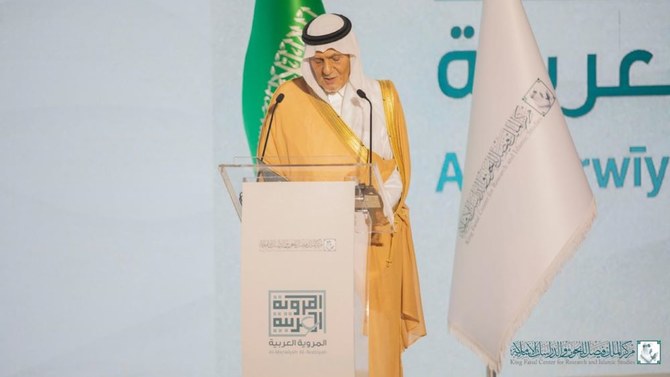
Chairman of the King Faisal Center for Research and Islamic Studies Prince Turki Al-Faisal. (Supplied)
2 / 3
President of the Motoko Katakura Foundation for Desert Culture Katakura Kunio. (Supplied)
3 / 3
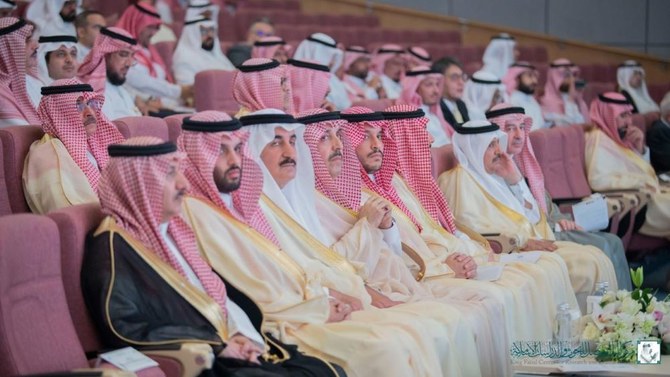
Attendees at the Al-Marwiyah Al-Arabiyah Conference. (Supplied)
Short Url
Updated 06 May 2024
Follow

Riyadh forum highlights importance of cultural identity and Arab heritage

  • Scholars, officials, experts explore and celebrate Arabian Peninsula
  • Katakura Kunio said that both Japanese and Islamic cultures had historic roots in promoting peace

RIYADH: The Al-Marwiyah Al-Arabiyah Conference, called “Desert Culture,” concluded on Monday in Riyadh. The two-day event brought together a diverse group of scholars, officials, and experts to explore and celebrate the rich cultural heritage of the Arabian Peninsula.

Prince Turki Al-Faisal, the chairman of the King Faisal Center for Research and Islamic Studies, said that nomadism was central to Arab culture, emphasizing its roots in values over materialism. He noted that Arabs were natural storytellers, adept at turning chaos into clarity.

Katakura Kunio, president of the Motoko Katakura Foundation for Desert Culture in Japan, delivered a speech in memory of his late wife, anthropologist Motoko Katakura, which highlighted her research in Saudi Arabia.

Kunio said: “Motoko’s enduring passion for comfort inspired our foundation to establish the Comfort Prize, aimed at supporting both Japanese and international researchers and artists. This award honors individuals who dedicate their lives to enriching desert culture.

“In the current climate of positive change within Saudi Arabia, including the increased societal participation of women and the focus on tourism development, it is natural to re-evaluate the traditional value of comfort. Perhaps, in a world increasingly driven by hyper-capitalism, comfort can offer a remedy for the global population yearning for a slower pace.”

Kunio said that both Japanese and Islamic cultures had historic roots in promoting peace. He noted that Prince Shotoku of Japan endorsed “respect for peace” in his 17-Article Constitution, while the Prophet Muhammad established the Madinah Charter, which also emphasized peace and tolerance. These parallels suggested a common ground for fostering cross-cultural understanding, he added.

Abdullah Hamidaddin, assistant secretary-general for scientific affairs at the KFCRIS, described Al–Marwiyah Al-Arabiyah as a research initiative which aimed to address confusion about Arab civilization. It sought to combat attempts to undermine and marginalize Arab culture.

Hamidaddin said that the project used scientific methods to study Arab narratives and the origin of language in the Arabian Peninsula, while promoting dialogues, field studies, and critical analyses in various fields, including history, archaeology, sociology, philosophy, literature, and art.

The conference aimed to highlight the civilizational and cultural significance of the Arabian Peninsula, while seeking to strengthen the sense of Arab identity for future generations. It also promoted cultural exchange between the Arab world and neighboring regions.

A lecture titled “Gifts of God (Camels),” by Sulaiman Al-Theeb, cultural adviser at the center, was presented during the conference.

He spoke of the Arabian Peninsula’s deep connection with camels through three key concepts: rock and mural art; archaeological finds, like daily tools; and references to camels in ancient Arabic inscriptions, especially Thamudic writings.

Al-Theeb highlighted the significant status of camels in the region, which has earned them the moniker “the ship of the desert.”

Mohammed Al-Rowaily, a member of the Cultural Council at the Abdulrahman Al-Sudairy Cultural Center, said that the Arabic narrative played a crucial role in sharing ideas with others. He noted that Arabic storytelling enhanced cross-cultural understanding by conveying elements from history, oral literature, civilization, arts, and other creative works.

Hajar Al-Shammari, a linguistic researcher in Saudi history, said that the event boosted cultural engagement by fostering dialogue and cultural exchange among academics. Through the sharing of ideas it helped to establish a foundation for field studies and critical analyses focused on Arab perceptions and identity.

Al-Shammari added that Arabic storytelling played a significant role in promoting social cohesion, fulfilling the search for roots, and reinforcing values. This was especially important in the context of cultural identity and Arab heritage.


From historic desert landscapes to sound stages: AlUla’s bid to become the region’s film capital

Updated 07 February 2026
Follow

From historic desert landscapes to sound stages: AlUla’s bid to become the region’s film capital

DUBAI: AlUla is positioning itself as the center of cinema for the MENA region, turning its dramatic desert landscapes, heritage sites and newly built studio infrastructure into jobs, tourism and long‑term economic opportunity.

In a wide‑ranging interview, Zaid Shaker, executive director of Film AlUla, and Philip J. Jones, chief tourism officer for the Royal Commission for AlUla, laid out an ambitious plan to train local talent, attract a diverse slate of productions and use film as a catalyst for year‑round tourism.

“We are building something that is both cultural and economic,” said Shaker. “Film AlUla is not just about hosting productions. It’s about creating an entire ecosystem where local people can come into sustained careers. We invested heavily in facilities and training because we want AlUla to be a place where filmmakers can find everything they need — technical skill, production infrastructure and a landscape that offers limitless variety. When a director sees a location and says, ‘I can shoot five different looks in 20 minutes,’ that changes the calculus for choosing a destination.”

At the core of the strategy are state‑of‑the‑art studios operated in partnership with the MBS Group, which comprises Manhattan Beach Studios — home to James Cameron’s “Avatar” sequels. “We have created the infrastructure to compete regionally and internationally,” said Jones. “Combine those studios with AlUla’s natural settings and you get a proposition that’s extremely attractive to producers; controlled environment and unmatched exterior vistas within a short drive. That versatility is a real selling point. We’re not a one‑note destination.”

The slate’s flagship project, the romantic comedy “Chasing Red,” was chosen deliberately to showcase that range. “After a number of war films and heavy dramas shot here, we wanted a rom‑com to demonstrate the breadth of what AlUla offers,” said Shaker. “‘Chasing Red’ uses both our studio resources and multiple on‑location settings. It’s a story that could have been shot anywhere — but by choosing AlUla we’re showing how a comical, intimate genre can also be elevated by our horizons, our textures, our light.

“This film is also our first under a broader slate contract — so it’s a proof point. If ‘Chasing Red’ succeeds, it opens the door for very different kinds of storytelling to come here.”

Training and workforce development are central pillars of the program. Film AlUla has engaged more than 180 young Saudis in training since the start of the year, with 50 already slated to join ongoing productions. “We’re building from the bottom up,” said Shaker. “We start with production assistant training because that’s often how careers begin. From there we provide camera, lighting, rigging and data-wrangling instruction, and we’ve even launched soft‑skill offerings like film appreciation— courses that teach critique, composition and the difference between art cinema and commercial cinema. That combination of technical and intellectual training changes behavior and opens up real career pathways.”

Jones emphasized the practical benefits of a trained local workforce. “One of the smartest strategies for attracting productions is cost efficiency,” he said. “If a production can hire local, trained production assistants and extras instead of flying in scores of entry‑level staff, that’s a major saving. It’s a competitive advantage. We’ve already seen results: AlUla hosted 85 productions this year, well above our initial target. That momentum is what we now aim to convert into long‑term growth.”

Gender inclusion has been a standout outcome. “Female participation in our training programs is north of 55 percent,” said Shaker. “That’s huge. It’s not only socially transformative, giving young Saudi women opportunities in an industry that’s historically male-dominated, but it’s also shaping the industry culture here. Women are showing up, learning, and stepping into roles on set.”

Looking to 2026, their targets are aggressive; convert the production pipeline into five to six feature films and exceed 100 total productions across film, commercials and other projects. “We want private-sector partners to invest in more sound stages so multiple productions can run concurrently,” said Jones. “That’s how you become a regional hub.”

The tourism case is both immediate and aspirational. “In the short term, productions bring crews who fill hotels, eat in restaurants and hire local tradespeople,” said Shaker. “In the long term, films act as postcards — cinematic invitations that make people want to experience a place in person.”

Jones echoed that vision: “A successful film industry here doesn’t just create jobs; it broadcasts AlUla’s beauty and builds global awareness. That multiplies the tourism impact.”

As “Chasing Red” moves into production, Shaker and Jones believe AlUla can move from an emerging production destination to the region’s filmmaking epicenter. “We’re planting seeds for a cultural sector that will bear economic fruit for decades,” said Shaker. “If we get the talent, the infrastructure and the stories right, the world will come to AlUla to film. And to visit.”
