TEHRAN: UN atomic watchdog chief Rafael Grossi arrived in Iran Monday, where he is expected to speak at a conference and meet officials for talks on Tehran’s nuclear program.
The visit comes at a time of heightened regional tensions and with the International Atomic Energy Agency (IAEA) criticizing Iran for lack of cooperation on inspections and other outstanding issues.
News agencies reported Grossi’s arrival “at the head of a delegation to participate in the nuclear conference and negotiate with top nuclear and political officials of the country.”
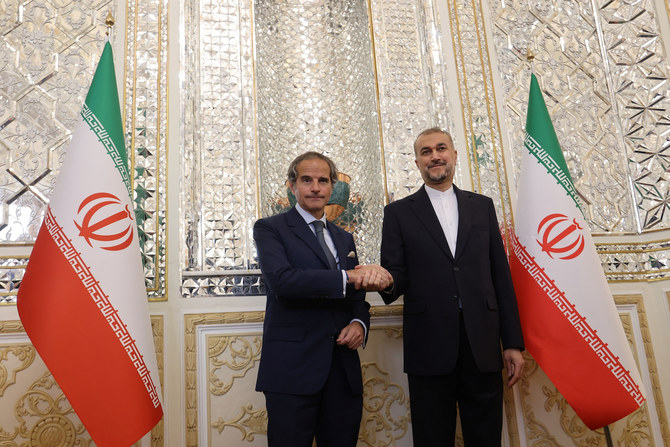
He met with Foreign Minister Hossein Amir-Abdollahian and is scheduled to meet Atomic Energy Organization of Iran chief Mohammad Eslami.
Grossi later said in a post on X, formerly Twitter, that at his meeting with the foreign minister he proposed “concrete practical measures” with the “aim of restoring process of confidence building and increasing transparency.”
Grossi is also expected to deliver a speech at Iran’s first International Conference on Nuclear Science and Technology, which began on Monday.
At its opening ceremony, Eslami expressed hopes of cooperation with the IAEA, saying this was “at the forefront of the Islamic republic of Iran’s policies.”
“We hope that the agency can play its role as an independent international institution free from political pressures,” he added.
The three-day event is being held in Isfahan province, home to the Natanz uranium enrichment plant and where strikes attributed to Israel hit last month.
IAEA and Iranian officials reported “no damage” to nuclear facilities after the reported attack on Isfahan.
This was widely seen as Israel’s response to Iran’s first-ever direct attack on its arch-foe days earlier, which itself was retaliation for a deadly strike on Tehran’s Damascus consulate.
On Wednesday Eslami said he was “sure that these negotiations will further help clear ambiguities, and we will be able to strengthen our relations with the agency.”
Iran has in recent years deactivated IAEA monitoring devices at its nuclear facilities and barred inspectors, according to the UN agency.
Grossi last visited in March 2023 and met top officials including President Ebrahim Raisi.
Iran has suspended its compliance with caps on nuclear activities set by a landmark 2015 deal with major powers after the United States in 2018 unilaterally withdrew from the agreement and reimposed sweeping sanctions.
Tensions between Iran and the IAEA have repeatedly flared since the deal fell apart, and EU-mediated efforts have so far failed both to bring Washington back on board and to get Tehran to again comply with the terms of the accord.
Last year, Iran slowed the pace of its uranium enrichment, which was seen as a goodwill gesture while informal talks began with the United States.
But the Vienna-based UN nuclear agency said Iran accelerated the production of 60-percent enriched uranium in late 2023.
Enrichment levels of around 90 percent are required for military use.
Tehran has consistently denied wanting to develop nuclear weapons, insisting that its atomic activities were entirely peaceful.
In February, the IAEA said in a confidential report seen by AFP that Iran’s estimated stockpile of enriched uranium had reached 27 times the limit set out in the 2015 accord.
On Sunday, the official IRNA news agency said Grossi’s visit provided “an opportunity for the two sides to share their concerns,” especially regarding IAEA inspectors.
Iran in September withdrew the accreditation of several inspectors, a move the UN agency described at the time as “extreme and unjustified.”
Tehran said its decision was a consequence of “political abuses” by the United States, France, Germany and Britain.
Eslami has previously said the IAEA has “more than 130 inspectors” working in Iran.
On Monday, he insisted that the UN body carries out more inspections in Iran than in any other part of the world.
“Our nuclear capacity is 3 percent of the world and the (IAEA) inspection stands at 22 percent,” he said.


![]()

IAEA chief in Iran as concern grows over nuclear activity
Short Url
https://arab.news/9dscr
IAEA chief in Iran as concern grows over nuclear activity
- Grossi met with Foreign Minister Hossein Amir-Abdollahian and is scheduled to meet Atomic Energy Organization of Iran chief Mohammad Eslami


Latest updates


© 2026 SAUDI RESEARCH & PUBLISHING COMPANY, All Rights Reserved And subject to Terms of Use Agreement.