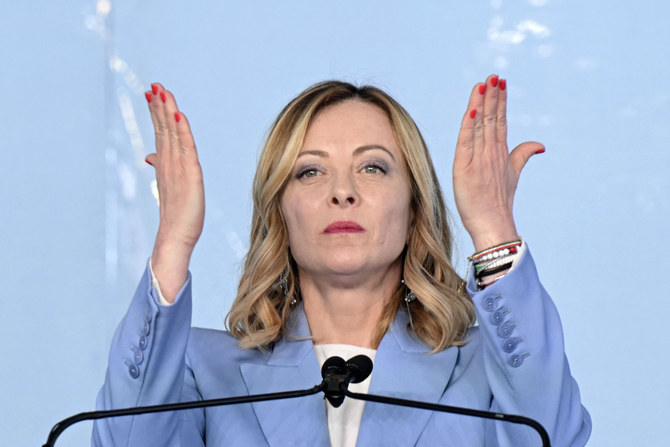


ROME: Having fostered pragmatic relations with Brussels, Italy’s Giorgia Meloni is for many the “moderate” face of Europe’s radical right — and is leading the charge for June elections.
The ascent to power of Meloni’s post-fascist, euroskeptic Brothers of Italy in 2022 sent shockwaves through the European Union, sparking fears of a lurch to the right within a founding member of both the bloc and NATO.
But her strong support for Ukraine has won Meloni friends in Washington and Brussels, particularly after she helped persuade Hungary’s Viktor Orban — a long-time ally sympathetic to Moscow — to drop his veto of EU aid to Kyiv.
Meloni has also worked closely with European Commission President Ursula von der Leyen, particularly on migration, a priority for the far-right premier.
“At a European level, she’s trying to present herself as a sort of moderate conservative and mediator” with the rest of the radical right, noted Lorenzo Castellani, a political analyst at Rome’s LUISS University.
At home, Meloni has pursued a nationalist populist agenda focused on traditional family values, law and order, and migration, including a clampdown on rescue ships operating in the central Mediterranean.
It has raised hackles among the Italian left — particularly moves to exert influence over the RAI public state broadcaster — but nothing yet to spark alarm in Brussels, as with judicial reforms in Hungary and Poland.
Fiscal policy meanwhile has been relatively prudent, reflecting the constraints of being part of the EU’s single currency.
“She wants to be in many aspects the acceptable extreme for the rest of the European political establishment,” Castellani told AFP.
“She’s like the last island before the border.”

With her Atlanticism and pragmatic relations with Brussels, Italy's Prime Minister Giorgia Meloni is for many the "moderate" face of Europe's radical right — and is leading the charge for the upcoming European elections. (AFP)
“More credible”
Meloni heads the European Conservatives and Reformists (ECR) group in the European Parliament, which includes Spain’s Vox, Poland’s populist Law and Justice (PiS), and France’s Reconquete!.
Marked by a pro-Ukraine, pro-NATO stance, it is viewed as more credible by the Brussels establishment than the other far-right grouping, the euroskeptic Identity and Democracy group (ID).
ID includes Marine Le Pen’s National Rally (RN) in France, Germany’s anti-immigrant AfD and Meloni’s own coalition ally, Matteo Salvini’s far-right League.
Rosa Balfour, director of the Carnegie Europe think tank, says both Rome and Brussels have benefited from a pragmatic working relationship.
“What the Commission has been doing is embrace Meloni and isolate Orban,” who is not part of either grouping, she told AFP.
“And that’s worked very well for Italy because Meloni has managed to extract concessions.”
This has mainly entailed EU support for the premier’s efforts to stop the tens of thousands of migrants who land on Italy’s shores each year on boats from North Africa.
Von der Leyen joined Meloni on the island of Lampedusa last year after a surge in arrivals, and the two women joined EU delegations to Egypt and Tunisia in recent months to agree new deals on energy and migration.
Building bridges
Analysts say the shift to a tougher EU approach on migration was well underway before Meloni arrived — but that has not stopped her claiming credit.
“We want Italy to be central to changing what doesn’t work in Europe,” she said during her election campaign launch last month.
She is standing in the vote — despite an EU rule barring government ministers from taking up their seats — and urged the European right to follow her example.
“We want to do in Europe exactly what we did in Italy on September 25, 2022,” she said.
But Castellani calls this a “bluff.”

With her Atlanticism and pragmatic relations with Brussels, Italy's Prime Minister Giorgia Meloni is for many the "moderate" face of Europe's radical right — and is leading the charge for the upcoming European elections. (AFP)
“The real game she’s playing is trying to enter within the European game of alliances,” he said, notably building bridges between the ECR and Von der Leyen’s conservative European People’s Party (EPP).
The divisions in the European right are echoed within Meloni’s coalition, notably between her and Salvini — they share similar domestic priorities but differ on foreign affairs.
Salvini’s League has a history of warm ties with Moscow, while he never misses an opportunity to criticize Brussels.
But he has been eclipsed. The League came top in 2019 European elections in Italy with 34 percent, but is now polling closer to eight percent, compared to more than 27 percent for Meloni’s Brothers of Italy.
Fresh face, skilled communicator
Surveys show voters are supportive of Meloni’s foreign policy — and less so of her migration efforts — but Lorenzo Pregliasco, founder of polling company YouTrend, says personality plays a big role.
Meloni is also seen as “more credible” than other Italian leaders, a skilled communicator and a “genuine figure, someone who says what she thinks,” he told AFP.
He notes her 2022 victory was driven by her image as a fresh face, the only party leader who did not join Mario Draghi’s technocratic government.
With the opposition still divided, as they were back then, he predicts she could stay in power for the full five-year term.
But by then the political landscape may be very different, not least if Donald Trump wins the November US presidential election.
Balfour suggests Meloni may have to reposition herself.
If Trump wins, “then you’ve got all the political leaders elbowing each other to lead the right. And Orban has already positioned himself there.”