UK Labour official acknowledges electoral backlash over Gaza

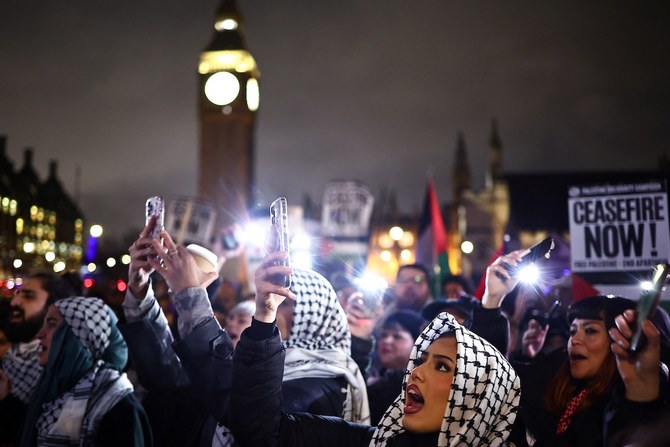
Pro-Palestinian demonstrators wave Palestinian flags and hold placards as they protest in Parliament Square in London on February 21, 2024. (File/AFP)
Short Url
Updated 05 May 2024
Follow

UK Labour official acknowledges electoral backlash over Gaza

  • Analysis shows decline of nearly 18 percent in Labour vote in areas where over a fifth of the population are Muslim

LONDON: A senior Labour official on Sunday said the party has to recalibrate its campaigning strategy to win back voters opposing its position on Gaza, The Observer reported.
Pat McFadden, Labour’s national election coordinator, told the BBC program “Sunday with Laura Kuenssberg” that it would “work to get people’s support back,” and that the Middle East is a “high foreign policy priority” for the party.
Analysis has revealed that despite substantial gains in Thursday’s local elections in England, as well as Sadiq Khan securing a third term as mayor of London, there was a decline of nearly 18 percent in the Labour vote in areas of the country where over a fifth of the population identify as Muslim.
The analysis, conducted across 930 wards by Prof. Will Jennings from the University of Southampton, highlighted the extent of the protest vote against Labour leader Keir Starmer’s stance on Gaza, particularly his delay in calling for a ceasefire.
Ali Milani, chair of the Labour Muslim Network, voiced concern over the sense of betrayal within the Muslim community.
“We are now seeing the electoral consequence of that,” Milani told The Obsever. “If I was a Labour MP in Bradford or Birmingham or Leicester or parts of London or Manchester, I would be seriously concerned.”
Jennings said: “What this highlights is certainly that Labour is in an uncomfortable position on Gaza. And it is not just Muslim voters.
“But in a general election when we are looking at an anti-incumbent mood and there are fewer small parties and independents, we shouldn’t expect the pattern to be repeated.”
Labour MP Ellie Reeves said: “We have recognized the strength of feeling on this issue. We have called for an immediate ceasefire, we have also said there should absolutely be no ground offensive on Rafah.”
When questioned about Labour’s previous stance on the war, she told The Observer: “Keir Starmer has always been clear that our position would always respond to what is happening there.”



Rubio says technical talks with Denmark, Greenland officials over Arctic security have begun

Updated 29 January 2026
Follow

Rubio says technical talks with Denmark, Greenland officials over Arctic security have begun

  • US Secretary of State on Wednesday appeared eager to downplay Trump’s rift with Europe over Greenland

WASHINGTON: Technical talks between the US, Denmark and Greenland over hatching an Arctic security deal are now underway, Secretary of State Marco Rubio said on Wednesday.
The foreign ministers of Denmark and Greenland agreed to create a working group aimed at addressing differences with the US during a Washington meeting earlier this month with Vice President JD Vance and Rubio.
The group was created after President Donald Trump’s repeated calls for the US to take over Greenland, a Danish territory, in the name of countering threats from Russia and China — calls that Greenland, Denmark and European allies forcefully rejected.
“It begins today and it will be a regular process,” Rubio said of the working group, as he testified before the Senate Foreign Relations Committee. “We’re going to try to do it in a way that isn’t like a media circus every time these conversations happen, because we think that creates more flexibility on both sides to arrive at a positive outcome.”
The Danish Foreign Ministry said Wednesday’s talks focused on “how we can address US concerns about security in the Arctic while respecting the red lines of the Kingdom.” Red lines refers to the sovereignty of Greenland.
Trump’s renewed threats in recent weeks to annex Greenland, which is a semiautonomous territory of a NATO ally, has roiled US-European relations.
Trump this month announced he would slap new tariffs on Denmark and seven other European countries that opposed his takeover calls, only to abruptly drop his threats after a “framework” for a deal over access to the mineral-rich island was reached, with NATO Secretary-General Mark Rutte’s help. Few details of the agreement have emerged.
After stiff pushback from European allies to his Greenland rhetoric, Trump also announced at the World Economic Forum in Davos, Switzerland, last week that he would take off the table the possibility of using American military force to acquire Greenland.
The president backed off his tariff threats and softened his language after Wall Street suffered its biggest losses in months over concerns that Trump’s Greenland ambitions could spur a trade war and fundamentally rupture NATO, a 32-member transatlantic military alliance that’s been a linchpin of post-World War II security.
Rubio on Wednesday appeared eager to downplay Trump’s rift with Europe over Greenland.
“We’ve got a little bit of work to do, but I think we’re going to wind up in a good place, and I think you’ll hear the same from our colleagues in Europe very shortly,” Rubio said.
Rubio during Wednesday’s hearing also had a pointed exchange with Sen. Tim Kaine, D-Virginia, about Trump repeatedly referring to Greenland as Iceland while at Davos.
“Yeah, he meant to say Greenland, but I think we’re all familiar with presidents that have verbal stumbles,” Rubio said in responding to Kaine’s questions about Trump’s flub — taking a veiled dig at former President Joe Biden. “We’ve had presidents like that before. Some made a lot more than this one.”