

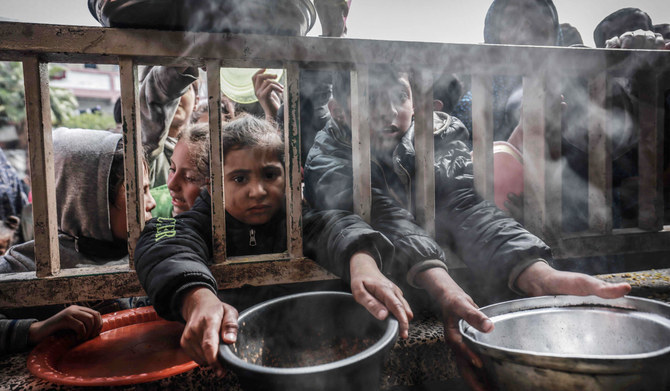

WASHINGTON: A top UN official said Friday that hard-hit northern Gaza was now in “full-blown famine” after more than six months of war between Israel and Hamas and severe Israeli restrictions on food deliveries to the Palestinian territory.
Cindy McCain, the American director of the UN World Food Program, became the most prominent international official so far to declare that trapped civilians in the most cut-off part of Gaza had gone over the brink into famine.
“It’s horror,” McCain told NBC’s “Meet the Press” in an interview to air Sunday. “There is famine — full-blown famine — in the north, and it’s moving its way south.”
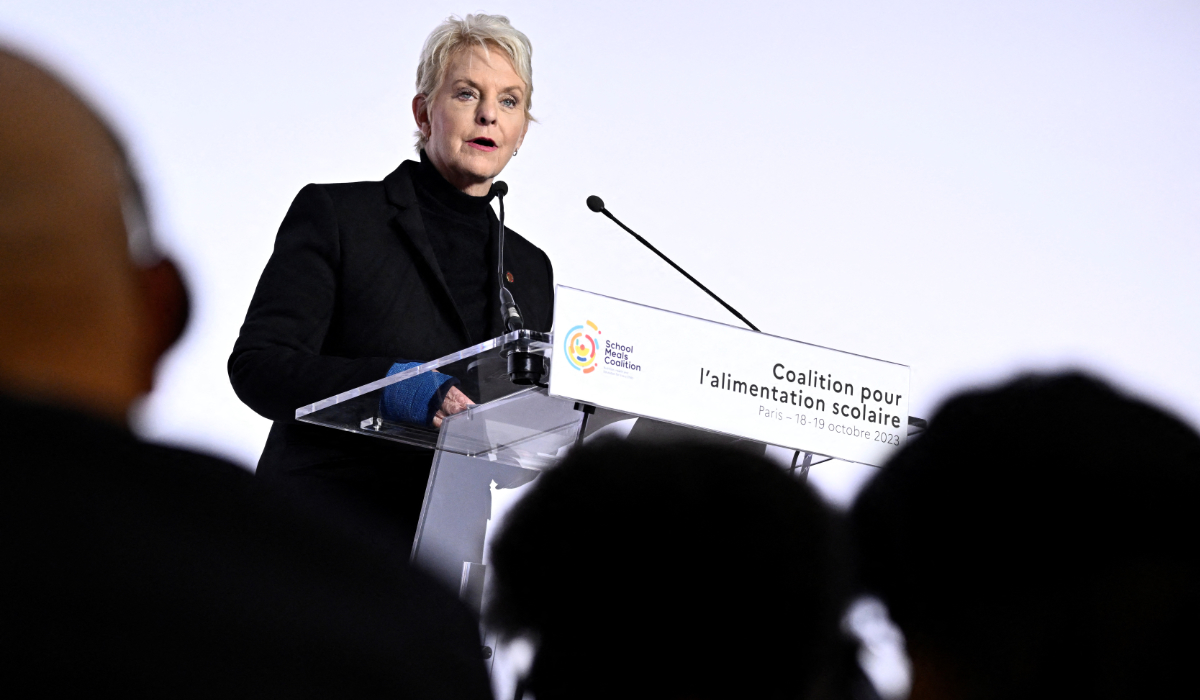
Executive Director of the World Food Programme Cindy McCain delivers a speech at the first meeting of the Global School Meals Coalition in Paris on October 18, 2023. (AFP)
She said a ceasefire and a greatly increased flow of aid through land and sea routes was essential to confronting the growing humanitarian catastrophe in Gaza, home to 2.3 million people.
There was no immediate comment from Israel, which controls entrance into Gaza and says it is beginning to allow in more food and other humanitarian aid through land crossings.
The panel that serves as the internationally recognized monitor for food crises said earlier this year that northern Gaza was on the brink of famine and likely to experience it this month. The next update will not come before this summer.
One of the US Agency for International Development’s humanitarian officials in Gaza told The Associated Press that on-the-ground preparations for a new US-led sea route were on track to bring in more food — including treatment for hundreds of thousands of starving children — by early or mid-May. That’s when the American military expects to finish building a floating pier to receive the shipments.
Ramping up the delivery of aid on the planned US-backed sea route will be gradual as aid groups test the distribution and security arrangements for relief workers, the USAID official said.
The official spoke on condition of anonymity over security concerns for work done in a conflict zone. They were some of the agency’s first comments on the status of preparations for the Biden administration’s $320 million Gaza pier project, for which USAID is helping coordinate on-the-ground security and distribution.
At a factory in rural Georgia on Friday, USAID Administrator Samantha Power pointed to the food crises in Gaza and other parts of the world as she announced a $200 million investment aimed at increasing production of emergency nutritional paste for starving children under 5.
Power spoke to factory workers, peanut farmers and local dignitaries sitting among pallets of the paste at the Mana nonprofit in Fitzgerald. It is one of two factories in the US that produces the nutritional food, which is used in clinical settings and made from ground peanuts, powdered milk, sugar and oil, ready to eat in plastic pouches resembling large ketchup packets.
“This effort, this vision meets the moment,” Power said. “And it could not be more timely, more necessary or more important.”
Under pressure from the US and others, Israeli officials in recent weeks have begun slowly reopening some border crossings for relief shipments.
But aid coming through the sea route, once it’s operational, still will serve only a fraction — half a million people — of those who need help in Gaza. Aid organizations including USAID stress that getting more aid through border crossings is essential to staving off famine.
Children under 5 are among the first to die when wars, droughts or other disasters curtail food. Hospital officials in northern Gaza reported the first deaths from hunger in early March and said most of the dead were children.
Power said the UN has called for 400 metric tons of the nutritional paste “in light of the severe hunger that is pervading across Gaza right now, and the severe, acute humanitarian crisis.” USAID expects to provide a quarter of that, she said.
Globally, she said at the Georgia factory, the treatment made there “will save untold lives, millions of lives.”
USAID is coordinating with the World Food Program and other humanitarian partners and governments on security and distribution for the pier project, while US military forces finish building it. President Joe Biden, under pressure to do more to ease the humanitarian catastrophe in Gaza as the US provides military support for Israel, announced the project in early March.
US Central Command said in a statement Friday that offshore assembly of the floating pier has been temporarily paused due to high winds and sea swells, which caused unsafe conditions for soldiers. The partially built pier and the military vessels involved have gone to Israel’s Port of Ashdod, where the work will continue.
A US official said the high seas will delay the installation for several days, possibly until later next week. The official, who spoke on condition of anonymity to discuss operation details, said the pause could last longer if the bad weather continues because military personnel and divers have to get into the water for the final installation.
The struggles this week with the first aid delivery through a newly reopened land corridor into north Gaza underscored the uncertainty about security and the danger still facing relief workers. Israeli settlers blocked the convoy before it crossed Wednesday. Once inside Gaza, the convoy was commandeered by Hamas militants, before UN officials reclaimed it.
In Gaza, the nutritional treatment for starving children is most urgently needed in the northern part of the Palestinian territory. Civilians have been cut off from most aid supplies, bombarded by Israeli airstrikes and driven into hiding by fighting.
Acute malnutrition rates there among children under 5 have surged from 1 percent before the war to 30 percent five months later, the USAID official said. The official called it the fastest such climb in hunger in recent history, more than in grave conflicts and food shortages in Somalia or South Sudan.
One of the few medical facilities still operating in northern Gaza, Kamal Adwan hospital, is besieged by parents bringing in thousands of children with malnutrition for treatment, the official said. Aid officials believe many more starving children remain unseen and in need, with families unable to bring them through fighting and checkpoints for care.
Saving the gravely malnourished children in particular requires both greatly increased deliveries of aid and sustained calm in fighting, the official said, so that aid workers can set up treatment facilities around the territory and families can safely bring children in for the sustained treatment needed.


