

Philippine bishops instruct flock to pray for rain, heat relief

1 / 3
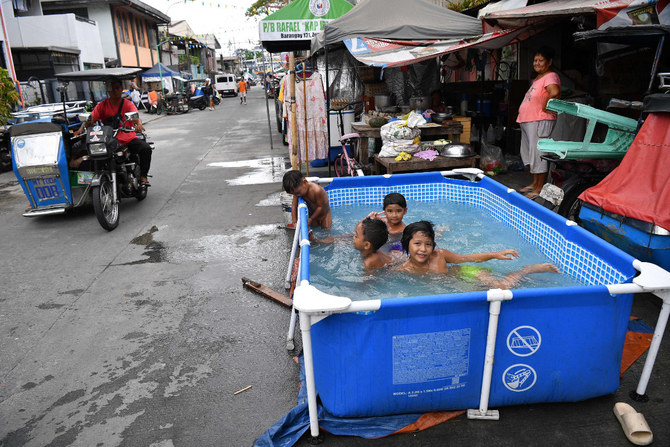
A tricycle speeds past children cooling off on a makeshift pool along a street in Manila on May 3, 2024, amid a heat wave. (AFP)
2 / 3
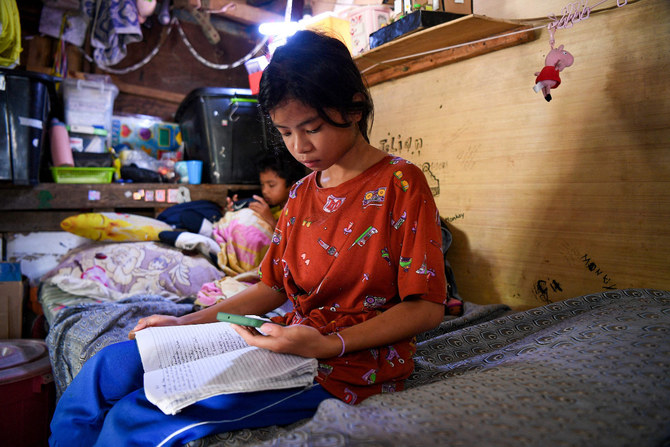
Sixth-grader Jalian Mangampo does homework at their house in Manila on April 30, 2024. Her widowed mother, shopkeeper Richel Mangampo, took on a high-interest loan to buy them an 8,500-peso ($148) mobile phone for use in her online classes as schools have suspended in-person classes amid a heat wave. (AFP)
3 / 3
A drone view shows a centuries-old sunken town that reemerged as extreme heat caused the Pantabangan Dam in Nueva Ecija, Philippines, to dry up. (REUTERS)
Short Url
Updated 04 May 2024
Follow

Philippine bishops instruct flock to pray for rain, heat relief

  • Rising temperatures have forced the government to shut down tens of thousands of schools over the past week
  • Increased demand has also stressed the country’s already strained power supply

MANILA: Catholic bishops in the Philippines are pitching in to seek divine relief from the extreme heatwave scorching the country, instructing their flock to recite special prayers for rain and lower temperatures.
Rising temperatures have forced the government to shut down tens of thousands of schools over the past week, while increased demand has stressed the country’s already strained power supply.
A widespread El Nino drought that began early this year is compounding the problem, ruining 5.9 billion pesos ($103 million) worth of farm produce so far according to the Department of Agriculture.
The Catholic Bishops Conference of the Philippines issued an “Oratio Imperata,” instructing parishes in the mainly Catholic nation to recite a prayer for deliverance from calamities during masses, according to the text seen by AFP on Saturday.
“We humbly ask you to grant us relief from the extreme heat that besets your people at this time, disrupting their activities and threatening their lives and livelihood,” the prayer read.
“Send us rain to replenish our depleting water sources, to irrigate our fields, to stave off water and power shortages and to provide water for our daily needs.”
A record-high 38.8 degrees Celsius (101.8 degrees Fahrenheit) was recorded in the capital Manila on April 27, forcing the closure of more than 47,000 schools for two days.
Nearly 8,000 schools remained shuttered as of Friday, the education department said, while the highest temperature in the country was recorded at 38.2C on the island of Mindoro south of the capital.


Bomb attacks on Thailand petrol stations injure 4: army

Updated 11 January 2026
Follow

Bomb attacks on Thailand petrol stations injure 4: army

  • Authorities did not announce any arrests or say who may be behind the attacks

BANGKOK: Assailants detonated bombs at nearly a dozen petrol stations in Thailand’s south early Sunday, injuring four people, the army said, the latest attacks in the insurgency-hit region.
A low-level conflict since 2004 has killed thousands of people as rebels in the Muslim-majority region bordering Malaysia battle for greater autonomy.
Several bombs exploded within a 40-minute period after midnight on Sunday, igniting 11 petrol stations across Thailand’s southernmost provinces of Narathiwat, Pattani and Yala, an army statement said.
Authorities did not announce any arrests or say who may be behind the attacks.
“It happened almost at the same time. A group of an unknown number of men came and detonated bombs which damaged fuel pumps,” Narathiwat Governor Boonchauy Homyamyen told local media, adding that one police officer was injured in the province.
A firefighter and two petrol station employees were injured in Pattani province, the army said.
All four were admitted to hospitals, none with serious injuries, a Thai army spokesman told AFP.
Thailand’s Prime Minister Anutin Charnvirakul told reporters that security agencies believed the attacks were a “signal” timed with elections for local administrators taking place on Sunday, and “not aimed at insurgency.”
The army’s commander in the south, Narathip Phoynok, told reporters he ordered security measures raised to the “maximum level in all areas” including at road checkpoints and borders.
The nation’s deep south is culturally distinct from the rest of Buddhist-majority Thailand, which took control of the region more than a century ago.
The area is heavily policed by Thai security forces — the usual targets of insurgent attacks.