

Israel builds ‘cyber dome’ against Iran’s hackers

1 / 2
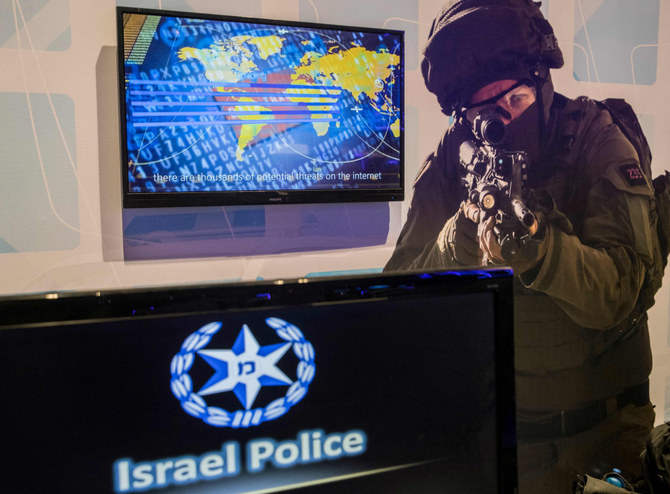
The stand of the Israeli police is seen in the 4th International conference on Home Land Security and Cyber in Tel Aviv on November 15, 2016. Israel is building a "cyber dome" to defend against online attacks, especially from arch foe Iran. (AFP)
2 / 2
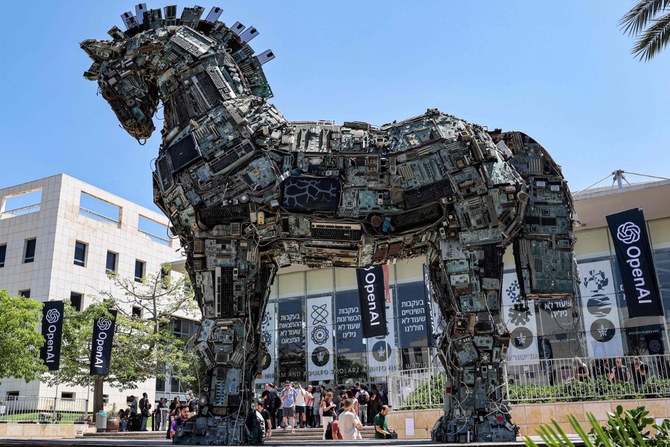
Banners of US artificial intelligence company OpenAI fly near an installation depicting the legendary "Trojan horse" built entirely out of microelectronic circuit boards and other computer components, outside at the campus of Tel Aviv University in Tel Aviv on June 5, 2023. (AFP)
Short Url
Updated 03 May 2024
Follow

Israel builds ‘cyber dome’ against Iran’s hackers

  • Israeli cybersecurity agency had thwarted around 800 significant attacks since the Oct. 7 Gaza war erupted
  • But some attacks could not be foiled, including against hospitals in which patient data was stolen

TEL AVIV: Israel’s Iron Dome defense system has long shielded it from incoming rockets. Now it is building a “cyber dome” to defend against online attacks, especially from arch foe Iran.

“It is a silent war, one which is not visible,” said Aviram Atzaba, the Israeli National Cyber Directorate’s head of international cooperation.
While Israel has fought Hamas in Gaza since the October 7 attack, it has also faced a significant increase in cyberattacks from Iran and its allies, Atzaba said.
“They are trying to hack everything they can,” he told AFP, pointing to Hamas and Lebanon’s Hezbollah movement but adding that so far “they have not succeeded in causing any real damage.”
He said around 800 significant attacks had been thwarted since the war erupted. Among the targets were government organizations, the military and civil infrastructure.
Some attacks could not be foiled, including against hospitals in the cities of Haifa and Safed in which patient data was stolen.
While Israel already has cyber defenses, they long consisted of “local efforts that were not connected,” Atzaba said.
So, for the past two years, the directorate has been working to build a centralized, real-time system that works proactively to protect all of Israeli cyberspace.
Based in Tel Aviv, the directorate works under the authority of the prime minister. It does not reveal figures on its staff, budget or computing resources.
Israel collaborates closely with multiple allies, including the United States, said Atzaba, because “all states face cyber terrorism.”
“It takes a network to fight a network,” he said.

Israel’s arch foe Iran is “an impressive enemy” in the online wars, said Chuck Freilich, a researcher at the Institute for National Security Studies, which is affiliated with Tel Aviv University.
“Its attacks aim to sabotage and destroy infrastructure, but also to collect data for intelligence and spread false information for propaganda purposes,” he said.
Iran has welcomed Hamas’s October 7 attack on Israel, which resulted in the deaths of 1,170 people, mostly civilians, according to an AFP tally based on Israeli official figures.
Israel’s retaliatory offensive against Hamas has killed at least 34,596 people in Gaza, mostly women and children, according to the Hamas-run territory’s health ministry.
Regional tensions have soared, particularly after Iran for the first time fired hundreds of missiles directly at Israel last month in retaliation for a deadly Israeli air strike on the Iranian consulate in Damascus.
It was the most dramatic escalation yet after a years-long shadow war of killings and sabotage attacks between Israel and Iran.
Freilich argued in a study published in February that Iran was relatively slow to invest in cyberwarfare, until two key events triggered a change.
First, its leaders took note of how anti-government protesters used the Internet as a tool to mobilize support for a 2009 post-election uprising.
In the bloody crackdown that crushed the movement, Iran’s authorities cut access to social media and websites covering the protests.
Then, in September 2010, a sophisticated cyberattack using the Stuxnet virus, blamed by Iran on Israel and the United States, caused physical damage to Tehran’s nuclear program.
Freilich said the attack “demonstrated Iran’s extreme vulnerability and led to a severe national shock.”
Since then, Iran has gained substantial expertise to become “one of the most active countries in cyberspace,” he said

While Israel is considered a major cyber power, Iran was only likely to improve, said Freilich.
He pointed to assistance from Russia and China, as well as its much larger population and an emphasis on cyber training for students and soldiers alike, adding that the trend was “concerning for the future.”
Atzaba insisted that the quantity of hackers is secondary to the quality of technology and the use it is put to.
“For the past two years, we have been developing a cyber dome against cyberattacks, which functions like the Iron Dome against rockets,” he said.
“With cyber dome, all sources are fed into a large data pool that enables a view of the big picture and to invoke a national response in a comprehensive and coordinated manner.”
The Israeli system has various scanners that continuously “monitor Israeli cyberspace for vulnerabilities and informs the stakeholders of the means to mitigate them,” he said.
Israel’s cyber strength relied on close cooperation between the public, private and academic sectors, as well as Israel’s “white hat” hackers who help identify weaknesses.
“We work hand in hand,” he said.


Arab Coalition announces ‘limited’ airstrike targeting two ships that smuggled weapons to Yemen

Updated 14 sec ago
Follow

Arab Coalition announces ‘limited’ airstrike targeting two ships that smuggled weapons to Yemen

RIYADH: The Coalition to Support Legitimacy in Yemen on Tuesday said it conducted a “limited” airstrike targeting two ships that smuggled weapons and other military hardware into Mukalla in southern Yemen.

In a statement carried by the Saudi Press Agency (SPA), the Coalition Forces spokesman, Major General Turki Al-Maliki, said that two ships coming from the port of Fujairah in the United Arab Emirates entered the port of Mukalla without obtaining official permits from the Joint Forces Command of the Coalition. 

“The crews of the two ships disabled the tracking systems of the two ships and unloaded a large quantity of weapons and combat vehicles to support the Southern Transitional Council forces in the eastern governorates of Yemen (Hadramawt, Al-Mahra) with the aim of fueling the conflict. This is a clear violation of imposing a truce and reaching a peaceful solution, as well as a violation of UN Security Council Resolution No. (2216) of 2015 AD,” said the spokesman.

Google map showing the location of Mukalla in southern Yemen

Al-Maliki said the Coalition Forces acted on a request by Rashad Al-Alimi, the president of the Yemeni Presidential Leadership Council, “to take all necessary military measures to protect civilians in the governorates of Hadramawt and Al-Mahra.”

Al-Alimi, the president of the Yemeni Presidential Leadership Council, warned last week that unilateral actions by the STC were pushing the country toward a dangerous tipping point.

“Given the danger and escalation posed by these weapons, which threaten security and stability, the Coalition Air Forces conducted a limited military operation this morning targeting weapons and combat vehicles unloaded from the two ships at the port of Al-Mukalla. This was done after documenting the unloading, and the military operation was carried out in accordance with international humanitarian law and its customary rules, ensuring no collateral damage occurred,”  spokesman Al-Maliki said on Tuesday.


READ MORE: Analysis: The risks of carving up Yemen


He affirmed the Coalition’s "continued commitment to de-escalation and enforcing calm in the governorates of Hadramawt and Al-Mahra, and to prevent any military support from any country to any Yemeni faction without coordination with the legitimate Yemeni government and the Coalition. This is aimed at ensuring the success of the Kingdom and the Coalition’s efforts to achieve security and stability and prevent the conflict from spreading.”

Disregarding previous agreements with the Coalition, the group calling itself Southern Transitional Council, or STC, launched a sweeping military campaign early in December, seizing the governorates of Hadramaut along the Saudi border and the eastern governorate of Al-Mahra in Yemen’s border with Oman.

The UAE-backed STC forces captured the city of Seiyun, including its international airport and the presidential palace. They also took control of the strategic PetroMasila oilfields, which account for a massive portion of Yemen’s remaining oil wealth.

This prompted Saudi Arabia to issue a firm demand for the STC to withdraw and hand over the seized areas to the National Shield Forces, a Saudi-backed unit.

The coalition warned that any military movements undermining de-escalation efforts would be dealt with immediately to protect civilians, according to the Saudi Press Agency.

On Dec. 26, the UAE issued a statement welcoming Saudi Arabia’s efforts to support security and stability in Yemen.

The statement carried by state news agency WAM praised Saudi Arabia’s constructive role in advancing the interests of the Yemeni people and supporting their legitimate aspirations for stability and prosperity.