

Pakistan inflation eases to 22-month low at 17.3% in April amid monetary tightening

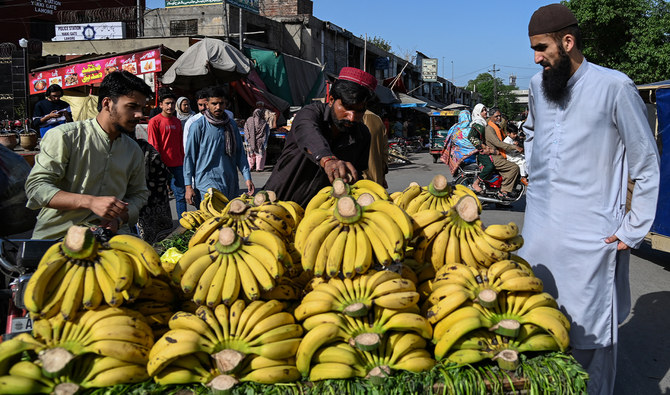
A vendor sells bananas on a cart along a street in Lahore on March 31, 2024. (AFP)
Short Url
Updated 02 May 2024
Follow

Pakistan inflation eases to 22-month low at 17.3% in April amid monetary tightening

  • Pakistan beset by inflation above 20% since May 2022, registering high of 38% in May 2023 due to high food, energy costs
  • Pakistan is currently navigating strict reforms as part of an International Monetary Fund bailout program

KARACHI: Pakistan’s inflation eased off to 17.3%, the lowest since May 2022, on a year-on-year basis in April 2024 from 20.7% recorded in March 2024 and 36.4% in April 2023, official data issued on Thursday said.

Pakistan has been beset by inflation above 20% since May 2022, registering a high of 38 percent in May 2023 mainly due to high food and energy costs. 

Pakistan’s central bank, which has kept the interest rate steady at 22% since June last year amid tight monetary tightening, had forecasted that ” inflation will continue to remain on downward trajectory further moderation.”

“Besides the coordinated tight monetary and fiscal policy response, other factors that have led to this favorable outcome include lower global commodity prices, improved food supplies and high base effect,” the central bank said in its monetary policy statement issued on Monday.

On a month-on-month basis, inflation decreased to 0.4% in April 2024 as compared to an increase of 1.7% in the previous month and a hike of 2.4% in April 2023, according to the Pakistan Bureau of Statistics (PBS). 

In April on an annual basis the prices of onions increased by 156.16%, tomatoes 126.67%, chicken 33.62% and meat 22.18%. In the non-food category, gas charges surged by 318.74%, electricity charges 71.12%, accommodation services 31.50%, transport services 26.70%, cotton cloth 23.00%, drugs and medicines 22.78%, and footwears 21.38%.

Urban core inflation measured by non-food non-energy items increased to 13.1% on an annual basis in April 2024 as compared to an increase of 12.8% in the previous month and 19.5% in April 2023.

Rural core inflation measured by non-food non-energy items increased to 19.3% on a year-on-year basis in April 2024 as compared to an increase of 20% in the previous month and 24.9% in April 2023.


Pakistan, ADB sign $730 loan agreements to boost SOE reforms, energy infrastructure

Updated 25 December 2025
Follow

Pakistan, ADB sign $730 loan agreements to boost SOE reforms, energy infrastructure

  • Both sign $330 million Power Transmission Strengthening Project and $400 million SOE Transformation Program loan agreements
  • Economic Affairs Division official says Transmission Project will secure Pakistan’s energy future by strengthening national grid’s backbone

KARACHI: Pakistan and the Asian Development Bank (ADB) on Thursday signed two loan agreements totaling $730 million to boost reforms in state-owned enterprises (SOEs) and energy infrastructure in the country, the bank said.

The first of the two agreements pertains to the SOE Transformation Program worth $400 million while the second loan, worth $330 million, is for a Power Transmission Strengthening Project, the lender said. 

The agreements were signed by ADB Country Director for Pakistan Emma Fan and Pakistan’s Secretary of Economic Affairs Division Humair Karim. 

“The agreements demonstrate ADB’s enduring commitment to supporting sustainable and inclusive economic growth in Pakistan,” the ADB said. 

Pakistan’s SOEs have incurred losses worth billions of dollars over the years due to financial mismanagement and corruption. These entities, including the country’s national airline Pakistan International Airlines, which was sold to a private group this week, have relied on subsequent government bailouts over the years to operate.

The ADB approved the $400 million loan for SOE reforms on Dec. 12. It said the program seeks to improve governance and optimize the performance of Pakistan’s commercial SOEs. 

Karim highlighted that the Power Transmission Strengthening Project will enable reliable evacuation of 2,300 MW from Pakistan’s upcoming hydropower projects, relieve overloading of existing transmission lines and enhance resilience under contingency conditions, the Press Information Department (PID) said. 

“The Secretary emphasized that both initiatives are transformative in nature as the Transmission Project will secure Pakistan’s energy future by strengthening the backbone of the national grid whereas the SOE Program will enhance transparency, efficiency and sustainability of state-owned enterprises nationwide,” the PID said. 

The ADB has supported reforms by Pakistan to strengthen its public finance and social protection systems. It has also undertaken programs in the country to help with post-flood reconstruction, improve food security and social and human capital. 

To date, ADB says it has committed 764 public sector loans, grants and technical assistance totaling $43.4 billion to Pakistan.