Pakistan’s drug enforcement agency nets record ‘ice’ haul in major anti-trafficking operation

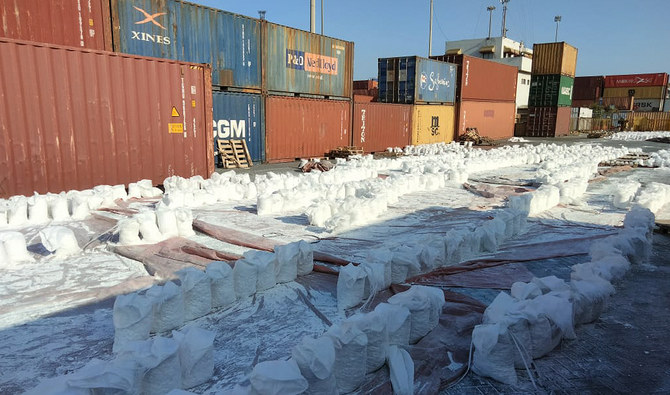
This handout photo, taken and released by Pakistan Anti-Narcotics Force (ANF) shows seized bags of soapstone containing “224 kilograms of Methamphetamine drug substance” exported from Afghanistan to Belgium at the Karachi port in Karachi on May 2, 2024. (Photo courtesy: ANF)
Short Url
Updated 02 May 2024
Follow

Pakistan’s drug enforcement agency nets record ‘ice’ haul in major anti-trafficking operation

  • The Anti-Narcotics Force seizes 224 kilograms of the substance while it was being transported to Belgium
  • The authorities also apprehended three suspects, among them two Afghan nationals, who were trying to escape

ISLAMABAD: Pakistan’s Anti-Narcotics Force (ANF) announced on Thursday it had achieved a “monumental victory” in the ongoing battle against drug trafficking by intercepting the largest consignment of methamphetamine, popularly called “ice,” in the nation’s history.
Methamphetamine, known for its potent and addictive properties, has seen a significant rise in use not just in Pakistan but globally, contributing to a burgeoning health crisis.
The drug’s accessibility and escalating abuse have heightened law enforcement and public health efforts to curtail its spread.
This major seizure highlights the ongoing challenges and the critical need for continued vigilance and international cooperation in combating drug trafficking and its societal impacts.
“A total of 224 kilograms of Methamphetamine (Ice) was seized by the diligent ANF team at the Karachi port,” an official statement announced. “Disguised within five containers labelled as ‘Soapstone’ exports from Afghanistan to Belgium, this illicit substance was artfully concealed within the container’s roof and doors.”
The authorities also apprehended three suspects involved in the smuggling attempt, among them two Afghan nationals.
“The suspects were attempting to flee to Afghanistan via the Torkham border when they were intercepted by ANF Team,” the statement continued.
It added the intercepting the massive methamphetamine consignment by ANF prevented its distribution and potential harm to countless people.


World Bank approves $700 million for Pakistan’s economic stability

Updated 6 sec ago
Follow

World Bank approves $700 million for Pakistan’s economic stability

  • Of this, $600 million will go for federal programs and $100 million will ⁠support a provincial program in Sindh
  • The results-based design ensures that resources are only disbursed once program objectives are achieved

ISLAMABAD: The World Bank has approved $700 million in ​financing for Pakistan under a multi-year initiative aimed at supporting the country’s macroeconomic stability and service delivery, the bank said on Friday.

The funds will be released under the bank’s Public ‌Resources for Inclusive ‌Development — Multiphase ‌Programmatic ⁠Approach (PRID-MPA) that ‌could provide up to $1.35 billion in total financing, according to the lender.

Of this amount, $600 million will go for federal programs and $100 million will ⁠support a provincial program in ‌the southern Sindh province. The results-based design ensures that resources are only disbursed once program objectives are achieved.

“Pakistan’s path to inclusive, sustainable growth requires mobilizing more domestic resources and ensuring they are used efficiently and transparently to deliver results for people,” World Bank country director Bolormaa Amgaabazar said in a statement.

“Through this MPA, we are working with the Federal and Sindh governments to deliver tangible impacts— more predictable funding for schools and clinics, fairer tax systems, and stronger data for decision‑making— while safeguarding priority social and climate investments and strengthening public trust.”

The approval ‍follows a $47.9 ‍million World Bank grant ‍in August to improve primary education in Pakistan’s most populous Punjab province.

In November, an IMF-World Bank ​report, uploaded by Pakistan’s finance ministry, said Pakistan’s fragmented ⁠regulation, opaque budgeting and political capture are curbing investment and weakening revenue.

Regional tensions may surface over international financing for Pakistan. In May, Reuters reported that India would oppose World Bank funding for Pakistan, citing a senior government ‌source in New Delhi.

“Strengthening Pakistan’s fiscal foundations is essential to restoring macroeconomic stability, delivering results and strengthening institutions,” said Tobias Akhtar Haque, Lead Country Economist for the World Bank in Pakistan.

“Through the PRID‑MPA, we are launching a coherent nationwide approach to support reforms that expand fiscal space, bolster investments in human capital and climate resilience, and strengthen revenue administration, budget execution, and statistical systems. These reforms will ensure that resources reach the frontline and deliver better outcomes for people across Pakistan with greater efficiency and accountability.”

In Sindh, the program is expected to increase provincial revenues, enhance the speed and transparency of payments, and broaden the use of data to guide provincial decision making. The program will directly support the increase of public resources for inclusive development, including more equitable and responsive financing for primary health care facilities and more funding for schools.