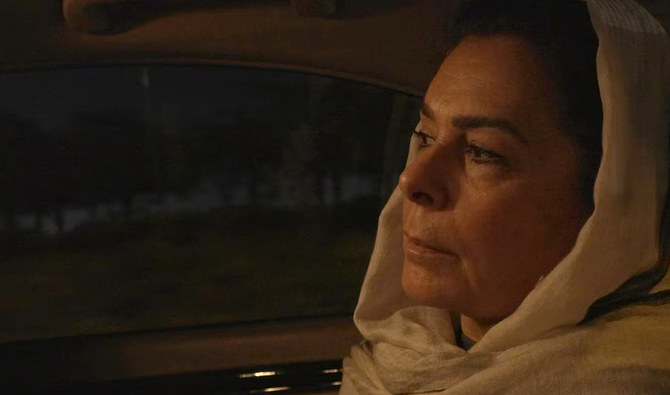
TORONTO: The new documentary “The Sharp Edge of Peace” begins with a harrowing scene: Fawzia Koofi, a former member of Afghanistan’s parliament and a women’s rights activist, recovering in a hospital bed after surviving an assassination attempt in August 2020.
While traveling to Kabul with her daughter, Koofi was ambushed by unidentified gunmen who opened fire on her vehicle.
“They thought I was shot in the head and died,” Koofi says in the documentary, which has its world premiere on Saturday at the Canadian documentary festival Hot Docs that runs through May 5.
Directed by Roya Sadat, the 95-minute film is a testament to the courage of Afghan women leaders who continue advocating for change since the Taliban seized power in August 2021, and have drastically curtailed women’s freedoms and rights.
“This is a tragedy, but at the same time, you can see the power of women and see the beauty of this country when women participate,” Sadat told Reuters.
Koofi’s resolve remained unshaken even after the attack, which was not the first she’s faced.
She was a key figure among women negotiators, including Fatima Gailani, Habiba Sarabi, and Sharifa Zurmati, involved in the intra-Afghan talks in Doha, Qatar aimed at striking a peace deal with the Taliban.
The documentary covers the failed negotiations from the perspective of the women on Afghanistan’s negotiating team.
Once at the negotiating table, Koofi realized the Taliban already saw themselves as victorious.
“When President Biden came to power, he announced that he would withdraw his troops from Afghanistan regardless, with no conditions, and that was a boost to the Taliban’s morale,” she said in an interview.
The Biden administration has previously blamed the chaotic US withdrawal on the Trump administration, which struck the agreement with the Taliban.
‘WE ARE BEING ERASED’
Koofi, now in exile, continues to work from the UK by engaging with international bodies like the United Nations and the European Union, pushing policymakers to recognize the plight of Afghan women under Taliban rule.
“It’s painful that most of these countries think that we should influence and change the perspectives of the Taliban,” Koofi said, adding that since regaining power, they have not changed at all.
“We are being erased,” Koofi said of the steady decline in women’s rights in Afghanistan.
Undeterred, Koofi founded the Afghan Women Coalition for Change with a goal of establishing gender apartheid as an internationally recognized crime against humanity.
Gailani, chair of Afghanistan Future Thought Forum, told Reuters the negotiating team never wanted US soldiers or NATO to stay in the country forever, but expected a smoother withdrawal and a political settlement.
“Some Westerners believe that they alone gave freedom to the Afghan woman, that she couldn’t do anything herself, which is not the case,” says fellow negotiator Sarabi at the close of the film. “Afghan women didn’t get here easily, they endured a lot of struggles.”

New film captures Afghan women’s courage in failed peace talks with Taliban
https://arab.news/4xyc3
New film captures Afghan women’s courage in failed peace talks with Taliban
- Directed by Roya Sadat, the 95-minute “The Sharp Edge of Peace” is a testament to the courage of Afghan women leaders
- Fawzia Koofi and other leaders continue advocating for change since Taliban seized power in 2021 and curtailed women’s rights
Reference to Trump’s impeachments is removed from the display of his Smithsonian photo portrait
- For now, references to Presidents Andrew Johnson and Bill Clinton being impeached in 1868 and 1998, respectively, remain as part of their portrait labels, as does President Richard Nixon’s 1974 resignation as a result of the Watergate scandal
WASHINGTON: President Donald Trump’s photo portrait display at the Smithsonian’s National Portrait Gallery has had references to his two impeachments removed, the latest apparent change at the collection of museums he has accused of bias as he asserts his influence over how official presentations document US history.
The wall text, which summarized Trump’s first presidency and noted his 2024 comeback victory, was part of the museum’s “American Presidents” exhibition. The description had been placed alongside a photograph of Trump taken during his first term. Now, a different photo appears without any accompanying text block, though the text was available online. Trump was the only president whose display in the gallery, as seen Sunday, did not include any extended text.
The White House did not say whether it sought any changes. Nor did a Smithsonian statement in response to Associated Press questions. But Trump ordered in August that Smithsonian officials review all exhibits before the nation celebrates the 250th anniversary of the Declaration of Independence on July 4. The Republican administration said the effort would “ensure alignment with the president’s directive to celebrate American exceptionalism, remove divisive or partisan narratives, and restore confidence in our shared cultural institutions.”
Trump’s original “portrait label,” as the Smithsonian calls it, notes Trump’s Supreme Court nominations and his administration’s development of COVID-19 vaccines. That section concludes: “Impeached twice, on charges of abuse of power and incitement of insurrection after supporters attacked the US Capitol on January 6, 2021, he was acquitted by the Senate in both trials.”
Then the text continues: “After losing to Joe Biden in 2020, Trump mounted a historic comeback in the 2024 election. He is the only president aside from Grover Cleveland (1837– 1908) to have won a nonconsecutive second term.”
Asked about the display, White House spokesman Davis Ingle celebrated the new photograph, which shows Trump, brow furrowed, leaning over his Oval Office desk. Ingle said it ensures Trump’s “unmatched aura ... will be felt throughout the halls of the National Portrait Gallery.”
The portrait was taken by White House photographer Daniel Torok, who is credited in the display that includes medallions noting Trump is the 45th and 47th president. Similar numerical medallions appear alongside other presidents’ painted portraits that also include the more extended biographical summaries such as what had been part of Trump’s display.
Sitting presidents are represented by photographs until their official paintings are commissioned and completed.
Ingle did not answer questions about whether Trump or a White House aide, on his behalf, asked for anything related to the portrait label.
The gallery said in a statement that it had previously rotated two photographs of Trump from its collection before putting up Torok’s work.
“The museum is beginning its planned update of the America’s Presidents gallery which will undergo a larger refresh this Spring,” the gallery statement said. “For some new exhibitions and displays, the museum has been exploring quotes or tombstone labels, which provide only general information, such as the artist’s name.”
For now, references to Presidents Andrew Johnson and Bill Clinton being impeached in 1868 and 1998, respectively, remain as part of their portrait labels, as does President Richard Nixon’s 1974 resignation as a result of the Watergate scandal.
And, the gallery statement noted, “The history of Presidential impeachments continues to be represented in our museums, including the National Museum of American History.”
Trump has made clear his intentions to shape how the federal government documents US history and culture. He has offered an especially harsh assessment of how the Smithsonian and other museums have featured chattel slavery as a seminal variable in the nation’s development but also taken steps to reshape how he and his contemporary rivals are depicted.
In the months before his order for a Smithsonian review, he fired the head archivist of the National Archives and said he was firing the National Portrait Gallery’s director, Kim Sajet, as part of his overhaul. Sajet maintained the backing of the Smithsonian’s governing board, but she ultimately resigned.
At the White House, Trump has designed a notably partisan and subjective “Presidential Walk of Fame” featuring gilded photographs of himself and his predecessors — with the exception of Biden, who is represented by an autopen — along with plaques describing their presidencies.
The White House said at the time that Trump himself was a primary author of the plaques. Notably, Trump’s two plaques praise the 45th and 47th president as a historically successful figure while those under Biden’s autopen stand-in describe the 46th executive as “by far, the worst President in American History” who “brought our Nation to the brink of destruction.”


