

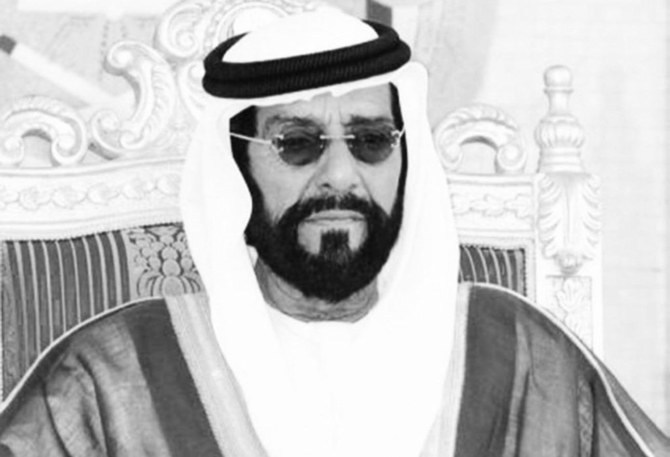
Saudi king, crown prince offer condolences to UAE president on key official’s death

Short Url
Updated 02 May 2024
Follow

Saudi king, crown prince offer condolences to UAE president on key official’s death

RIYADH: Saudi Arabia's King Salman and Crown Prince Mohammed bin Salman on Thursday offered condolences to the ruler of the United Arab Emirates on the death of a key official and a member of the royal family, the Saudi Press Agency reported. 

In a cable to Sheikh Mohammed bin Zayed Al Nahyan, the UAE president, King Salman expressed "our deepest and sincere condolences" on the death of Sheikh Tahnoun bin Mohammed Al Nahyan, Abu Dhabi’s ruler representative in Al Ain, who died on May 1, 2024.

Crown Prince Mohammed bin Salman expressed "my warmest and most sincere condolences" in a separate cable to the UAE leader, the SPA said.


Riyadh Writers Con a bold new chapter for storytellers

Updated 8 sec ago
Follow

Riyadh Writers Con a bold new chapter for storytellers

  • ‘Initiatives like this are vital to the growth of the Saudi creative sector,’ says Princess Noura Al-Saud
  • Saudi author could write the next ‘Star Wars’ or the next big romance, cofounder says

JEDDAH: In a city often understood by its speed and scale of ideas, a creative movement is unfolding around tables with ink stains and unfinished drafts.

Three years ago, British writer Lubna Ahmed-Haque arrived in the Kingdom’s capital and had a simple proposition: coffee and conversation for anyone interested in writing. This idea blossomed into Writers in Riyadh, a community of nearly 600 creatives preparing for its inaugural Riyadh Writers Con in February.

“We are passionate about giving aspiring writers a platform to grow their art and take an idea from being an outline, a thought, into an actual, full-blown story,” Ahmed-Haque told Arab News. “We’re really, really passionate about mental well-being, so that underpins a lot of what we do.” 

Within the community’s story is the larger vision of why Riyadh is becoming the region’s creative capital. As a meeting point of cultures, professions, and creative impulses, the city proved to be fertile ground. From that first coffee meetup, Writers in Riyadh expanded organically into weekly workshops, open mic nights, and poetry supper clubs with Beast House, a members club for creative professionals.

Ahmed-Haque herself understands the vulnerability of the writing process as a medical copywriter working on her own contemporary fantasy novel. “Your first draft is literally you telling yourself the story,” she said. “That’s the best advice someone gave me.”

Writers in Riyadh also addresses something fundamental: writing’s inherent loneliness. “Being able to sit with other people who have been through or are going through the process, it just makes you feel less alone,” she added.

A steady accumulation of voices and needs eventually led to a larger, riskier idea. Enter Mariana De’ Carli, a Brazilian writer with Arab roots who published her first novel “The Knightsbridge Crowd” while living in the Kingdom’s capital and now runs US publishing house SLKY World LLC. The Riyadh Writers Con came into being from what she describes as “a crazy idea” shared during “a frantic phone call with Lubna.”

“People were asking us constantly to repeat workshops with Writers in Riyadh,” De’ Carli told Arab News. “I’ve done my publishing workshop twice and people would still be like, ‘We need more time.’ We would end up getting kicked out of venues just for taking too long.”

Scheduled for Feb. 6-7 at the British International School of Riyadh (Al-Waha campus), the event will feature international speakers, hands-on workshops, a writing competition, and opportunities for aspiring authors to pitch directly to publishers. A pre-conference mixer will be held on Feb. 4 at Beast House.

The conference mirrors Riyadh itself: ambitious, outward-looking, and eager to connect ideas across borders. 

Princess Noura Al-Saud, the founder of two leading Saudi cultural incubators, told Arab News: “Rukun and AlMashtal are proud to take part in the first edition of the Riyadh Writers Conference. Initiatives like this are vital to the growth of the Saudi creative sector, and we are pleased to support and be part of a platform that brings writers and ideas together.”

The first day of Riyadh Writers Con is all about writing craft, opening with Abdul Ghafoor Danish’s keynote speech on “The Art of Storytelling.” A visiting professor at the London School of Business, his stories have moved audiences globally. 

The second day shifts to the business of books, from marketing and branding to platform-building, and the often opaque world of publishing options. Spanish author Laura Opazo Viso will open the day with an introduction to marketing, drawing on her experience as a traditionally-published author in Europe.

That balance between art and infrastructure is reflected in the speaker lineup of local and international creatives and publishing professionals whose work spans continents and genres. 

Contributors include: Rana Hajjar, Leena Magdi, Hiba Noor Khan, Lyrique Richards, Giada Angeli, Shelley Murdoch, Dr. Charles Hall, Amber Lee Ragland, Simar Nounou, and Dina Alzibdeh. The Q App, DQ Living, Crea Print House, Inception and Destination Riyadh are among the community partners. 

Saudi writer and workshop facilitator Raneem Rabaan, who will approach the business side of publishing, told Arab News: ”I want to provide writers with actionable steps, so that as soon as they leave the doors of the venue, they feel capable and empowered enough to let their voices sing.”

Arab Scientific Publishers, Inc., a publishing house in Beirut, will join as the official publisher for the event’s Meet the Publisher session. Lina Chebaro, rights director and chief editor, put it simply: “Together, we are building pathways for stories to travel farther.”

The event’s organizing committee includes authors Elie B. Hart and Deborah Munoz de Cote, as well as Shams Within Wellness founder Ayaz Rehman, DQ Living columnist Mohammed Ameen, graphic designer Farheen Khan, and photographer Arslan Khan.

Writers in Riyadh open mic nights have previously featured performances in Urdu, Chinese, and Arabic; a ventriloquist sharing Saudi culture through his puppet; and a restaurant chef who surprised everyone as an Arabic opera singer. “It was just incredible, emotional talent from someone who would typically be unseen behind the counter,” De’ Carli recalled.

Local businesses have enthusiastically partnered with them. “We’ve never had to pay for a venue,” Ahmed-Haque said. “People are genuinely willing to support communities.”

But that generosity extends beyond logistics, as within the group, knowledge circulates freely. De’ Carli emphasizes beta readers who offer line-by-line feedback, editors who volunteer their expertise, and accountability partners. 

“We’ve heard from our community members of people paying through the roof for mentorship, whereas here people are very generous and donate their time,” she said. “In other places, this would be a very different experience.”

De’ Carli’s own book launch in Riyadh last year is an example of the community showing up to support one of their own. “These are people who had been cheering me on since the very beginning,” she said.

Mental well-being is a through-line, with prompt writing sessions that create a safe space for reflective work. At a poetry supper club recently, a woman who had recently begun her writing journey told Ahmed-Haque: “I just want to share my story as a Saudi woman, about my identity, my struggles.” 

“Being a collective, a community, gives you the opportunity to really soak that magic from one another,” Ahmed-Haque said.

As a publisher in Riyadh and with plans to launch in the Kingdom, De’ Carli brings extensive insight into the regions evolving literary market.

“There are a lot of authors who are keen, who have really original ideas,” she said. But infrastructure is still developing. “We only have the very first agent or two agents maximum.”

And so, opportunity abounds. Saudi authors are moving beyond traditional themes to explore new genres. “We can have a Saudi author who writes the next ‘Star Wars,’ or the next big romance,” De’ Carli said.

Saudi author and founder of Desert Publisher, Mohammed Babelli — among the local industry experts participating — also sees the Kingdom’s publishing industry as an expanding landscape full of opportunities to adapt and evolve.

He told Arab News: “Publishing is going viral on digital platforms. Before, we had either books or periodicals. Now, we have, in addition, a full range of different platforms. This provides more options to those interested, both creators and readers.”

Social media platforms like TikTok are disrupting traditional publishing globally, with young Saudi authors connecting to readers online and catering to their tastes, such as through storytelling tropes and creative book covers to match trends on BookTok.

“We are seeing this huge evolution of the industry,” Di’ Carli said. “Saudis read a lot … People are finding their voice and realizing the constraints and boundaries that were previously a part of traditional publishing worldwide no longer apply in the Internet era.

“We created Riyadh Writers Con to give writers and publishers practical context,” she added. “Not inspiration for its own sake, but insight that supports sustainable publishing decisions.”

De’ Carli is particularly appreciative of the Kingdom’s robust intellectual property framework in a time when creative industries must navigate the intricacies of artificial intelligence. 

“Saudi Arabia has great IP laws. And I’m a big fan of the Saudi IP Authority because they’re very fast to strike down things that are infringing copyright,” she said. 

While AI discourse in the Kingdom is still developing — as opposed to the lawsuit-heavy landscape in the US — De’ Carli sees opportunity in this moment to raise awareness among writers and publishing professionals about authors’ legal rights, emphasizing that Saudi law already protects creators’ autonomy over their copyrighted work. 

Her publishing house amplifies regional writers internationally, creating space for them to tell their stories in their own voices: “We don’t want people writing about Saudi Arabia who have never been here. We want to take the voices of people who live here to an audience in a language that they’re going to understand.”

As the Riyadh Writers Con approaches, those intent on developing their craft have the opportunity to get insights into the full spectrum of the writing and publishing process.

Samantha Moonsammy, cofounder of Lucky Book Publishing in Canada, will lead sessions focused on turning literary ambitions into reality. 

“Riyadh is a city of vision, innovation, and global connection,” she said. “My hope is that attendees leave these workshops seeing their book not as a distant dream, but as a real, doable next step, one that can create ripple effects far beyond the page, in their communities, businesses, and lives.”

Book illustrator Inda Ahmad Zahri, based in Kuala Lumpur, Malaysia, brings her expertise in children’s literature to a session on narrative structure, using picture books as a masterclass. 

“It’s a medium I absolutely love for the layers couched within its seeming simplicity,” she said. “I truly believe the essence of this craft is applicable across all creative writing.”

American author and organizing committee member Hart told Arab News she wants attendees to “feel heard and realize they are existing in a shared experience, not just out to sea alone without a life raft. We want to be that life raft. 

“I am hoping that every creative who comes to the conference can feel a sense of safety, support, and belonging.”

For the members embedded in the community, the transformation over time has been profound. Ciara Bolger Gammans had this to say: “Being a part of Writers in Riyadh has completely transformed how I approach writing. I am writing more consistently and with greater confidence. Everyone is very encouraging and helpful with their feedback.”

New Zealand author Winston Cowie, who is flying in for the conference, said: “I’m eager to meet the burgeoning Saudi Arabian writing community in person. So many cool and exciting things happening in Saudi Arabia at the moment.”

In a digital age that often overwhelms and isolates, perhaps the real story is written in the workshops and poetry readings where someone discovers they are not alone.