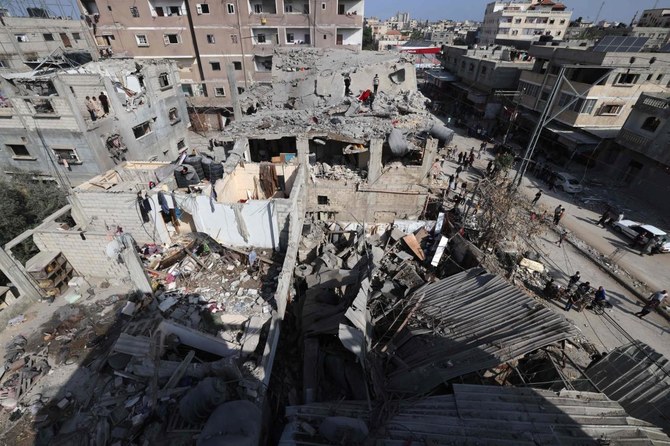
GENEVA: The Gaza Strip is filled with more war debris and rubble than Ukraine, the head of UN demining operations for the narrow Palestinian territory said Wednesday.
And the danger for clearance work is restricted not just to unexploded ordnance but includes possible exposure to toxic substances such as asbestos.
The United Nations Mine Action Service (UNMAS) estimated the amount of debris in Gaza at 37 million tons in mid-April, or 300 kilogrammes per square meter.
“Gaza has more rubble than Ukraine, and to put that in perspective, the Ukrainian front line is 600 miles (nearly 1,000 kilometers) long, and Gaza is 25 miles (40 km) long,” said Mungo Birch, head of the UNMAS program in the Palestinian territories.
But the sheer volume of rubble is not the only problem, said UNMAS.
“This rubble is likely heavily contaminated with UXO (unexploded ordnance), but its clearance will be further complicated by other hazards in the rubble,” Birch told journalists.
“There’s estimated to be over 800,000 tons of asbestos, for instance, alone in the Gaza rubble.” The cancer-causing mineral used in construction requires special precautions when handling.
Birch said he hoped UNMAS, which works to mitigate the threats posed by all types of explosive ordnance, would become the coordination body for mine action in Gaza.
It has secured $5 million of funding but needs a further $40 million to continue its work in Gaza over the next 12 months.
However, “the sector as a whole will need hundreds of millions of US dollars over multiple years in order to make Gaza safe again for the population,” Birch added.
The Gaza war started after Hamas’s October 7 attack on southern Israel, which resulted in the deaths of 1,170 people, mostly civilians, according to an AFP tally of Israeli official figures.
Israel’s retaliatory offensive has killed at least 34,568 people in Gaza, mostly women and children, according to the health ministry in the Hamas-run territory.


![]()
![]()

More war debris in Gaza than Ukraine: UN

Short Url
https://arab.news/5rzgj
More war debris in Gaza than Ukraine: UN
- UNMAS estimated the amount of debris in Gaza at 37 million tons in mid-April or 300 kilogrammes per square meter
- “Gaza has more rubble than Ukraine, and to put that in perspective, the Ukrainian front line is nearly 1,000 kilometers long, and Gaza is 40 km long,” said UNMAS’s head Mungo Birch


Latest updates


© 2026 SAUDI RESEARCH & PUBLISHING COMPANY, All Rights Reserved And subject to Terms of Use Agreement.