Pakistan to launch ‘historic’ lunar mission aboard China’s Chang’e 6 on May 3

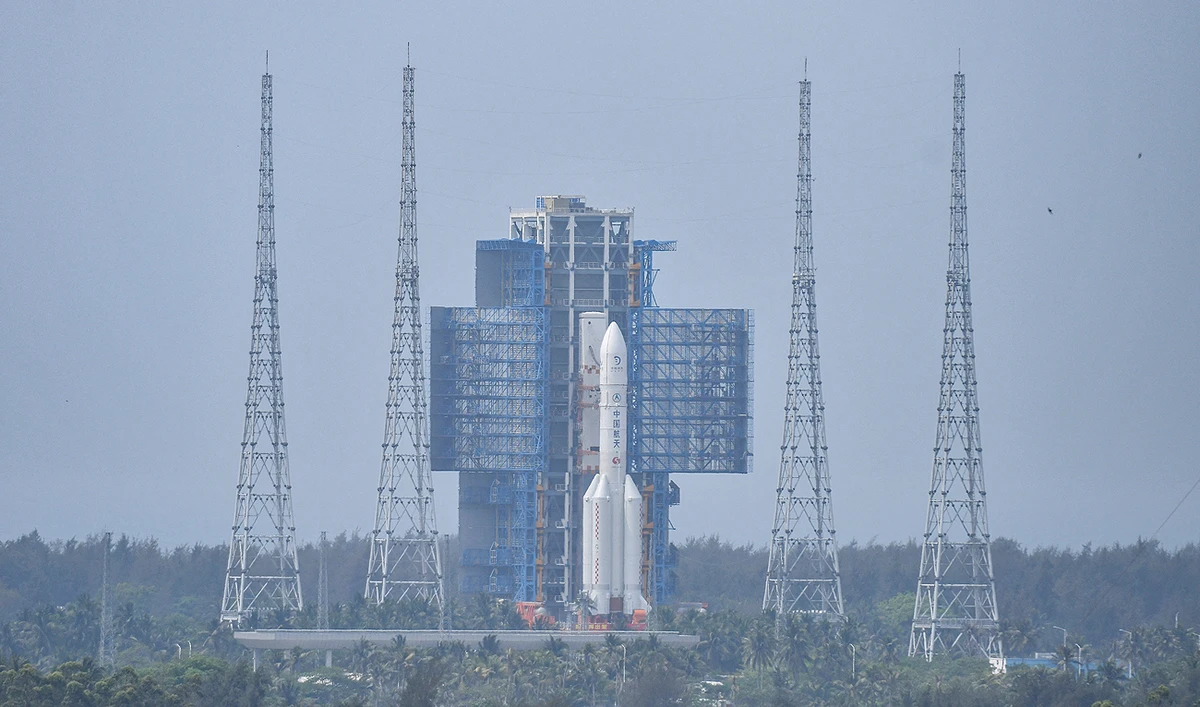
The Chang’e 6 lunar probe and the Long March-5 Y8 carrier rocket combination sit atop the launch pad at the Wenchang Space Launch Site in Hainan province, China April 27, 2024. (CNS Photo via REUTERS)
Short Url
Updated 01 May 2024
Follow

Pakistan to launch ‘historic’ lunar mission aboard China’s Chang’e 6 on May 3

  • Pakistan’s Institute of Space Technology has built ICUBE-Q in collaboration with Shanghai University and SUPARCO
  • The student-built payload carries two optical cameras to image lunar surface and will be part of China’s mission to the Moon

ISLAMABAD: Pakistan is scheduled to send its “historic” lunar mission (ICUBE-Q) on board China’s Chang’e6 which is scheduled to be launched on May 3, reported the state-owned Associated Press of Pakistan (APP) news agency on Tuesday.
ICUBE-Q has been designed and developed by the Institute of Space Technology in collaboration with China’s Shanghai University and Pakistan’s national space agency SUPARCO.
“ICUBE-Q orbiter carries two optical cameras to image the lunar surface,” the APP reported. “Following successful qualification and testing, ICUBE-Q has now been integrated with the Chang’e 6 mission.”
China is set to launch a first ever attempt to collect samples from the far side of the Moon.
The Chinese mission aims to grab samples containing material ejected from the lunar mantle and thus provide insight into the history of the Moon, Earth and Solar System.
According to the website of the Institute of Space Technology, China’s national space agency allowed Asia Pacific Space Cooperation Organization member states to send student-built payload to the Moon with its mission.
The Pakistani institution built a device that was selected for the purpose after rigorous evaluation.


Pakistan Airports Authority reports ‘historic’ twin-engine aircraft landing in Lahore

Updated 13 December 2025
Follow

Pakistan Airports Authority reports ‘historic’ twin-engine aircraft landing in Lahore

  • Twin-engine aircraft are usually larger, heavier and require better airport infrastructure, navigation systems to land
  • Pakistan Airports Authority says landing reflects its commitment to enhance aviation sector, strengthen infrastructure

ISLAMABAD: The Pakistan Airports Authority (PAA) announced on Saturday that the New General Aviation Aerodrome achieved a significant milestone when it handled the landing of a twin-engine aircraft. 

A twin-engine aircraft has two engines that provide it redundancy and increased performance compared to single-engine counterparts. These aircraft range from small twin-engine propeller planes to large commercial jetliners. The presence of multiple engines enhances safety by allowing the aircraft to continue flying in the event of an engine failure.

However, twin-engine aircraft are usually larger, heavier and more complex than single-engine planes. They require advanced airport infrastructure such as better runways, navigation systems and air traffic coordination. 

“The New General Aviation Aerodrome, Lahore achieved another significant operational milestone today with the successful landing of a twin-engine aircraft, following the recent arrival of a single-engine aircraft,” the PAA said in a statement. 

It said the flight was also boarded by Air Vice Marshal Zeeshan Saeed, the director general of the PAA. The move reflected “strong institutional confidence” in the aerodrome’s safety standards, operational capability, and overall readiness, it added. 

“The landing was conducted with exceptional precision and professionalism, demonstrating the aerodrome’s robust operational framework, technical preparedness, and effective airside coordination in accordance with contemporary aviation requirements,” the PAA said. 

It said the landing represented a “major advancement” in Pakistan’s general aviation sector and underscores the PAA’s commitment to enhancing regional aviation capacity, strengthening infrastructure and promoting excellence in aviation development.