WASHINGTON: House Republicans on Tuesday announced an investigation into the federal funding for universities where students have protested the Israel-Hamas war, broadening a campaign that has placed heavy scrutiny on how presidents at the nation’s most prestigious colleges have dealt with reports of antisemitism on campus.
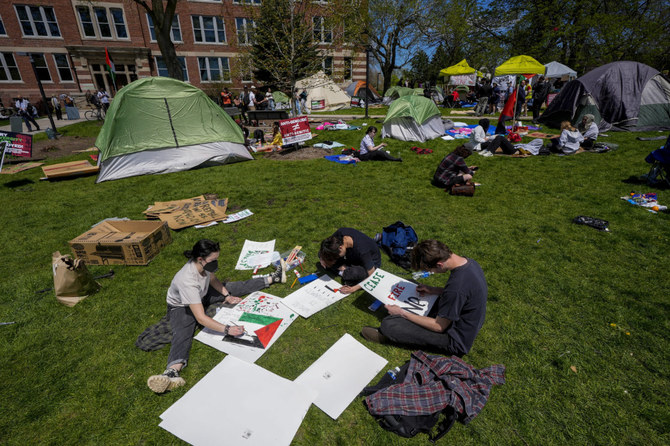
Several House committees will be tasked with a wide probe that ultimately threatens to withhold federal research grants and other government support to the universities, placing another pressure point on campus administrators who are struggling to manage pro-Palestinian encampments, allegations of discrimination against Jewish students and questions of how they are integrating free speech and campus safety.
The House investigation follows several recent high-profile hearings that precipitated the resignations of presidents at Harvard and the University of Pennsylvania. And House Republicans promised more scrutiny, saying they were calling on the administrators of Yale, UCLA and the University of Michigan to testify next month.
“We will not allow antisemitism to thrive on campus, and we will hold these universities accountable for their failure to protect Jewish students on campus,” said House Speaker Mike Johnson at a news conference.
Nationwide, campus protesters have called for their institutions to cut financial ties to Israel and decried how thousands of civilians in Gaza have been killed by Israel following the deadly attack by Hamas on Oct. 7.
Some organizers have called for Hamas to violently seize Israeli territory and derided Zionism. Jewish students, meanwhile, have reported being targeted and say campus administrators have not done enough to protect them.
After Johnson visited Columbia last week with several other top House Republicans, he said “the anti-Jewish hatred was appalling.”
Republicans are also turning to the issue at a time when election season is fully underway and leadership needs a cause that unites them and divides Democrats. The House GOP’s impeachment inquiry into President Joe Biden has fallen flat and the Republican conference is smarting after a series of important bills left GOP lawmakers deeply divided. Democrats have feuded internally at times over the Israel-Hamas war and how campus administrators have handled the protests.
Senate Majority Leader Chuck Schumer, a New York Democrat, said in a floor speech Tuesday that it was “unacceptable when Jewish students are targeted for being Jewish, when protests exhibit verbal abuse, systemic intimidation, or glorification of the murderous and hateful Hamas or the violence of October 7th.”
Rep. Pete Aguilar, the No. 3 House Democrat, at a news conference Tuesday said that it was important for colleges “to ensure that everybody has an ability to protest and to make their voice heard but they have a responsibility to honor the safety of individuals.”
“For many of Jewish descent, they do not feel safe, and that is a real issue,” he said, but added that he wanted to allow university administrators to act before Congress stepped in.
But the Republican speaker promised to use “all the tools available” to push the universities. Johnson was joined by chairs for six committees with jurisdiction over a wide range of government programs, including National Science Foundation grants, health research grants, visas for international students and the tax code for nonprofit universities.
Without Democratic support in the divided Congress, it is not clear what legislative punishments House Republicans could actually implement. Any bills from the House would be unlikely to advance in the Democratic-controlled Senate.
But so far, the House hearings with university presidents have produced viral moments and given Republicans high-profile opportunities to denounce campuses as hotbeds of antisemitism. In December, the presidents of Ivy League universities struggled to answer pointed questions about whether “calling for the genocide of Jews” would violate each university’s code of conduct.
Rep. Elize Stefanik, the New York Republican who posed the question in the December hearing, said it became the highest-viewed congressional hearing in history. She also cast the campaign against antisemitism as part of a broader conservative push against what they say is overt liberal bias at elite American universities.
“Enough is enough,” she said. “It is time to restore law and order, academic integrity and moral decency to America’s higher education institutions.”
The House Committee on Education and the Workforce is also requesting that the administrators of Yale, UCLA and the University of Michigan appear at a hearing on May 23 that focuses on how they handled the recent protests.
“As Republican leaders, we have a clear message for mealy-mouthed, spineless leaders: Congress will not tolerate your dereliction of duty to your Jewish students,” said the committee chair, North Carolina Rep. Virginia Foxx.
At a hearing of the committee earlier this month, Columbia University’s president took a firm stance against antisemitism. But at the same time, a protest was underway on Columbia’s campus that would soon set off others like it nationwide. The university began suspending students this week in an attempt to clear the protest encampment on campus.
The university is also facing federal legal complaints. A class-action lawsuit on behalf of Jewish students alleges Columbia breached its contract by failing to maintain a safe learning environment.
Meanwhile, a legal group representing pro-Palestinian students is urging the US Department of Education’s civil rights office to investigate whether Columbia’s treatment of the protesting students violated the Civil Rights Act of 1964.
Senate Republican Leader Mitch McConnell called on university administrators to “take charge.”
“On campus, protect Jewish community members. Clear the encampments. Let students go to class and take their exams. And allow graduations to proceed,” he said.


![]()

House Republicans launch investigation into federal funding for universities amid campus protests
Short Url
https://arab.news/n78mt
House Republicans launch investigation into federal funding for universities amid campus protests
- Nationwide, campus protesters have called for their institutions to cut financial ties to Israel


Latest updates






© 2026 SAUDI RESEARCH & PUBLISHING COMPANY, All Rights Reserved And subject to Terms of Use Agreement.