RedBird IMI withdraws from Telegraph deal, to sell UK newspaper

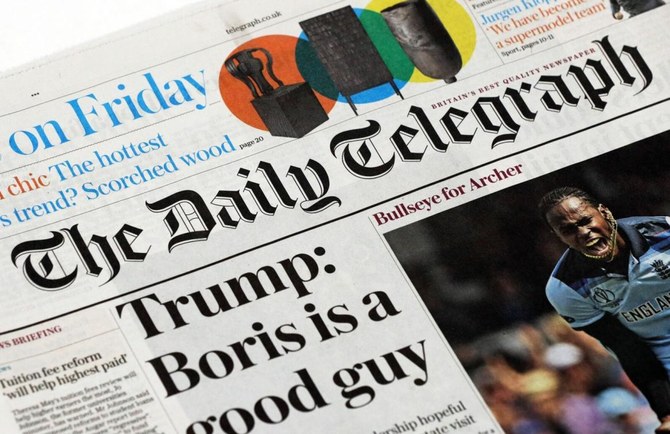
Culture Secretary Lucy Frazer said on Tuesday she would now allow RedBird IMI to conduct an orderly sale of the titles. (AFP/File)
Short Url
Updated 30 April 2024
Follow

RedBird IMI withdraws from Telegraph deal, to sell UK newspaper

  • Abu Dhabi-backed investor group to sell media outlet following government ban on foreign entities owning national newspapers
  • RedBird IMI says its focus is on securing the best price for the titles, but experts fear the asset could fecth a lower price than what was originally paid

LONDON: Abu Dhabi-backed RedBird IMI on Tuesday said it would sell the Telegraph after it scrapped its acquisition of the right-leaning newspaper group because government intervention meant the deal was “no longer feasible.”
RedBird IMI effectively took control of the Telegraph and the Spectator magazine in December when it repaid a debt owed by then-owner the Barclay family to Lloyds Bank, including a 600 million pound ($753 million) loan against the titles.
But the acquisition, which already faced a lengthy regulatory inquiry, was dealt a blow last month when Britain said it would stop foreign governments owning newspapers.
“RedBird IMI has today confirmed that it intends to withdraw from its proposed acquisition of the Telegraph Media Group and proceed with a sale,” a RedBird IMI spokesperson said.
“We have held constructive conversations with the government about ensuring a smooth and orderly sale for both titles.”
RedBird IMI, led by former CNN executive Jeff Zucker, is backed by Mansour bin Zayed Al Nahyan, a member of Abu Dhabi’s ruling family and the owner of Manchester City soccer club.
The government issued a notice in December stopping RedBird IMI transferring ownership of the newspaper or changing its management and board while it investigated the deal.
Culture Secretary Lucy Frazer said on Tuesday she would now allow RedBird IMI to conduct an orderly sale of the titles after it had signalled its intention to withdraw.
“Throughout this process I have raised concerns about the potential impact of this deal on free expression and accurate presentation of news, and I took steps to ensure that media freedom was protected while there was an investigation into those concerns,” she said.
RedBird IMI said its focus was on securing the best price for the titles, which are close to the ruling Conservatives.
Parties previously interested in the assets include hedge fund boss Paul Marshall, Daily Mail owner DMGT as well as private equity buyers.


Disinformation the new enemy in disaster zones, says Red Cross

Updated 05 March 2026
Follow

Disinformation the new enemy in disaster zones, says Red Cross

  • “Harmful information and dehumanizing narratives” undermines humanitarian aid and putting lives of aid workers at risk
  • Between 2020 and 2024, disasters affected nearly 700 million people, displaced over 105 million, and killed more than 270,000 — doubling the number in need of humanitarian aid

GENEVA: The rise of disinformation is undermining humanitarian aid and putting lives at risk, while disasters are affecting ever more people, the Red Cross warned Thursday.
“Between 2020 and 2024, disasters affected nearly 700 million people, caused more than 105 million displacements, and claimed over 270,000 lives,” the International Federation of Red Cross and Red Crescent Societies said.
The number of people needing humanitarian assistance more than doubled in the same timeframe, the IFRC said in its World Disasters Report 2026.
But the world’s largest humanitarian network said that “harmful information and dehumanizing narratives” were increasingly undermining trust, putting the lives of aid workers at risk.
“In polarized and politically-charged contexts, humanitarian principles such as neutrality and impartiality are increasingly misunderstood, misrepresented or deliberately attacked online,” it said.
The IFRC has more than 17 million volunteers across more than 191 countries.
“In every crisis I have witnessed, information is as essential as food, water and shelter,” said the Geneva-based federation’s secretary general Jagan Chapagain.
“But when information is false, misleading or deliberately manipulated, it can deepen fear, obstruct humanitarian access and cost lives.”
He said harmful information was not a new phenomenon, but it was now moving “with unprecedented speed and reach.”
Chapagain said digital platforms were proving “fertile ground for lies.”
The IFRC report said the challenge nowadays was no longer about the availability of information but its reliability, noting that the production and spread of disinformation was easily amplified by artificial intelligence.

- ‘Life and death’ -

The report cited numerous recent examples of harmful information hampering crisis response.
During the 2024 floods in Valencia, false narratives online accused the Spanish Red Cross of diverting aid to migrants, which in turn fueled “xenophobic attacks on volunteers,” the IFRC said.
In South Sudan, rumors that humanitarian agencies were distributing poisoned food “caused people to avoid life-saving aid” and led to threats against Red Cross staff.
In Lebanon, false claims that volunteers were spreading Covid-19, favoring certain groups with aid and providing unsafe cholera vaccines eroded trust and endangered vulnerable communities, the IFRC said.
And in Bangladesh, during political unrest, volunteers faced “widespread accusations of inaction and political alignment,” leading to harassment and reputational damage, it added.
Similar events were registered by the IFRC in Sudan, Myanmar, Peru, the United States, New Zealand, Canada, Kenya and Bulgaria.
The report underlined that around 94 percent of disasters were handled by national authorities and local communities, without international interventions.
“However, while volunteers, local leaders and community media are often the most trusted messengers, they operate in increasingly hostile and polarized information environments,” the IFRC said.
The federation called on governments, tech firms, humanitarian agencies and local actors to recognize that reliable information “is a matter of life and death.”
“Without trust, people are less likely to prepare, seek help or follow life-saving guidance; with it, communities act together, absorb shocks and recover more effectively,” said Chapagain.
The organization urged technology platforms to prioritize authoritative information from trusted sources in crisis contexts, and transparently moderate harmful content.
And it said humanitarian agencies needed to make preparing to deal with disinformation “a core function” of their operations, with trained teams and analytics.