Unrivaled UAE investment pledged for The Telegraph in RedBird IMI takeover bid

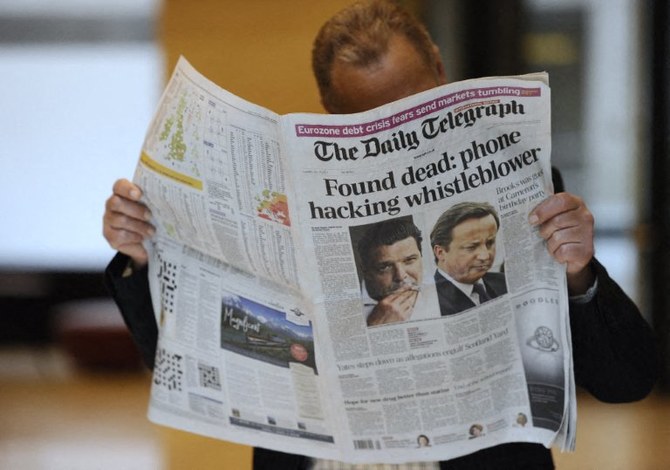
Raad highlighted RedBird IMI’s commitment to expanding The Telegraph brand amidst challenges facing the UK and US media industries. (AFP/File)
Short Url
Updated 16 February 2024
Follow

Unrivaled UAE investment pledged for The Telegraph in RedBird IMI takeover bid

  • Abu Dhabi-led group says it will preserve journalistic integrity, expand group if deal goes through
  • IMI CEO Rani Raad addresses takeover ‘misconception’ in newspaper column

LONDON: The chief executive of UAE-based International Media Investments has pledged unparalleled investment for The Telegraph if the company’s takeover bid is successful.

Rani Raad said in a column in the newspaper on Friday that the Emirati group could “offer investment to The Telegraph like nobody else.” IMI is providing 75 percent of the funding for RedBird IMI’s proposed deal.

In the first public comments about the bid, Raad wrote: “The motives of the people who own national newspapers matter more than ever at a time where there are legitimate fears about a post-truth world and alternative facts.

“That is even more the case when those newspapers have the history and status of The Daily and Sunday Telegraph, and The Spectator.”

Addressing what he called “several significant misconceptions,” Raad offered assurances that RedBird IMI was committed to preserving the heritage and stature of the publications and safeguarding their “distinctive editorial focus and fearless journalism.”

He said: “We are clear about what stays the same if our bid is successful: the independence, editorial integrity, and point of view of all the titles is beyond question. I can go further: the quality of the journalism and the titles are inviolable.”

Raad, a former president of CNN Commercial Worldwide, sought to allay fears that the historic newspaper group could become a PR arm of the Emirati government.

If the takeover happened, he said, RedBird — a US private equity firm contributing 25 percent of the £600m price tag — would manage The Telegraph and be shielded from external interference by legislation. 

“So let me address the elephant in the living room,” Raad said. “At IMI, we are not going to get involved in what The Telegraph reports or chooses not to write about.

“We have learned the lessons of News Corp, when promises were made that were never fully kept,” he added, referring to failed promises made during Rupert Murdoch’s takeover of The Times. “Ours meet a far higher standard of enforceability.”

Raad said no job losses were anticipated. He also highlighted RedBird IMI’s commitment to expanding The Telegraph brand amidst challenges facing the UK and US media industries.

While rival bidders — including a consortium led by hedge fund billionaires Sir Paul Marshall and Ken Griffin, and the publisher of the Daily Mail — remain interested in acquiring The Telegraph, the deal with RedBird IMI faces various obstacles. These include cross-party opposition from Britain’s parliament and scrutiny from Ofcom, the UK’s media regulator.

Signaling its ongoing investment strategy, RedBird IMI announced on Friday it had acquired British production and distribution company All3Media for a reported $1.45 billion.


Saudi Media Forum urges ethical coverage as crises redefine Arab journalism

Updated 04 February 2026
Follow

Saudi Media Forum urges ethical coverage as crises redefine Arab journalism

  • Raw news without context can mislead audiences and distort credibility, experts say

RIYADH: Arab media was born in crisis and shaped by conflict rather than stability, Malik Al-Rougi, general manager of Thaqafeyah Channel, said during the Saudi Media Forum in Riyadh on Wednesday.

Al-Rougi was speaking during a panel titled “Media and Crises: The Battle for Awareness and the Challenges of Responsible Coverage,” which examined how news organizations across the region navigated credibility and professional standards amid fast-moving regional developments.

“Today, when you build a media organization and invest in it for many years, a single crisis can destroy it,” he said.

Referring to recent events, Al-Rougi said that he had witnessed news channels whose credibility “collapsed overnight.”

“In journalistic and political terms, this is not a process of news production. It is a process of propaganda production,” he said. “The damage caused by such a post … is enormous for an institution in which millions, perhaps billions, have been invested.”

When a media outlet shifts from professionalism and credibility toward “propaganda,” he added, it moves away from its core role. 

Saudi media leaders, journalists, and experts gathered at the Saudi Media Forum in Riyadh to discuss credibility, ethics, and innovation. (AN photo by Huda Bashatah/Supplied)

“A crisis can work for you or against you,” Al-Rougi added. “When, in the heart of a crisis, you demonstrate high credibility and composure, you move light-years ahead. When you fail to adhere to ethical standards, you lose light-years as well.”

Abdullah Al-Assaf, professor of political media studies at Imam Muhammad bin Saud Islamic University, said that in many crises across the Arab world, agendas and directives had often prevailed over professionalism.

“Credibility was buried,” he added.

Hasan Al-Mustafa, writer and researcher at Al-Arabiya channel, said that raw information could be subject to multiple interpretations if not placed within a proper political, security, historical or geographical context.

He added that such an approach was urgently needed during periods of political and security volatility in the Middle East. 

When, in the heart of a crisis, you demonstrate high credibility and composure, you move light-years ahead. When you fail to adhere to ethical standards, you lose light-years as well.

Malik Al-Rougi Thaqafeyah, Channel general manager

“This objectivity, or this reliability, is a great responsibility,” Al-Mustafa said. “It is reflected not only in its impact on the audience, but also on the credibility of the content creator.”

Al-Mustafa warned against populism and haste in coverage, saying that they risked deepening crises rather than providing informed public perspectives.

He also said that competition with social media influencers had pushed some traditional outlets to imitate influencer-driven models instead of strengthening their own professional standards.

“Our media has been crisis-driven for decades,” he said, describing much of the region’s coverage as reactive rather than proactive.

During a separate panel titled “The Official Voice in the Digital Age: Strategies of Influence,” speakers discussed how rapid technological and social changes were reshaping the role of institutional spokespersons.

Abdulrahman Alhusain, official spokesperson of the Saudi Ministry of Commerce, said that the role was no longer limited to delivering statements or reacting to events.

“Today, the spokesperson must be the director of the scene — the director of the media narrative,” he said.

Audiences, he added, no longer accept isolated pieces of information unless they were presented within a clear narrative and structure.

“In the past, a spokesperson was expected to deliver formal presentations. Today, what is required is dialogue. The role may once required defense, but now it must involve discussion, the exchange of views, and open, candid conversation aimed at development — regardless of how harsh the criticism may be.”

He said that spokespersons must also be guided by data, digital indicators and artificial intelligence to understand public opinion before speaking.

“You must choose the right timing, the right method and the right vocabulary. You must anticipate a crisis before it happens. That is your role.”

Abdullah Aloraij, general manager of media at the Riyadh Region Municipality, said that the most important skill for a spokesperson today was the ability to analyze and monitor public discourse.

“The challenge is not in transferring words, but in transferring understanding and impact in the right way,” he said.