

JERUSALEM: Hamas was studying Tuesday Israel’s offer of a 40-day truce in the war in the Gaza Strip in exchange for the release of scores of hostages held since the Palestinian militant group’s October 7 attacks.
Returning to Qatar after the latest talks in Cairo, the Hamas delegation said it would “discuss the ideas and the proposal... we are keen to respond as quickly as possible,” a Hamas source told AFP on condition of anonymity.
Egyptian sources told Al-Qahera News, a site linked to Egyptian intelligence services, that the Hamas delegation would “return with a written response.”
US Secretary of State Antony Blinken described the truce terms as “extraordinarily generous,” while the White House asked fellow mediators Egypt and Qatar to increase pressure on Hamas to accept the latest push to halt the nearly seven-month-old war.
According to Monday night call readouts, US President Joe Biden urged the Egyptian and Qatari leaders “to exert all efforts to secure the release of hostages held by Hamas,” calling this “the only obstacle” to securing relief for civilians in the besieged strip.
For months, Egypt, Qatar and the United States have been trying to secure a new agreement between the combatants. A one-week truce in November saw 80 Israeli hostages exchanged for 240 Palestinians held in Israeli prisons.
Relentless Israeli bombardment has meanwhile devastated Hamas-run Gaza, flattening much of the territory and bringing its people to the brink of famine, while threatening to unfurl into a wider regional conflict.
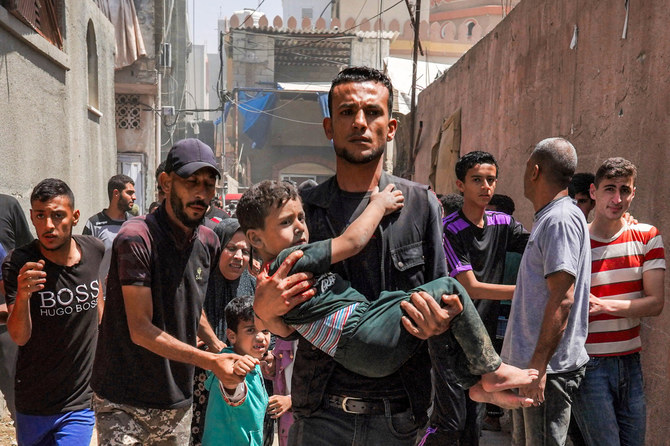
In the far southern city of Rafah, Palestinians despaired over the war while searching for victims of the latest strike.
“Civilian individuals with no ties to Hamas or any other group were struck by a rocket, torn apart,” Um Louay Masri said at a destroyed building where children were being pulled out from underneath the rubble. “Why did this occur?“
To global alarm, Israel has vowed to go after Hamas battalions in Rafah, where the majority of Gaza’s 2.4 million people have sought refuge.
But Foreign Minister Israel Katz said over the weekend the government may “suspend” that operation if a truce is reached.
Blinken’s Mideast tour
Speaking in Riyadh on his seventh visit to the region since the start of the war in Gaza, top US diplomat Blinken underscored the need for Hamas to “decide quickly” on the truce.
He told a World Economic Forum special meeting that he was “hopeful that they will make the right decision.”
At the WEF meeting, Egypt’s Foreign Minister Sameh Shoukry said “the proposal has taken into account the positions of both sides.”
“We are hopeful,” he added.
British Foreign Secretary David Cameron said that Hamas has been offered a “sustained 40 days’ ceasefire, the release of potentially thousands of Palestinian prisoners, in return for the release of these hostages.”
On the sidelines of the WEF, US, European and Arab representatives met to discuss how to advance a two-state solution to the Israeli-Palestinian conflict.
Saudi Foreign Minister Prince Faisal bin Farhan told the gathering that tangible and irreversible steps toward establishing a Palestinian state would be an essential component of any durable ceasefire deal.
To incentivise Israel to support a Palestinian state, Washington has pushed the prospect of normalized Israel-Saudi relations, with Blinken suggesting Monday that some progress was being made in that arena.
Israeli Prime Minister Benjamin Netanyahu is a long-standing opponent of Palestinian statehood however, and Israel has previously rejected a permanent ceasefire.
A Hamas source has told AFP the group is keen for a deal that “guarantees a permanent ceasefire, the free return of displaced people, an acceptable deal for (a prisoner-hostage) exchange and an end to the siege” in Gaza.
Mounting pressure
Netanyahu is under tremendous pressure from the families of hostages taken by Hamas in the October 7 attack to secure their release.
On Monday, the families of two Israeli captives seen alive in a video released by Hamas last weekend called for their release.
“I demand the leaders of the free world to help us bring our people home,” said Aviva Siegel, who was freed in the November truce and is the wife of captive Keith Siegel.
Israel estimates 129 hostages remain in Gaza, including 34 believed to be dead.
Hamas’s attack resulted in the deaths of about 1,170 people in Israel, mostly civilians, according to an AFP tally based on Israeli official figures.
Israel’s retaliatory offensive has killed at least 34,488 people in Gaza, mostly women and children, according to the health ministry in the Hamas-run territory.
That tally includes at least 34 deaths in a 24-hour window, the ministry said Monday, down from a peak this month of at least 153 deaths on April 9.
At Rafah’s Al-Najjar hospital, a crowd of grief-stricken relatives jostled over the dead, shrouded in white.
“We demand the entire world to call for a lasting truce,” Abu Taha said at the hospital.
Access of aid
After an Israeli drone strike in early April killed seven workers from a US-based charity, Biden suggested to Netanyahu, for the first time, that continued US support could be conditional on protection and aid for civilians.
On Sunday, the White House said Israel was letting more aid trucks into Gaza in line with “commitments” Biden asked it to meet.
The UN has, however, continued to cite “access constraints” that significantly hinder delivery.
The US military is building a pier to help boost humanitarian supplies — an effort that the Pentagon on Monday said would cost Washington at least $320 million.
The UN has warned a heatwave and the proliferation of insects are increasing the risk for diseases at the swelling tent cities in Gaza.
“I have sick children who cannot tolerate the heat,” said Alaa Al-Saleh, a Palestinian displaced to an encampment in Rafah. “We are cramped inside the tent, rarely going outside.”


