PM welcomes Saudi Arabia’s interest in developing energy projects in Pakistan

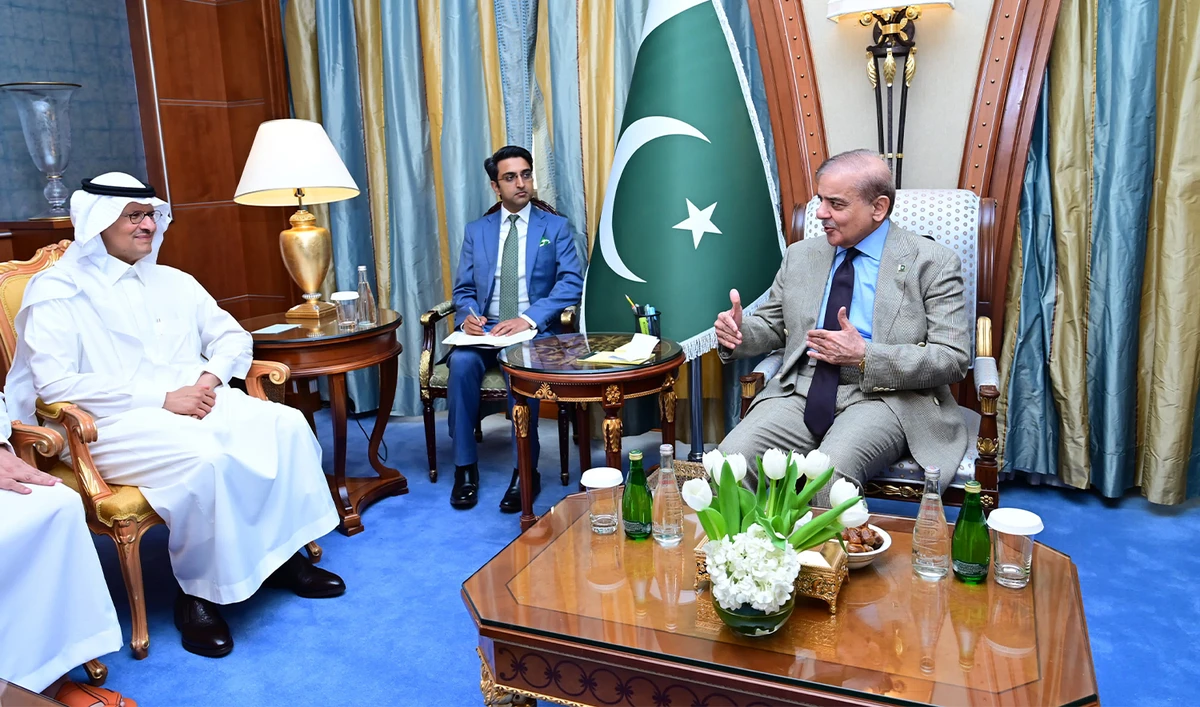
Pakistan Prime Minister Shehbaz Sharif (R) meets Saudi Energy Minister Prince Abdulaziz bin Salman in Riyadh, Pakistan on April 29, 2024. (PID)
Short Url
Updated 30 April 2024
Follow

PM welcomes Saudi Arabia’s interest in developing energy projects in Pakistan

  • PM Shehbaz Sharif met Saudi Energy Minister Prince Abdulaziz bin Salman on WEF sidelines in Riyadh
  • The PM highlighted various initiatives undertaken by Pakistan to facilitate investment in energy sector

ISLAMABAD: Prime Minister Shehbaz Sharif has welcomed Saudi Arabia’s interest in developing energy projects in Pakistan, Sharif’s office said on Monday, following his meetings with Saudi officials on the sidelines of a World Economic Forum (WEF) meeting in Riyadh.

The Pakistan prime minister was in Riyadh to attend the WEF special meeting on Global Collaboration, Growth and Energy for Development on April 28-29.

During his visit, PM Sharif held meetings with Saudi Arabia’s ministers of energy, economy and planning, and environment, water, and agriculture, according to his office.

In a meeting with Saudi Energy Minister Prince Abdulaziz bin Salman, the PM highlighted initiatives undertaken by Pakistan to facilitate investment in the energy sector.

“The Saudi side showed keen interest in developing energy projects identified by the Prime Minister,” Sharif’s office said in a statement. “The Prime Minister welcomed the interest by the Kingdom to enhance economic partnership with Pakistan.”

The proposed projects included building new and improving existing energy infrastructure, increasing focus on renewable energy, and bringing efficiency across the entire energy ecosystem in Pakistan, according to the statement. 

The Saudi energy minister was accompanied by the president of Aramco, a Saudi state-owned petroleum and natural gas company, and other officials.

PM Sharif said both sides were pursuing the economic cooperation agenda with “renewed vigour and commitment,” following his meeting with Crown Prince Mohammed bin Salman on Sunday.

He expressed hope that technical teams of the two countries would complete their work and many mutually beneficial projects would be launched soon.

Pakistan and Saudi Arabia enjoy strong trade, defense and cultural ties. The Kingdom is home to over 2.7 million Pakistani expatriates and serves as the top source of remittances to the cash-strapped South Asian country.

Both countries have been closely working to increase bilateral trade and investment deals, and the Kingdom recently reaffirmed its commitment to expedite an investment package worth $5 billion.

Later, PM Sharif held a meeting with Saudi Minister of Economy and Planning Faisal Al-Ibrahim, wherein he highlighted the potential of the Pakistani agriculture sector.

“Pakistan can become a bread basket for the Kingdom and could play a critical role in ensuring food security not only for the two countries but for the entire region,” Sharif’s office quoted him as saying.

Saudi Minister for Environment, Water and Agriculture Abdulrahman Al-Fadhli briefed the prime minister on the fruitful discussions that he and his delegation held in Islamabad this month, according to Sharif’s office. He said Saudi agriculture companies were looking at Pakistan with “great interest” and hoped that both countries would benefit from joint ventures for improving the value chain of the agriculture economy.

PM Sharif also congratulated the Saudi minister of economy for successfully hosting the WEF summit in Riyadh and lauded the Kingdom’s role as a thought leader in taking forward the global economic and development agenda.
UN torture expert decries Pakistan ex-PM Khan’s detention

Updated 12 December 2025
Follow

UN torture expert decries Pakistan ex-PM Khan’s detention

  • Khan’s party alleges government is holding him in solitary confinement, barring prison visits
  • Pakistan’s government rejects allegations former premier is being denied basic rights in prison

GENEVA: Pakistan’s former prime minister Imran Khan is being held in conditions that could amount to torture and other inhuman or degrading treatment, the United Nations’ special rapporteur on torture warned Friday.

Alice Jill Edwards urged Pakistan to take immediate and effective action to address reports of the 73-year-old’s inhumane and undignified detention conditions.

“I call on Pakistani authorities to ensure that Khan’s conditions of detention fully comply with international norms and standards,” Edwards said in a statement.

“Since his transfer to Adiala Jail in Rawalpindi on September 26, 2023, Imran Khan has reportedly been held for excessive periods in solitary confinement, confined for 23 hours a day in his cell, and with highly restricted access to the outside world,” she said.

“His cell is reportedly under constant camera surveillance.”

Khan an all-rounder who captained Pakistan to victory in the 1992 Cricket World Cup, upended Pakistani politics by becoming the prime minister in 2018.

Edwards said prolonged or indefinite solitary confinement is prohibited under international human rights law and constitutes a form of psychological torture when it lasts longer than 15 days.

“Khan’s solitary confinement should be lifted without delay. Not only is it an unlawful measure, extended isolation can bring about very harmful consequences for his physical and mental health,” she said.

UN special rapporteurs are independent experts mandated by the Human Rights Council. They do not, therefore, speak for the United Nations itself.

Initially a strong backer of the country’s powerful military leadership, Khan was ousted in a no-confidence vote in 2022, and has since been jailed on a slew of corruption charges that he denies.

He has accused the military of orchestrating his downfall and pursuing his Tehreek-e-Insaf (PTI) party and its allies.

Khan’s supporters say he is being denied prison visits from lawyers and family after a fiery social media post this month accusing army leader Field Marshal Asim Munir of persecuting him.

According to information Edwards has received, visits from Khan’s lawyers and relatives are frequently interrupted or ended prematurely, while he is held in a small cell lacking natural light and adequate ventilation.

“Anyone deprived of liberty must be treated with humanity and dignity,” the UN expert said.

“Detention conditions must reflect the individual’s age and health situation, including appropriate sleeping arrangements, climatic protection, adequate space, lighting, heating, and ventilation.”

Edwards has raised Khan’s situation with the Pakistani government.