

US President holds separate calls with leaders from Qatar, Egypt over Gaza ceasefire talks

1 / 4
US President Joe Biden speaks on the phone. (AFP file photo)
2 / 4
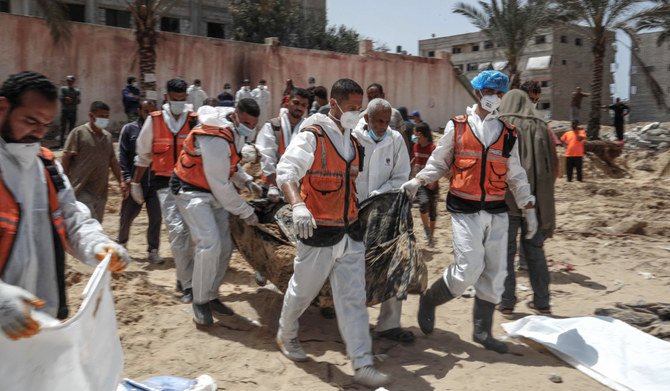
People and health workers unearth bodies found at Nasser Hospital in Khan Yunis in the southern Gaza Strip on April 23, 2024 amid the ongoing conflict between Israel and the Palestinian militant group Hamas. (AFP)
3 / 4
A person looks at a vehicle where employees from the World Central Kitchen (WCK), including foreigners, were killed in an Israeli airstrike, according to the NGO as the Israeli military said it was conducting a thorough review at the highest levels to understand the circumstances of this "tragic" incident, amid the ongoing conflict between Israel and Hamas, in Deir Al-Balah, in the central Gaza, Strip April 2, 2024. (REUTERS)
4 / 4
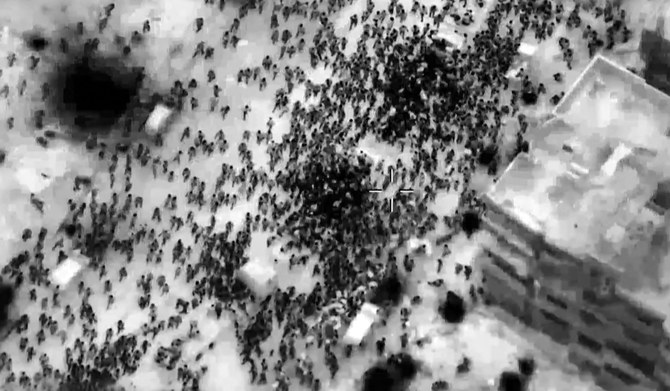
Israeli forces shot dead 104 people when a crowd rushed towards aid trucks on February 29, the health ministry in Hamas-run Gaza said. (AFP file photo)
Short Url
Updated 30 April 2024
Follow

US President holds separate calls with leaders from Qatar, Egypt over Gaza ceasefire talks

  • The danger of a military escalation in Rafah was also stressed, in how it would add catastrophe to an already worsening humanitarian crisis that would impact stability and security in the region, the statement said

CAIRO: Egyptian President Abdel Fattah El-Sisi received a phone call on Monday from US President Joe Biden to discuss the latest developments in negotiations over a ceasefire in Gaza and the dangers of a military escalation in Rafah, a statement from Egypt’s presidency said.
The spokesman for the Egyptian Presidency said the call also touched on the exchange of Israeli hostages for Palestinian prisoners, a main sticking point in any comprehensive ceasefire deal between Hamas and Israel.
A Hamas delegation is currently in Cairo to deliberate on Israel’s response to a ceasefire deal.
The danger of a military escalation in Rafah was also stressed, in how it would add catastrophe to an already worsening humanitarian crisis that would impact stability and security in the region, the statement said.
“President El-Sisi stressed the necessity of full and adequate access to humanitarian aid, reviewing the intensive Egyptian efforts in this regard.
The two presidents also stressed the necessity of working to prevent the expansion of the conflict and reaffirmed the importance of the two-state solution as the means to achieve security, peace, and stability in the region,” the Egyptian presidency statement said.
Biden also held a phone call late on Monday with Qatar’s Emir Sheikh Tamim bin Hamad Al Thani, whose country has also played a role as mediator to the conflict.
“During the call, they discussed developments in the situation in the Gaza Strip and the occupied Palestinian territories, and efforts of the two countries to reach an immediate and permanent ceasefire agreement in Gaza,” Qatar’s Emiri Diwan said in a statement.


Poland slow to counter Russia’s ‘existential threat’: general

Updated 4 sec ago
Follow

Poland slow to counter Russia’s ‘existential threat’: general

  • The general highlighted a low “pace of technical modernization,” compared to increases in the army’s size
  • Kukula said the Polish army should reach 500,000 soldiers by 2039

WARSAW: Russia poses an “existential threat” to Poland and its military is lagging, the country’s armed forces chief warned senior officials on Wednesday.
Poland, the largest country on NATO’s eastern flank and a neighbor of Russia, Belarus, and Ukraine, is the western alliance’s largest spender in relative terms.
This year, the country is allocating 4.8 percent of its GDP to defense, just shy of the alliance’s five percent target to be met by 2035.
However, that record defense spending was not enough to “make up for nearly three decades of chronic underfunding of the armed forces,” General Wieslaw Kukula, chief of the general staff, argued at the meeting, which included top officers, the defense minister and Poland’s president.
The general highlighted a low “pace of technical modernization,” compared to increases in the army’s size.
Kukula said the Polish army should reach 500,000 soldiers by 2039, compared with around 210,000 at present.
As a result of a lack of updates, some new Polish units “are not achieving combat readiness,” due to insufficient equipment, rather than a personnel shortage, the general argued.
Meanwhile, he added, “the Russian Federation remains an existential threat to Poland.”
Russia “is constantly reorganizing its forces, drawing on the lessons from its aggression in Ukraine, and building up the capacity for a conventional conflict with NATO countries,” he stressed.
Poland is to receive 43.7 billion euros ($51,5 billion) in loans under the European Union’s Security Action For Europe (SAFE) scheme, designed to strengthen Europe’s defensive capabilities.
Warsaw plans to use these funds to boost domestic arms production.
The Polish government claims that Poland will be able to access SAFE finance even if President Karol Nawrocki — backed by Poland’s conservative-nationalist opposition — vetos a law setting out domestic arrangements for its implementation.
Law and Justice (PiS) — the main opposition party — argues that SAFE could become a new tool for Brussels to place undue pressure on Poland, thanks to a planned mechanism for monitoring the funds, which they claim risks undermining Polish sovereignty.